

How Xi appeared to outmanoeuvre Trump at their summit
The Chinese leader was unmoved by his rival’s flattery, and surprised Trump by threatening to call off the trip
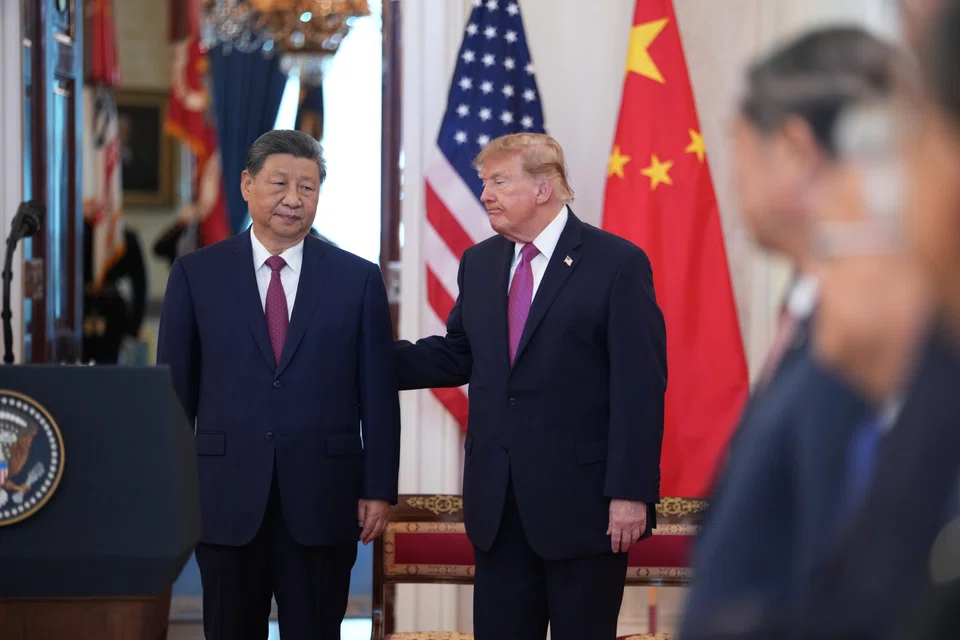
MANY words and photographs have been published about Chinese President Xi Jinping’s landmark visit to Washington from Wednesday (Sep 23) to Friday.
However, the defining moment was US President Donald Trump’s decision to greet Xi on his arrival at Joint Base Andrews with an 100-foot red carpet, in addition to a 21-member honour guard and military flyover.
The highly unusual, deferential greeting cements China’s – and much of the world’s – perception of Xi as at least Trump’s equal. It also symbolises the changing balance of power in the bilateral relationship.
The last time a US president met a foreign leader visiting Washington on the tarmac this way, apart from sitting popes, was a political eternity ago: In 1962, then-US president John F Kennedy greeted then-UK prime minister Harold Macmillan.
Much ado about nothing
Yet, despite all the enormous US pomp and pageantry, including the grand state dinner attended by First Lady Melania Trump and Xi’s wife Peng Liyuan, comparatively little was agreed on during the much-vaunted trip.
Indeed, one of the few tangible concessions from Xi was the gifting of two giant pandas to the Atlanta zoo.
This lack of advancement was despite Trump’s assertion that “tremendous strides” were made, and he and Xi have “never gotten along better”.
At best, this was a summit focused on stability that left lots of key unfinished business for the two leaders, presuming they meet again in November during the Asia-Pacific Economic Cooperation (Apec) Summit in China, and in December at the Group of 20 Summit hosted in Florida.
Certainly, it was not the breakthrough political event that the US president hinted at. Competition between the two powers remains as intense as ever.
For instance, Beijing offered Washington no new help with resolving the Iran crisis. Moreover, on artificial intelligence, it is unclear how meaningful the new “US-China Super Intelligence Dialogue” will be in enhancing cooperation on managing the risks and benefits of AI.
The wider lack of progress includes the very short two-month extension to the trade truce between US and China – until January 2027 – that was originally agreed at the Apec summit in South Korea in October 2025.
That economic bargain struck in 2025 had Beijing pausing its new rare earth export restrictions for 12 months, and agreeing to purchase more US agricultural products, while Washington reduced overall tariffs on Chinese goods by 10 per cent.
US-China trade of goods in 2025 was just under US$415 billion, down around 30 per cent year on year.
Even with the trade truce, there seems little chance that flows will reach the 2022 peak, when bilateral trade reached about US$690 billion for at least the remainder of Trump’s presidency, which constitutionally ends in January 2029.
The short extension, which could presage significant market uncertainty later in 2026, has disappointed many business groups who had hoped for more than a plaster over the wound.
Before the summit, their expectations had been raised, given reports that Xi would be accompanied by a significant commercial delegation.
However, he arrived in the US largely without business leaders, a contrast from his visit in 2015, which included Tencent and Alibaba founders Pony Ma and Jack Ma, respectively, along with leaders from state-owned companies and banks.
Xi’s art of the deal
The Trump-Xi summit has underlined how much the Chinese leader is now appearing to outsmart Trump, having apparently found a formula to manage the mercurial nature of the US president.
For one, Xi appeared unmoved by his US counterpart’s blatant flattery. On Friday, Trump called Xi and his wife “outstanding” and the trip “one of the biggest and most beautiful events to take place in many years”.
This is language most previous US presidents would have reserved for their most trusted partners, like Kennedy and his ties with Macmillan, rather than rivals.
Even before the visit began, moreover, the Chinese president took a leaf out of his counterpart’s playbook. He had threatened earlier in September to pull out of the big event over potential further US arms sales to Taiwan, which he has long called a “red line” in bilateral relations.
Xi’s move blindsided the US president and piled the pressure on the White House, given that it badly needed diplomatic wins. Ahead of November’s US midterm elections, the summit offered one of the last remaining chances for Trump to potentially show global statesmanship.
Clearly, Xi is using Trump’s negotiating tactics found in The Art of the Deal, the US president’s 1987 best-selling book, on the global stage.
This includes being unpredictable to gain an advantage over counterparts and keeping them guessing, in addition to using leverage to find and exploit pressure points, including on Iran.
Hence, any bilateral breakthrough, from trade to AI, has been more difficult to achieve.
While the summit failed to deliver significant outcomes, it was nonetheless widely scrutinised by much of the rest of the world.
US security allies in the Asia-Pacific region, such as Australia, Japan and South Korea, were watching for any Trump concessions to China, including over Taiwan.
Those concerns were exacerbated by Trump’s criticism of those countries over their lack of adequate assistance to the US campaign in Iran.
Taken together, the summit underlines the shifting scales of power between China and the US. While Xi did not secure all that he wanted, he appears to increasingly have the upper hand over Trump, at least in terms of political manoeuvring.
The US president’s deal-making strategies may have been a winning formula for him on Wall Street during the 1980s, but it is proving much more difficult for him to translate them into sustained success for the US in today’s geopolitical landscape.
The writer is an associate at LSE IDEAS at the London School of Economics
TRENDING NOW
‘My grandfather’s legacy’: Sherman Kwek lays out three-year plan for CDL to drive returns
CDL to hire dedicated CEO for fund management as it steps up push into private funds
Built on trust since 1964: How this award-winning finance company has grown with its SME customers
VSMC opens US$7.8 billion chip fab in Singapore, bets on ‘physical AI’ demand

