IMF warns of stagflationary shock ahead

It estimates that even if the US-Iran ceasefire holds, countries may need around US$20 billion in bailout support
Summarise
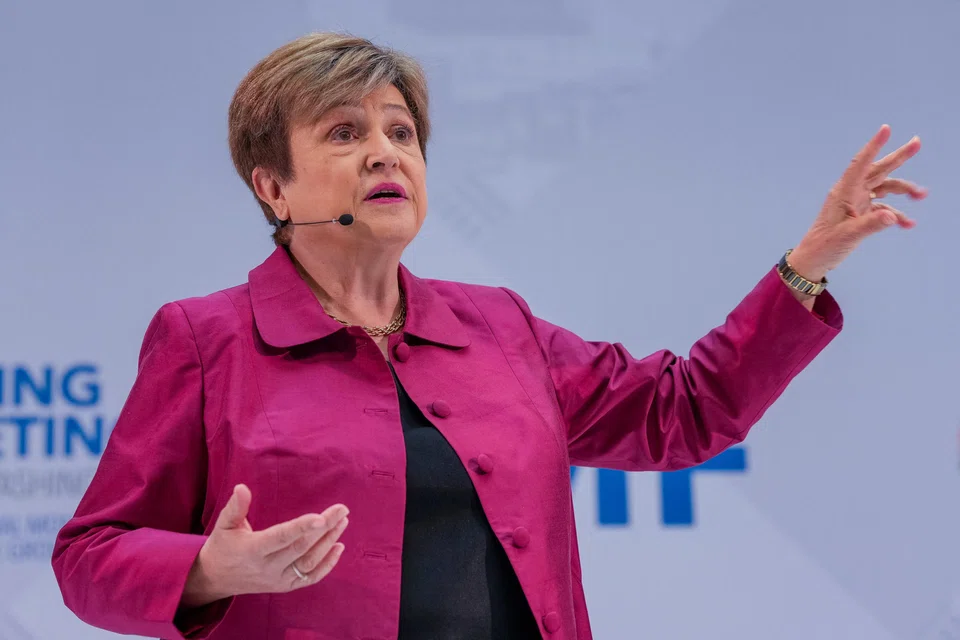
    • IMF managing director Kristalina Georgieva speaking ahead of the IMF/World Bank's spring meetings, says "there will be no neat and clean return to the status quo".
    • IMF managing director Kristalina Georgieva speaking ahead of the IMF/World Bank's spring meetings, says "there will be no neat and clean return to the status quo". PHOTO: REUTERS
    Published Sat, Apr 11, 2026 · 08:00 AM

    THE announcement of a ceasefire in the Iran war on Tuesday (Apr 7) provided immediate relief for global markets.

    However, International Monetary Fund (IMF) managing director Kristalina Georgieva warned two days later that the conflict is triggering a systemic stagflationary shock to the world economy.

    In her speech ahead of the IMF-World Bank Spring meetings, she was clear that “even in a best case, there will be no neat and clean return to the status quo” that was in place before the US and Israel military campaign against Iran began in late February.


    This outlook will be confirmed in the IMF World Economic Outlook on Apr 14, which will downgrade growth projections even in the “most hopeful scenario”.

    It is not just the IMF, but also private sector analysts who perceive global prospects to have deteriorated materially in the last month and a half.

    Societe Generale’s global head of commodities research Michael Haigh projects that oil prices will be at least around US$85 per barrel by the end of 2026, well above the pre-war levels.

    Independent Commodity Intelligence Services (ICIS), an independent provider of chemicals and energy commodity intelligence, said that even if the current ceasefire evolves into a comprehensive US-Israel-Iran settlement, it would take three to six months for energy and wider markets to recover from the disruptions.

    If the ceasefire collapses in April or later, a six-month conflict would require a longer recovery period of at least eight to 10 months.

    Unfortunately, a breakdown is more than a non-trivial possibility. This is not least given the continuing disagreements between the US and Iran over the reopening of the Strait of Hormuz, and the exclusion of Lebanon from the ceasefire.

    There is no indication that the US is scaling back its military build-up in the Middle East, so further action remains a clear option. If the war resumes in the second half of April or in May, it may prompt a further postponement of US President Donald Trump’s trip to China planned for May.

    IMF “firefighter” role

    The Iran crisis has been a net negative for nearly every economy, including those in Asia. This is especially true for countries that rely heavily on oil and gas imports.

    However, IMF’s Georgieva highlighted in particular the vulnerability of emerging markets such as the Small Island Developing States and sub-Saharan Africa, which lack the capacity to cope with a stagflationary shock.

    Highlighting concerns from the UN’s World Food Programme, she said high fertiliser prices will intensify food insecurity for another 45 million people, expanding the number of people in hunger to more than 360 million.

    She added that the crisis will therefore likely require the IMF to step up its “firefighter” role. Even if the ceasefire holds, the global body estimates that countries requiring bailout support may need around US$20 billion to alleviate “considerable hardship”. This could rise to some US$50 billion if the ceasefire breaks down.

    Separately, the IMF also announced on Thursday an initial next-steps agreement with Sri Lanka. The Asian nation is still recovering from its 2022 foreign debt default and the subsequent bailout of almost US$3 billion from the IMF. The deal, if finalised, could unlock around US$700 million, depending upon reforms to help drive stability and growth.

    Beyond Sri Lanka, the IMF recognises that governments across the world have less fiscal firepower to counteract this shock than in the past.

    Global public debt reached a record high of US$102 trillion in 2024. Developing nations accounted for nearly a third of that total – some US$31 trillion – and their debt has worryingly grown twice as fast as that of developed economies since 2010.

    Another key trend that the IMF flagged is the doubling of the share of emerging market debt from portfolio investors in the past two decades to around 80 per cent. This reflects the retreat of traditional banks from these higher-risk markets since the 2007-2008 international financial crisis.

    During this period, emerging markets have received cumulative inflows of around US$4 trillion. However, the IMF asserts that nations reliant on this portfolio investment, with limited policy capacity and/or less-deep financial markets, are “particularly vulnerable to global financial shocks”.

    This is because portfolio investors, especially hedge and investment funds, have generally become less risk-tolerant, increasing the likelihood of rapid capital flight when market sentiment shifts.

    The IMF said a “sudden drop in these flows could intensify external financing pressures, widen corporate and sovereign spreads and trigger sharp currency depreciations”.

    In emerging markets, external portfolio debt liabilities average about 15 per cent of gross domestic product. The IMF estimates that portfolio equity liabilities average around 7 per cent of GDP, but represent “an economically meaningful share of stock market capitalisation in some emerging markets”.

    Major uncertainty still on horizon

    Ironically, the IMF had previously planned to upgrade global growth forecasts on Tuesday, not lower them. This prior optimism had been fuelled by strong investments in artificial intelligence (AI) and tech and supportive financial conditions.

    Now, however, the upcoming IMF-World Bank Spring meetings will focus on how much worse the situation could become.

    To this end, Georgieva appealed to nations not to “pour gasoline on the fire” by adopting measures such as export and/or price controls that “can further upset global conditions”.

    Beyond the Iran war, the lingering uncertainty of Trump’s trade tariff agenda remains. The IMF has flagged that US inflation could rise if firms pass on more tariff costs, or if goods diverted from the US market force a new round of tariff hikes elsewhere.

    What this illustrates is the growing risk of a poly-crisis – an era of successive, interconnected disruptions where the permanent sense of crisis is a new normal.

    Such political turmoil has been a recurrent feature of the global landscape for several years. Several market commentators assert that, since at least around 2016, geopolitical risks are at a post-Cold War high.

    That year was the key year anti-establishment populism gained significant momentum, possibly reaching its zenith, with the election of Trump and the UK’s Brexit vote.

    Uncertainty is therefore likely to remain elevated. An increasing number of investors are hoping for the best, but preparing for worse scenarios.

    The writer is an associate at LSE Ideas at the London School of Economics