Index-tracking funds may deliver more risk than investors bargained for
Concentration risk in indices is at the highest level, thanks to enthusiasm over all things AI-related

INDEX-TRACKING funds are now so ubiquitous that it’s hard to imagine that when the late Jack Bogle of Vanguard rolled out the first such fund 50 years ago in 1976, the fund was ridiculed as “un-American” and a “sure path to mediocrity”.
Vanguard’s first fund, the First Index Investment Trust tracking the S&P 500, is now called the Vanguard 500 Index Fund. It raised just US$11 million at its launch; today, it has a total of around US$1.7 trillion in assets.
Despite the inauspicious start, indexing has helped to catapult Vanguard into the ranks of fund giants, with a total of US$12 trillion in assets, second to BlackRock.
It took another 17 years before index funds made their debut on stock exchanges as exchange-traded funds, around 1993. Both innovations have upended the approach to investments and portfolios – with lasting impact.
Institutions paved the way with their use of index trackers as an efficient way to get market returns or beta, with satellite investments at the margins for more concentrated bets.
This approach has trickled down to retail investors, who, for a modest sum, can invest in indices representing hundreds of companies.
But market access was not Bogle’s sole legacy. Equally important was his conviction that high fees exact a toll on fund returns.
Vanguard funds’ average expense ratios have plunged from 0.68 per cent in 1976 to 0.07 per cent as at end-2025.
This has helped to exert downward pressure on the industry at large, where asset-weighted expense ratios have also declined from 0.73 per cent to 0.44 per cent, based on data on Vanguard’s website.
There is surely no turning back. Yet, on this 50th anniversary of index funds, it’s fair to question how adequately index trackers reflect an economy or a market.
Concentration risk in indices is at the highest level in history, thanks to investors’ enthusiasm over all things related to artificial intelligence.
The top 10 stocks of the S&P 500 – mostly information technology stocks – have a collective share of 40 per cent. The largest stock, Nvidia, accounts for over 7 per cent of the index.
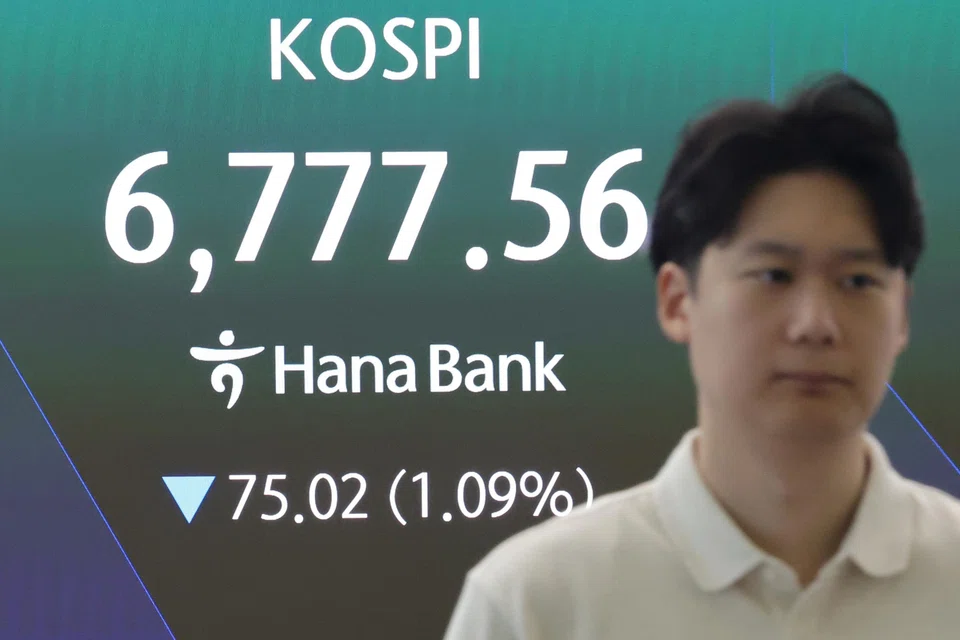
But Nvidia’s share is dwarfed by the outsized clout of chip giants in Asian indices. In South Korea, Samsung Electronics and SK Hynix together account for more than 50 per cent of the Kospi Index.
In Taiwan, a single stock – Taiwan Semiconductor Manufacturing Co – accounts for 40 per cent of the benchmark Taiex index.
No one disputes the transformative potential of AI on business and industry. After all, the US stock market appears to have successfully scaled a wall of worry, ranging from geopolitical crises and trade wars to inflation fears.
There are good reasons, however, to tread cautiously.
One, higher bond yields have accentuated valuation pressures, as the discount rates used to assess the present value of future cash flows rise.
Two, some valuation metrics are flashing red. The Shiller cyclically adjusted price-to-earnings ratio has risen to its highest level since 2000, evoking the tech correction which ensued.
The market may well continue to appreciate. But especially for retirement savers and retirees, it is prudent to dial down risk, and to weed out inadvertent exposures to the tech theme that could lurk elsewhere in a portfolio.
After all, what’s important isn’t to get the best of market returns, but to stay solvent and liquid for the long run.