

Inside TSMC chairman Mark Liu's short but impactful reign
His legacy includes sustainability, global expansion and the application of a crucial chip technology
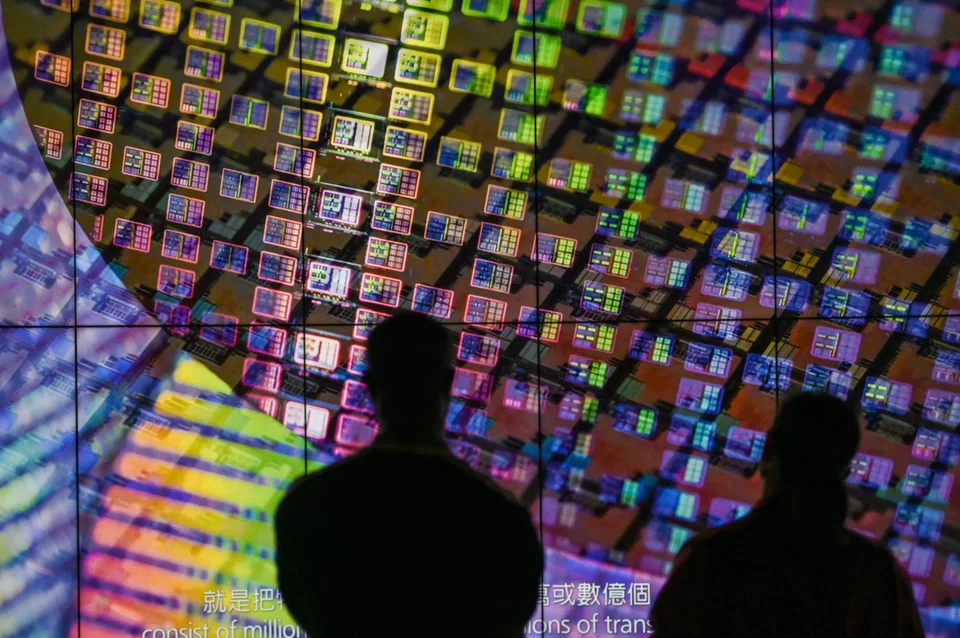
MARK Liu’s term as chairman of Taiwan Semiconductor Manufacturing Co (TSMC) has been brief compared to that of his predecessor. Liu took over in 2018 from founder Morris Chang and will step down in June. Yet Liu’s reign has taken the chipmaker in directions unimaginable a decade ago, and will ripple for generations to come.
For investors, his tenure has been fabulous: a 252 per cent rise in the stock even pips key client Apple, and has propelled the Taiwanese company’s market value past US$720 billion.
Thursday’s (Apr 18) earnings further proved the point. After a record profit in 2022, before last year’s decline amid a global economic slowdown, net income grew and full-year revenue is on track for a new high.
Management has also upped the size of its cash dividends, making TSMC both a growth and an income play for shareholders. Finally, gross margin – an important measure of its pricing power with clients – has expanded to unprecedented levels, where it looks set to stay.
ESG a top priority
Beyond the income statement, Liu’s legacy consists of three parts. The first is his elevation of environmental, social, and governance within company culture.
TSMC was already well on this path under Chang, who was a pioneer of this realm in Taiwan. Yet current management has taken it even further, notably with unprecedented purchases of renewable energy.
Among them was the 2020 deal with Orsted to buy 920 megawatts of offshore wind capacity for 20 years, at the time the largest ever contract of its kind. Last year, it sealed a joint procurement of 20,000 gigawatt hours in renewables through Taipei-based Ark Power.
Global footprint
The most obvious hallmark of Liu’s term is TSMC’s global expansion, which his predecessor had not embraced since founding the company in 1987.
When Liu took office six years ago, the chipmaker was very much bound to Taiwan. It had a tiny factory in Washington state and two lesser plants in China; it had no global footprint to speak of. By the end of this decade, it will have spent close to US$100 billion overseas and have a significant presence in the US, Japan and Germany.
Its US$65 billion investment in Arizona is a landmark deal lauded as proof that American chipmaking is on the rebound. US Commerce Secretary Gina Raimondo was quoted as saying that “for the first time ever, we will be making at scale the most advanced semiconductor chips on the planet here” in the US.
But Liu knows the truth. Raimondo was wrong on both counts: first, the term Silicon Valley came from Californian companies’ pioneering work in the chip industry, which maintained that lead for decades. Intel lost its supremacy only in the last 15 years – to TSMC.
Second, when those Arizona factories open, they’ll still lag TSMC’s Taiwanese facilities. The chairman will be acutely aware that these US plants don’t make financial or technological sense. They are happening because stakeholders – including foreign clients and governments – pushed the Taiwanese chipmaker into it.
Arizona will be less a production facility and more a marketing fab, allowing clients such as Apple and Nvidia to get on stage and proudly boast their products are “made in America”. US taxpayers will only partially fill the gap with a paltry US$6.6 billion of incentives.
Advanced technology
Finally, there’s a less obvious but very important development going on inside the billion-dollar cleanrooms that enable artificial intelligence (AI) systems to become ever more powerful.
For almost 60 years, the semiconductor industry was driven by an observation made by Intel co-founder Gordon Moore, that transistor density on a chip doubles every two years. Known as Moore’s Law, this high-paced advancement paved the way for modern computing, communication and transportation.
But adding more transistors into a two-dimensional space is getting harder. This challenge forced the industry to look upward – stacking chips on top of each other like layers of lasagna – but it’s not easy.
Over a decade ago, under Chang, TSMC developed a technology called Cowos – chip-on-wafer-on-substrate – that solved many of the technical problems. Today, under Liu, Cowos has become crucial in allowing Nvidia and Advanced Micro Devices to develop powerful AI chips.
In a recent paper for IEEE Spectrum magazine, which is edited by the Institute of Electrical and Electronics Engineers, Liu and TSMC’s chief scientist Philip Wong noted that its Cowos technology means the number of connections between layers increases 1.74 times every two years, or about threefold every four years.
This observation means that chips needn’t become more dense if they can get taller, with no loss in speed or efficiency. As a result, the industry is likely to continue advancing at the same pace it enjoyed for decades despite increasing complexity and cost.
When he retires in June, Liu will have delivered many wins for shareholders, governments, and clients. And the world will be left with a legacy almost as enduring as that of his predecessor.
TRENDING NOW
World’s largest offshore wind platform by Seatrium consortium on track to be completed by 2028

Is stamp collecting enjoying an analogue revival or are its best days over?
GovTech retrenches another 38 staff in second round of layoffs
MBS adjusted property Ebitda falls 20.6% in Q3 with fewer high-roller visits, weaker hold

