

Iran’s real weapon is the world economy
Missiles, drones, mining threats and selective maritime disruption can be enough to make insurers, traders, shipowners and governments reprice risk
WHEN the White House confirmed that US President Donald Trump would travel to Beijing on May 14 to 15 after postponing the trip because of the Iran war, it revealed that this conflict is now large enough to disrupt the calendars of great powers, distort global markets and force governments far from the Gulf to think in terms of energy security, inflation and supply-chain resilience.
The central question is no longer whether Iran can defeat the US or Israel conventionally. It is whether Iran can make the economic price of continuing the war too high, too global and too prolonged to ignore.
Iran’s strategy is calibrated economic coercion. Teheran is exploiting a rare combination of geography, target concentration and asymmetric tools.
The Strait of Hormuz remains one of the hardest chokepoints in the world to replace. Around 20 per cent of global oil consumption and liquefied natural gas (LNG) trade passes through the waterway. Iran does not need to dominate the world economy. It only needs to sit astride one of the arteries that the world economy cannot easily reroute.
Another “endowment” Iran benefits from is the surrounding industrial density. The Gulf today is a concentrated cluster of oil terminals, LNG trains, refineries, petrochemical plants, ports, airports and energy-intensive industries.
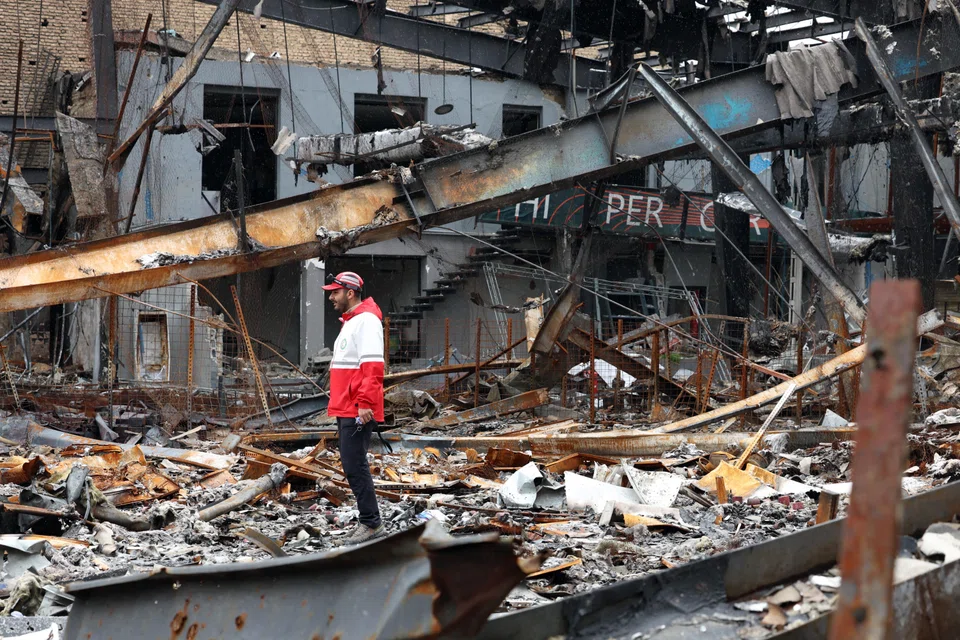
Iranian attacks knocked out 17 per cent of Qatar’s LNG export capacity, taking 12.8 million tonnes per year offline for three to five years and implying roughly US$20 billion in lost annual revenue. The same damage also cut condensate, liquefied petroleum gas (LPG), helium, naphtha and sulphur output. A hit on one Gulf node can ripple across global industry.
Furthermore, economic war is cheaper than military victory. Iran does not need conventional superiority to generate major pain. Missiles, drones, mining threats and selective maritime disruption can be enough to make insurers, traders, shipowners and governments reprice risk.
Tanker rates for very large crude carriers leaving the Middle East for Asia reached record highs in March after Iran’s obstruction of the Strait of Hormuz. Hapag-Lloyd said the crisis is costing it US$40 million to US$50 million a week in extra fuel, insurance and storage costs. Iran is weaponising fear and delay as well as disruption.
The first transmission channel of such endowments is energy itself. The International Energy Agency released 400 million barrels of oil from emergency reserves, the largest stock draw in its history. The agency also warned that supply-side measures alone cannot fully offset the disruption, and that restoring transit through the Strait of Hormuz remains essential.
The second channel is logistics. Much of the damage is not inflicted by destroyed cargo, but by more expensive movement of everything else.
Tanker rates, container shipping costs, war-risk premiums, rerouting and port congestion feed into trade far beyond the energy sector. Shipping companies pass costs downstream, manufacturers delay output, and governments spend more to cushion the blow.
The third channel is industrial scarcity. The war is already tightening fertiliser and helium supplies while darkening recession fears.
Damage to Qatar’s LNG system could erase as much as 35 million tonnes of global LNG supply this year. Once the crisis moves into fertilisers, food, industrial gases, petrochemicals and manufacturing inputs, it becomes a story about inflation, agriculture and global output.
“Teheran may not be able to defeat stronger enemies outright. But it has shown that it can impose costs far beyond the battlefield by exploiting chokepoints, concentrated infrastructure and the world economy’s dependence on both.”
That is why the time windows matter. For the first one to two weeks, the global economy absorbed the shock. Markets repriced quickly, reserves were released and governments reassured.
For the next two to six weeks, the system can still function, but buffers begin to thin. Stability is no longer being restored; it is being rented. By one to three months, the problem becomes macroeconomic and political.
The Organisation for Economic Co-operation and Development now projects global growth at 2.9 per cent in 2026, noting even that assumes current energy disruption eases from mid-year. It expects Group of 20 inflation in 2026 to be 1.2 percentage points higher than previously projected. If disruption persists, the downgrade gets worse.
Beyond three months, the crisis becomes harder to normalise. Energy-intensive industry starts making different decisions. Governments begin to choose between fiscal relief and fiscal credibility. Import-dependent countries face harsher trade-offs between growth and stability.
By six months, the question is no longer whether the world can withstand the war, but how much poorer and more fragmented it is willing to become. A conflict of this intensity, sustained across months, would push the world into a more stagflationary and protectionist equilibrium.
This is also why time changes great-power incentives. As disruption moves from the first window into the third and fourth, the costs become broader and less containable.
Beijing, though relatively resilient to energy shocks, remains directly exposed through the Strait of Hormuz and the Red Sea for its extensive trade with the Gulf and Europe. Washington faces inflation, market volatility, a divided Maga (Make America Great Again) base, and worsening midterm prospects. Moscow may enjoy an oil windfall for now, but not indefinitely if global growth weakens.
Iran’s real weapon, then, is not conventional supremacy. It is the ability to turn a narrow geography into a global economic battlefield. Teheran may not be able to defeat stronger enemies outright. But it has shown that it can impose costs far beyond the battlefield by exploiting chokepoints, concentrated infrastructure and the world economy’s dependence on both.
The real danger is not that Iran can shut down the global economy in a day. It is that it has found a way to make a regional war steadily more global, more expensive and more difficult to absorb with every passing week.
The writer is a research fellow with the Charhar Institute. He previously served at East Asian intergovernmental organisations including the Trilateral Cooperation Secretariat in Seoul and the Asean-China Centre in Beijing.
TRENDING NOW

If Europe goes to war, the fallout will be felt in East Asia

China’s market is tougher than ever. Where can Singapore firms still find room to grow?
Vietnam’s race for growth tests pace of energy transition: experts

Indonesia stocks suffer worst plunge in nearly 30 years as MSCI proposes standalone status

