It ain’t over for Biden until it’s over
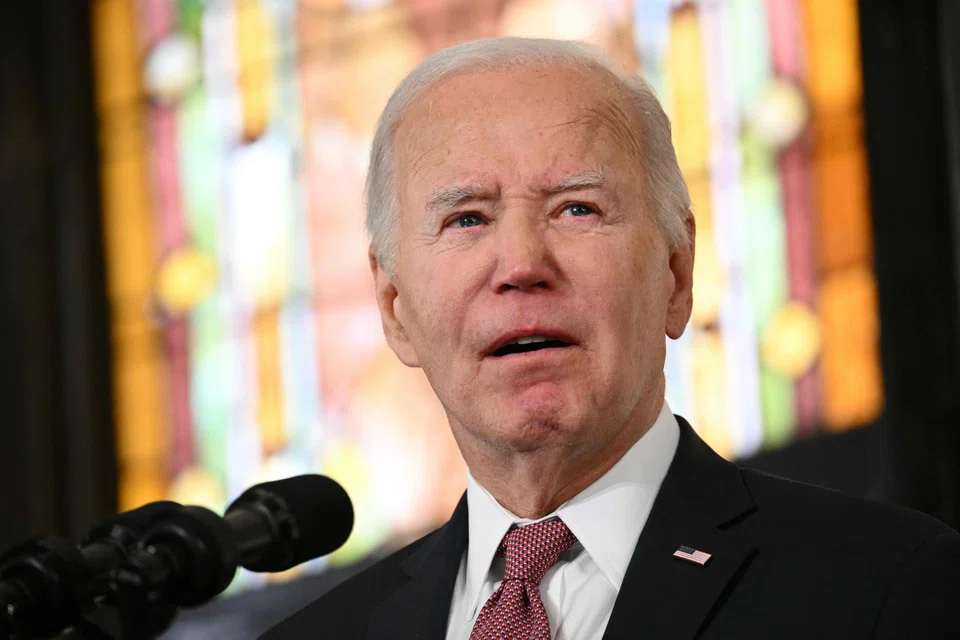
    • US President Joe Biden' s approval ratings have fallen, with many believing that inflation has risen and employment and wages have declined under him.
    • US President Joe Biden' s approval ratings have fallen, with many believing that inflation has risen and employment and wages have declined under him. PHOTO: AFP
    Published Wed, Jan 10, 2024 · 05:00 AM

    POLITICAL scientists and economists may one day refer to the phenomenon as the Biden Paradox – that of an American president with a high record of achievements who was seen by voters as a loser.

    The numbers point to a series of accomplishments: Under Democratic President Joe Biden, the US economy has grown an astounding 5.2 per cent in the third quarter of 2023.

    And economic growth for the full 12 months of 2023 is expected to be 2.1 per cent, according to the International Monetary Fund. That is a much more impressive performance than other major Western economies, including Germany, Canada and Britain.


    Inflation – until recently regarded as a leading economic and political threat to the White House – is now falling sharply while manufacturing employment is booming and wages are rising. The United States is now the larger producer of gas and oil, and its technology sector enjoys a dominant global position.

    Biden isn’t responsible for all these economic achievements. In fact, any president’s policies have only a marginal effect on the economy whose growth is usually driven by the course over the entire business cycle.

    Yet, it has been an axiom of sorts that the political fortunes of any president is determined in a large part by the performance of the economy during his presidency. Hence the adage: “It’s the economy, stupid!”. Based on that maxim, Biden’s ratings in the public opinion polls should be reaching the political stratosphere.

    Moreover, Biden has also proved to be an effective, if not successful, foreign-policy president. In response to Russia’s aggression in Ukraine, he has mobilised America’s Western allies to take robust economic and military action. He has provided Israel with strong support in the aftermath of Hamas’ brutal attack on the Jewish state. And, he has established new security arrangements in the Indo-Pacific region as part of a strategy to contain China.

    Yet Biden’s approval ratings are worse than that of former president Donald Trump at this point of his presidency – as a matter of fact, worse than any president in American history.

    The majority of Americans, including Democrats, are telling pollsters that they are worried about the 81-year-old president’s fitness for office, because of his age and associated health risks, including cognitive abilities.

    Moreover, most opinion polls give Biden low marks for his economic performance and believe that a second term-President Trump could do a better job in managing it.

    In fact, the same polls suggest that the majority of Americans believe that inflation has risen and employment and wages have fallen under Biden, and that the country is actually in a recession.

    Nor have Biden’s triumphs on the foreign policy front registered with the American voters, who disapprove of his policies vis-a-vis Russia and Israel.

    And, of course, Biden’s low public approval numbers seem even more astounding when you consider that his most probable Republican rival in November was impeached twice during his single term in office, and is the first former president in US history to face criminal charges, including four indictments, and is accused of orchestrating the Jan 6, 2021, attack on Capitol Hill in Washington, DC.

    Biden and his aides were hoping to turn his election campaign into a referendum over the former president and to persuade voters that Trump is not only unqualified for the country’s top job, but also a threat to American democracy, considering his conduct on Jan 6, 2021 – as an insurrectionist who sought to overturn the results of a democratic election.

    The 14th amendment to the US Constitution bars those who have sworn an oath to uphold the Constitution from federal office if they have “engaged in insurrection or rebellion” against the Constitution or “given aid or comfort to the enemies thereof”.

    Based on the notion that the former president’s attempts to secure himself a second term despite losing the 2020 election, culminating in the Capitol riot, count as an insurrection and so disqualifies him from seeking to recapture the White House, the Colorado Supreme Court ruled last December that Trump should be removed from the ballot in the state’s Republican primary.

    A similar decision was subsequently also made by Maine’s secretary of state. Trump and Republican officials have petitioned the US Supreme Court to review the cases, which the justices are expected to do within a few months.

    But the chances that the US Supreme Court with its Republican majority – with three justices nominated by Trump – would disqualify him from running for office are slim.

    Biden would therefore probably need to convince voters that, indeed, his predecessor in office is a threat to democracy and must be kept out of the White House – that is, to punish him in November.

    But that could prove to be a mission impossible when it comes to Republican voters, the majority of whom believe, according to opinion polls, that the 2020 presidential election was “stolen” by the Democrats and that Biden wasn’t legitimately elected that year.

    If anything, while the various legal proceedings against Trump and the events of Jan 6, 2021, have remained in the news, they have ironically helped to strengthen the former president politically among members of his political base, who buy into his charges that the government and the courts are conducting a “witch-hunt” against him.

    The question is whether campaigning against Candidate Trump by depicting him as a threat to democracy would convince enough independent voters in key electoral states to cast their ballots for Biden, despite their dissatisfaction with his handling of the economy and foreign policy.

    These independent voters and moderate Republicans – who include white suburban women who had voted for Biden in 2020 – may be less energised to do that this year.

    Indeed, polls suggest growing uneasiness among these voters with the left-leaning direction of the Democratic Party. In particular, its more powerful progressive wing has embraced identity politics and the “woke” culture, with its emphasis on “diversity” and “inclusion” that are seen more and more as code words for special treatment for minority groups and gay people.

    Biden had won the 2020 races in key electoral states, such as Pennsylvania, Michigan, Nevada and Arizona, by margins of less than 100,000 votes. That means that if just a few thousands of Democrats in those states decide to stay home on election day, he would lose the votes of the electoral college and wouldn’t be re-elected, even if he wins the popular vote.

    Adding to Biden’s worries are indications that Hispanics and Black men are planning to vote for Candidate Trump by a larger percentage than they did in 2020, and that the former president could win the support of young voters who four years ago had mobilised behind Biden.

    The good news for Biden is that opinion polls taken 10 months before election day don’t necessarily predict the results of the race. A lot can change in 10 months. For one thing, Trump could be convicted, and the US and Iran could end up in a shooting war.

    Perhaps the most effective strategy would be for Biden to highlight his economic achievements in the promise of a soft landing, full employment, wage growth and subsiding inflation.

    Presidents with a record like that are supposed to win elections.