

Jackson Hole offers reassurance, suggests soft landing likely for US economy
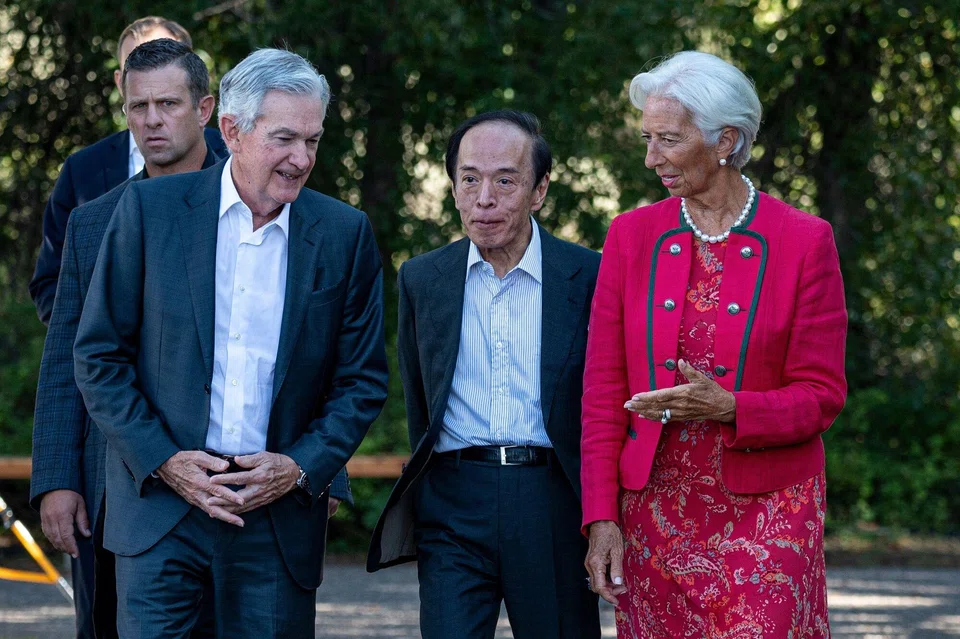
AT THE Jackson Hole central-banking confab on Friday (Aug 25), Federal Reserve chairman Jerome Powell hinted he may be done with interest-rate hikes.
Powell did not make any explicit promises because, as he has observed in the past, the Fed can stoke the flames of inflation by merely talking about a halt in rate hikes.
Any concrete guidance on a permanent halt would cause borrowing rates to fall pre-emptively, encouraging a bout of risk-taking that would reinflate bubbles in assets from oil to tech stocks to real estate.
Powell is instead trying to kill the rate-hike cycle offstage, slowly and quietly, hoping that nobody will notice until a few months have passed without any action.
For this reason, the rhetoric remained largely unchanged from recent Fed statements.
“Although inflation has moved down from its peak – a welcome development – it remains too high,” said Powell, in his speech from the Jackson Hole economic symposium in Wyoming, US.

“We are prepared to raise rates further, if appropriate, and intend to hold policy at a restrictive level until we are confident that inflation is moving sustainably down toward our objective.”
Strategists took this rhetoric with a pinch of salt. They are weighing what the Fed does more heavily than what it says.
“Was he hawkish? Yes,” said Ryan Detrick, chief market strategist at Carson Group, and Sonu Varghese, global macro strategist at the investment adviser, in a note to clients. “But given the jump in yields lately, he wasn’t as hawkish as some had feared.”
They noted that Powell “took out the bazooka” at last year’s meeting, determined to jolt markets out of their complacency on the outlook for rates. This year, he sounded much more reassuring.
The biggest hint Powell dropped about the possible end of rate hikes was when he said the Fed would “proceed carefully” with rate moves.
Proceeding with care could cut either way, of course. Powell made it clear inflation is still a danger.
The Fed will have to contend with the customary summer spike in energy prices. Extensive and interlaced supply chains mean these energy costs could be rapidly reflected in the prices of goods in American supermarkets.
So, Powell could be referring to caution about ignoring inflation. There’s a bigger danger out there now, however.
If the main risk for the central bank last year was doing too few rate hikes and letting inflation get out of control, the principal risk this year is doing too many rate hikes.
He must be careful about the weak spots in the US economy. The housing market has ground to a halt, with mortgage rates at an unthinkable 7 per cent and rising.
While the average home price in the US has remained steady over the last 18 months, at around US$300,000, the monthly payment has roughly doubled.
Few first-time homebuyers can afford that adjustment, while homeowners have little incentive to get out of their existing home and take out a new mortgage.
When rates rise, “things break” – as analysts at brokerage Bank of America Global Research have said. Already this cycle has caused some of the biggest bank failures in history: Silicon Valley Bank, Signature Bank and First Republic Bank among them.
Some credit rating agencies warn of catastrophic stresses in the regional banking business. Fitch Ratings and S&P Global have warned that rising interest rates and a change in office habits have slashed the outlook for other regional banks.
When Powell talks about proceeding carefully, he’s mostly talking about averting the risk that further interest-rate hikes will hasten the collapse of the residential and commercial real-estate markets, and start the domino-chain of bank failures once again.
The end of rate hikes is not set in stone, strategists warned.
“While our base case is that the Fed has already reached the end of its tightening cycle, views on the Fed could continue to shift in response to data over the coming weeks,” said Solita Marcelli, chief investment officer, Americas, at money manager UBS Global Wealth Management.
Marcelli is part of a growing group that believes Powell has engineered a “soft landing” – bringing inflation to heel, without sinking the US into a deep recession.
If there is no second wave of inflation, do not expect a second wave of rate increases. That is still a big if.
Decoding Asia newsletter: your guide to navigating Asia in a new global order. Sign up here to get Decoding Asia newsletter. Delivered to your inbox. Free.
Share with us your feedback on BT's products and services
TRENDING NOW

Who is Leo KoGuan, the Singapore-based billionaire backing Nvidia’s Jensen Huang?

Demand, tech capabilities position Apac and AI as Skyscanner’s next growth frontiers: CEO Bryan Batista

Higher rates, weaker spending: Is the Philippines entering stagflation?

South-east Asia has lost Nvidia’s best salesman

