Japan hopes electric cars were just a bad dream
A tale of two motor shows in Tokyo and Paris offers a surprising verdict of who’s better prepared for the future
FRANCE and Japan are both world leaders in design – but if you’re wanting to keep up with fashion, Paris is the unmissable trendsetter, while Tokyo is a backwater. It’s looking similar in the world of cars.
This week’s Paris Motor Show has been a chance for a tariff-buttressed European car industry to showcase its ability to fight back against affordable, innovative Chinese electric-vehicle (EV) imports. The buzz was palpable half a world away: Renault, Stellantis, and Volkswagen all teased new EVs around or below a competitive 25,000 euros (S$35,600) price level. Cheeky, crazy designs might even pique the interest of Europeans who increasingly seem to be drifting towards a post-car era.
Blink, and you might have missed the fact that Japan’s car sector was displaying its wares at the same time. What’s more, you’d be forgiven for thinking the EV revolution wasn’t happening at all.
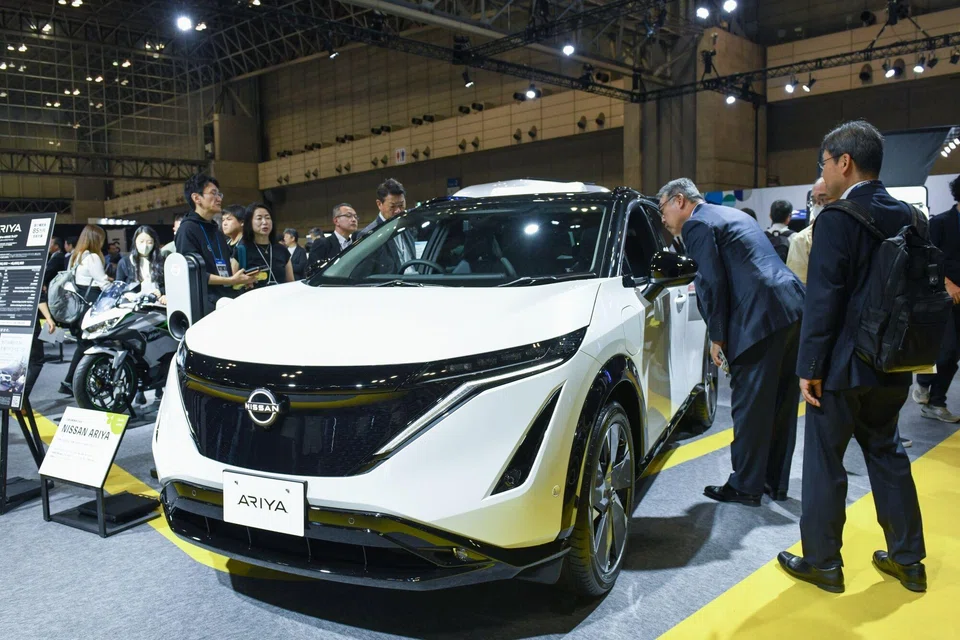
Just a single electric car was on display at this year’s Japan Mobility Show: the Nissan Ariya, on sale since 2022 and first unveiled five years ago. Toyota and Honda showed two cars (and, in Toyota’s case, a sort of emergency home battery pack) powered by hydrogen, and three models were being displayed for their ability to burn biofuel. That choice seems wildly out of touch with reality. At present, the number of battery EVs sold worldwide every three days is roughly equivalent to the total 90,762 hydrogen cars bought since that technology first came to market nine years ago.
It’s a quixotic approach that seems very much in tune with Japan’s broader positioning as the car industry goes electric. One in eight cars sold worldwide last year was a battery EV, or BEV, but in Japan the share was just 2.2 per cent – a lower penetration than India or South-east Asia, not to mention the one in four seen in China. In France, the share was 18 per cent, and 8.1 per cent in the US.
Automakers everywhere are facing plenty of bumps and setbacks on the road to electrification, but Japan is unique in arguing that the shift is not just logistically challenging, but fundamentally misconceived. Toyota chairman Akio Toyoda argued in January that BEVs will never achieve more than a 30 per cent market share – though they’re already around 13 per cent so far this year, compared with less than 5 per cent in the same period of 2021.
It’s a bizarre and dispiriting detour – not least because Japan was once a leader in electrification. For all the credit Elon Musk takes for the startup he bought his way into in 2004, Sony invented lithium-ion batteries, while Nissan and Mitsubishi were mass-producing EVs within months of Musk receiving the first Tesla Roadster. The Renault-Nissan-Mitsubishi alliance still had the edge over Tesla in terms of EV sales as recently as 2018.
You might seek to defend Japan on the basis that this is a deliberately low-key exhibition. Most car shows are biennial, to give automakers a chance to develop the new designs that wow attendees. Last year’s event in Tokyo was an unquestioned hit, with reviewers stunned by the range and features of EVs on offer. Japan is switching to annual expos, with its off-year meetings billed as a more insider-y event tacked on to the far larger CEATEC technology conference going on at the same time.
That’s fair enough – but the implication is, if anything, even more worrying. The real EV revolution, after all, isn’t about consumer delights like touchscreen dashes, heated seats and retractable door handles, but the business-to-business guts of the vehicle: its battery and motors.
Japanese manufacturers ought to have an interesting story to tell. Backed by more than US$3 billion in government subsidies, they’ve been working for more than a decade on solid-state batteries, which promise to drastically outperform the range, charging time and even safety of current lithium-ion variants. Toyota last month announced plans to start production as soon as 2026 – but even here, it’s Chinese manufacturers such as SAIC, Nio and Contemporary Amperex Technology who are taking pole position. This year’s show in Tokyo was a missed opportunity to regain the initiative.
Not every car show has to focus exclusively on lithium-ion batteries and motors. Still, if you deny the centrality of electrification to the car industry in 2024, you risk looking like you’re losing the plot.
“EV and hybrid automobiles are not the only solutions for carbon neutrality,” Masanori Katayama, chairman of truck-maker Isuzu Motors and the Japan Automobile Manufacturers Association, said on the first day of the conference. “Multi-pathway is the idea that we have adopted, including the use of hydrogen as well as alternative fuels.”
That’s a bit like using a 1924 transport exhibition to showcase the development of a stronger breed of draft horse, or more buoyant hot air balloons. Europe’s automakers may be struggling to hold their own against the Chinese EV onslaught – but at least they’re displaying an appetite for the fight. Their Japanese rivals seem to be rudderless and drifting.