Keppel South Central: Deals juiced up with income support need not be bad ones
Fundamentals matter in Keppel Reit’s proposed purchase of stake in CBD building at S$626 million

[SINGAPORE] Might you be tempted to sign up to buy an overseas home because the developer is guaranteeing an attractive yield on the purchase price?
Perhaps, a yield-hungry investor should be wary of being lured into buying a property by the promise of a high guaranteed yield.
Maybe the terms and conditions of the sale and purchase agreement include clauses that allow the developer to get out of delivering on the said guaranteed yield. Also, is the developer offering the guaranteed yield reputable and of strong credit standing?
Crucially, one must be comfortable with the rental and resale demand for the unit, which one is eyeing, post the period of the guaranteed yield.
Still, the provision by a vendor of some form of guaranteed income to a buyer is hardly uncommon in property deals, including those involving sophisticated buyers.
Sale and leaseback transactions
Think of industrial properties which are sold by manufacturers or logistics players to real estate investment trusts (Reits) or private property funds that involve leaseback arrangements.
Certainly, risks exist of property prices being inflated in sale and leaseback transactions.
After all, a vendor may be happy to pay a bullish rental rate for several years in order to bolster the price at which his property transacts. The said property’s transaction price may be justified based on the initial net yield.
Nonetheless, there can be sound rationale for property sales involving leaseback arrangements. A vendor might want to free up capital, which is tied up in a chunky physical property, while wanting to retain the use of the said premises for business operations.
With a resale home, a vendor might enter a lease agreement with the buyer to give him time to find a replacement home and carry out renovation works on the replacement unit.
Indeed, is much greater caution warranted in property deals where vendors who do not lease back their properties provide income support?
Keppel Reit’s related-party buy
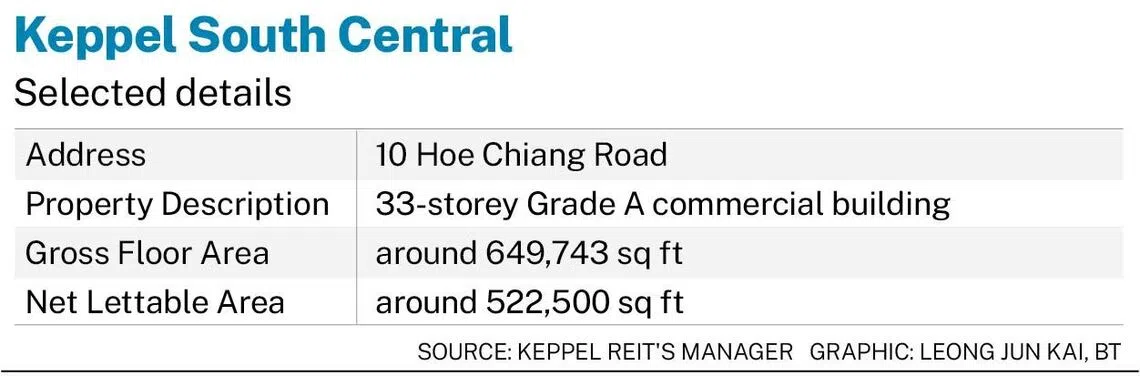
Recently, Keppel Reit’s manager announced that it entered into a conditional share purchase agreement to acquire a 51 per cent interest in Keppel South Central, a Grade A commercial building located in Tanjong Pagar, from its sponsor Keppel .
The agreed property value for the purchase of a 51 per cent interest on a 70-year leasehold basis is S$626.2 million or around S$2,350 per square foot (psf). The acquisition at an initial property yield of 4.3 per cent is seen to be accretive to pro forma distribution per unit.
Completed in January 2025, Keppel South Central offers about 522,500 square feet of net lettable area (NLA) comprising office space, together with complementary retail, event and flexible workspace offerings, as well as amenities such as an indoor gymnasium, a swimming pool, sky terraces and a social kitchen.
The building boasts strong sustainability performance, resilient digital infrastructure as well as advanced smart-building features, and is within walking distance of five MRT stations.
However, should investors be concerned that the above deal involves Keppel providing income support?
The income support, which provides Keppel Reit with a guaranteed monthly income of S$2.23 million, may last for up to five years from the completion of the proposed acquisition.
Arguably, the provision of income support helps Keppel strike a deal today to sell Keppel South Central to Keppel Reit at a price which works for both parties.
Furthermore, while the occupancy rate of Keppel South Central ramps up, Keppel Reit gets to enjoy a decent yield on the property right from the start.
Still, should a vendor of a newly completed office building seek to fetch a good price by selling the property to a buyer who may not need the provision of income support?
Also, might it be better to delay a transaction until when income at a newly completed building is more stabilised, thus rendering any provision of income support redundant?
For sure, inventors should pay extra attention when a Reit’s sponsor provides income support when selling a property that it owns to the said trust.
Perhaps, because of the generous amount of income support, the sponsor can achieve a bullish selling price for the property. And the Reit’s purchase of the said property may in turn yield the sponsor who owns the trust’s manager one-off acquisition fees as well as higher recurring management fees.
On reflection, the devil lies in the details of income support arrangements in any property deal, and what matters most are the property fundamentals.
Underlying property fundamentals
In the Keppel South Central deal, while Keppel may be on the hook to potentially pay Keppel Reit a substantial sum in income support, the proposed income support arrangement is well-supported by current rents at the property.
As at end-September, committed leases and leases which are in the process of documentation for Keppel South Central comprised 52.7 per cent of NLA at an average rent of around S$11.30 psf per month. This is above the monthly rent of S$11.15 psf assumed under the income support arrangement.
Importantly too, the difference in valuation of the property with and without income support is small, according to independent valuations by Colliers and CBRE as at end-September. Also, the said valuations even without income support exceed the agreed property value of S$626.2 million. Both valuers used the income capitalisation and discounted cash flow methods.
Doubtless, any property buyer should be mindful of overpaying for a property because the seller is propping up the income of the said asset.
Nevertheless, a property deal involving income support need not necessarily be a bad deal for a buyer.
What matters is that the purchaser is comfortable with the underlying fundamentals of the said property.
Ultimately, Keppel Reit could be acquiring a strong asset at a fair price with its proposed purchase of Keppel South Central. And having income support just helps to make the deal work better for the trust.
By adding Keppel South Central to its portfolio, Keppel Reit reinforces its leading position in Singapore’s Central Business District office market, where supply is constrained. In turn, the trust’s investment case is strengthened.
The writer owns units in Keppel Reit