Macron bets on Beijing to save his legacy
The French leader will seek a new economic and diplomatic equilibrium with Chinese President Xi Jinping
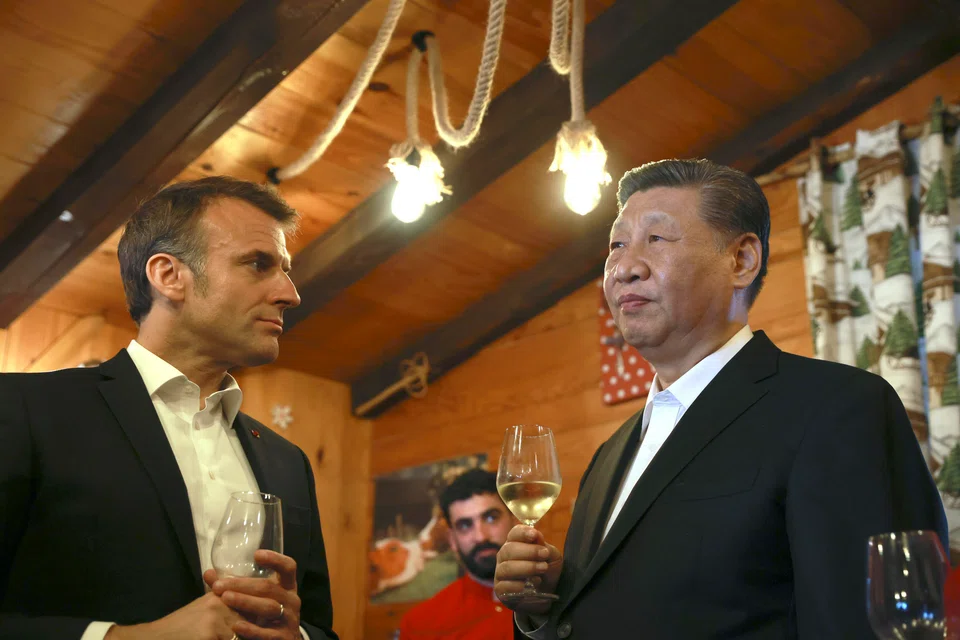
DEEP into his second term of office and unpopular at home, French President Emmanuel Macron is looking to reshape his legacy via foreign policy, starting with a key trip to China from Wednesday (Dec 3).
Macron, who is making his first visit to the rising superpower since April 2023, will meet President Xi Jinping in both Beijing and Chengdu.
The agenda for this bilateral state visit is dominated by the potentially much bigger regional prize of a new framework for Europe’s relationship with China – a grand goal on which the 27 EU member states remain internally divided.
In a volatile era of international relations, Macron seeks to bring a new equilibrium to Sino-European ties in economics and security. This comes as bilateral relations have generally trended downwards since the Covid-19 pandemic, exacerbated by China’s qualified support for Russia’s war in Ukraine.
From Beijing’s perspective, greater clarity on Europe’s strategy would be welcomed. China’s ambassador to France, Deng Li, previously asserted that the EU’s characterisation of Beijing as a partner, competitor and strategic rival is akin to being at an intersection with the red, green and yellow traffic lights on at the same time – “simply unworkable”.
Ultimately, Macron appears to want a reset towards a relationship independent of other powers, including the US and Russia.
This would be based on respect and reciprocity with both sides having complementary interests, such as Europe’s need for rare earths, and China’s demand for sophisticated microchips.
It is understood that Macron will argue for a strategic shift where China consumes more and exports less, with EU producers filling the gap. This is critical given the EU’s trade deficit with China reached 305.8 billion euros (S$460.7 billion) in 2024.
Macron has also advocated EU policies that challenge China, including industrial and economic security policies. This includes the anti-coercion instrument designed to deter Beijing from weaponising trade, such as its recent export controls on rare earths (which are key for European sectors such as cars).
At the same time, Macron is keen to charm Xi to secure market access for French business in sectors such as chemicals and energy. A delegation of French private sector executives will join Macron in Beijing and Chengdu.
The approach mirrors his previous visit, where he travelled with Xi to the Pyrenees – a place of childhood nostalgia for Macron. This time, the “charm offensive” follows Beijing’s decision to invite the French president to Guangzhou, where Xi’s father formerly resided as governor, for a tea ceremony.
However, scepticism remains back home. There are long-standing concerns that Beijing aims to “divide and rule”, undermining the EU’s collective interests.
Consider the Belt and Road infrastructure initiative, which numerous EU member states – including Croatia, Czech Republic, Hungary, Poland, Greece, Malta and Portugal – have joined, despite Brussels’ reservations about the transactional nature of Chinese investment.
There are also frustrations over Beijing’s perceived slowness to open up its own economy, and concerns about the wave of Chinese takeovers of European firms in key industries.
Crucially, unlike previous visits, Macron will not be accompanied by European Commission President Ursula von der Leyen this week. This could be significant as Dr von de Leyen has been more hawkish than Macron on relations with China. This includes devising the EU’s “de-risking” strategy towards Beijing to minimise “dangerous dependencies” in critical tech and raw materials.
Divisions extend beyond Brussels. For instance, Poland tends to be much more sceptical of Beijing, and Lithuania allowed Taiwan to open a representative office in the capital Vilnius in 2021. These differing views highlight not only intra-European splits but also schisms with the generally more hawkish US.
On the geopolitical stage, Macron has argued the EU should aim to become a “third pole” in world affairs, possessing “strategic autonomy” alongside Washington and Beijing.
At the top of the agenda is Ukraine. While China claims neutrality, it is suspected of supplying materials to Russia, including components needed to manufacture weapons.
Then there is Taiwan. Macron received much criticism in the West during a previous trip for asserting that Europe should not focus too strongly on the issue.
However, Taiwan will likely return to the agenda following the recent assertion by Japan’s Prime Minister Sanae Takaichi that a Chinese blockade or invasion of Taiwan would necessitate Tokyo deploying its military. US President Donald Trump has since urged Takaichi not to escalate the dispute. Macron must navigate these escalating tensions without appearing to undermine G7 unity.
Taken together, Macron’s goal is to show that, despite significant tensions, a deterioration of relations is not inevitable. Both the EU and China can still gain from an economic and political partnership on issues of common interest.
The writer is an associate at LSE IDEAS at the London School of Economics