Malaysia’s durian glut carries a wider lesson about growth
It is a warning that the upcoming Johor-Singapore Special Economic Zone should keep in mind
[JOHOR BAHRU] The Business Times’ recent piece on the challenges facing Malaysia’s durian industry indicates an issue that extends well beyond agriculture: Economic growth and market access do not necessarily determine who ultimately captures the value they create.
Malaysia’s durian story should, on paper, be a remarkable success.
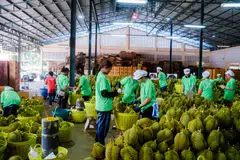
Chinese demand soared, Musang King became an internationally recognised premium product, investors poured money into orchards, and in 2024, Malaysia secured permission to export fresh durians directly to China.
Exports duly surged. But production expanded even faster. During the recent harvest, prices fell by more than half in parts of the market.
The lesson is not that opening the Chinese market was a mistake. It is that market access alone does not guarantee producer prosperity.
Malaysia cannot realistically compete with Thailand’s and Vietnam’s durian markets purely on volume. Its advantage lies instead in premium varieties, tree-ripened fruit, provenance and quality.
The next stage of the industry therefore needs to focus not on simply producing more durians, but also on capturing more value from them through logistics, processing, branding and downstream products.
There is a wider lesson here for Malaysia’s economic development.
The country is currently producing impressive headline numbers. Gross domestic product expanded 6 per cent year on year in the second quarter of 2026, following 5.4 per cent growth in the first.


Meanwhile, investment continues to flow into semiconductors, data centres and advanced manufacturing.
The harder question, increasingly, is what happens after that investment arrives.
Does a semiconductor plant create well-paid Malaysian jobs and develop local suppliers? Do data centres create capabilities elsewhere in the economy? Does infrastructure investment raise productivity and incomes in surrounding communities?
For Singapore businesses, this question will be particularly important in Johor.
The Johor-Singapore Special Economic Zone (JS-SEZ) recorded around RM77 billion (US$18.9 billion) in approved investments in 393 projects in 2025, associated with more than 18,000 employment opportunities.
But its long-term significance will depend on more than investment totals.
If Singaporean and international investment creates skilled jobs for Johor residents, develops Malaysian suppliers, raises wages and transfers capabilities into the local economy, the JS-SEZ can demonstrate that closer Singapore-Malaysia economic integration produces tangible benefits on both sides of the Causeway.
That should matter to companies considering expansion into Malaysia.
The investment calculation increasingly needs to go beyond incentives, land costs and proximity to Singapore.
Businesses should also consider the domestic economic footprint they create: who they employ, what those jobs pay, how much they procure locally and what capabilities they leave behind.
Malaysia’s durian farmers provide an unexpectedly useful reminder of why.
Producing more is not necessarily the same as earning more. Attracting investment is not automatically the same as spreading prosperity.
Closing the distance between the two may be the next important test of Malaysia’s growth story.
Shawn Balakrishnan Partner – Asia-Pacific, Penta Group
Decoding Asia newsletter: your guide to navigating Asia in a new global order. Sign up here to get Decoding Asia newsletter. Delivered to your inbox. Free.
Share with us your feedback on BT's products and services