

Nikki Haley for President? Asian-Americans project growing political power
IMAGINE the following scenario at the White House in early 2025: The 47th president of the United States, the first woman and first Asian-American to occupy this position, is welcoming British Prime Minister Rishi Sunak, whose parents, like those of the American head of state, are of Indian-Punjabi descent.
President Haley shakes hands with PM Sunak, although she then half-jokingly adds a Namaste greeting, and then whispers to him that when they don’t want their aides to hear what they have to say, they can converse in Punjabi.
The newly elected American president had just won a close presidential race against the Democratic opponent, former Vice President Kamala Harris, herself a daughter of an immigrant from the Madras province of India, while PM Sunak was re-elected after facing a strong challenge from the UK Labour Party candidate.
And they are both aware that they each is making history: The closing of an historical circle; descendants of people who had lived under British colonialism, she is leading a nation who had once fought against imperialism represented by the country that he now heads.
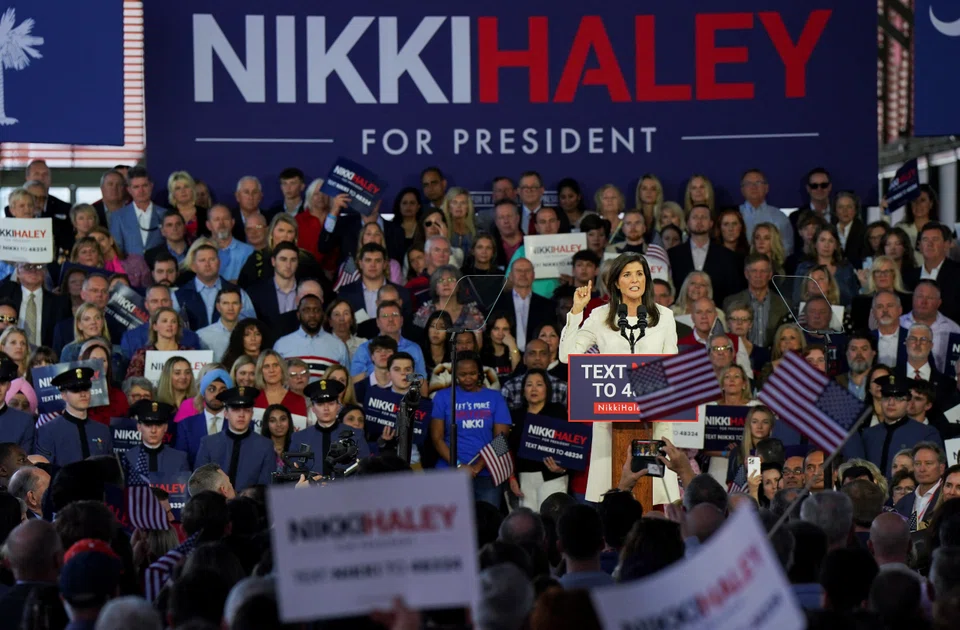
But we’re still in 2023 and the 51-year old former governor of South Carolina and former President Donald Trump’s one-time ambassador to the United Nations, a rising political star, charismatic and articulate, will be facing a long road full of obstacles she would need to overcome on her way to the White House.
Haley has already made history as the first Asian American governor of a state, the first Indian American to serve in the US Cabinet, and as the youngest governor in the country.
And she is also making history in another way – by becoming the first Republican to challenge her former boss for the party’s presidential nomination in 2024.
While she refrained from any direct mention of the ex-president when announcing her candidacy, she stressed that she was representing a new political breed, different from both former President Trump and current President Joe Biden, aging politicians who seek to lead a nation that prides itself on being young and dynamic.
“It is time for a new generation of leadership to rediscover fiscal responsibility, secure our border and strengthen our country, our prize and purpose,” she said on a campaign launch video on Tuesday (Feb 14), in which she emphasised both her gender and her family’s immigrant roots.
She declared: “I am Nikki Haley and I am running for president”, emphasising being a role model for women, immigrants and minorities – groups that the GOP needs to attract to the party if it wants to win the popular vote, which it failed to do in seven out of the last eight presidential elections.
The former governor led a state that historically was torn by racial tensions, and as she pointed out in her announcement, the railroad tracks in the town she grew up in South Carolina divided the place by race. “I was the proud daughter of Indian immigrants,” she said. “Not black, not white, I was different.”
Her defining action as governor was signing legislation removing the southern Confederate flag from the state capitol. That happened after the massacre in the Emanuel African Methodist Episcopal Church in Charleston, South Carolina, in June 2015, and after photos surfaced of the murderer holding Confederate flags.
Governor Haley compared the pain suffered by Blacks in her state to what she experienced as a young girl, when she saw her father profiled as a thief in Columbia, realising now that the “Confederate flag was the same pain that so many people were feeling”.
During her tenure, Governor Haley also appointed an African American, Tim Scott, to the Senate. He became the first Black senator from South Carolina and the only Black Republican serving in the Senate, and who may also try to run for the Republican presidential nomination in 2024.
But a large majority of African-Americans have traditionally been allied with the Democratic Party, and the chances of them voting for president a Republican, albeit a woman of colour, are not very high.
Haley’s candidacy does project the growing political power of the 24 million Asian-Americans in the country. According to some surveys, more than 40 per cent of Asian American registered voters think of themselves as Democrat, 20 per cent regard themselves as Republican, and the rest consider themselves Independent.
It’s not clear that Haley would be able to draw these voters into the Republican Party, especially when one considers that there isn’t really an “Asian American vote” and there isn’t any reason to believe that American voters of Korean or Japanese descent would vote for Haley just because of her Indian immigrant background.
Moreover, while Haley is trying to project an image of a progressive and forward-looking public figure, especially when it comes to gender, race, and immigration, her critics would point out that she ended up serving under a president who has been accused by women of sexual abuse, who refused to criticise racist organisations, and who has called for restricting illegal and legal immigration to the US.
As much as Haley may now try to distance herself from the former president now, she campaigned for presidential candidate Trump in 2020 and at some point suggested that she wouldn’t run for the presidency if Trump decided to seek the Republican presidential nomination in 2024. And this after first having been sharply critical of him during his 2016 presidential campaign.
One of her main strengths that she developed as US ambassador to the UN is her expertise and experience in foreign policy and her hawkish positions on these issues, including her strong support for Israel and promoting an image of an Iron Lady when it comes to dealing with threats to US national security posed by China, Russia and Iran.
But these positions are also shared by other Republicans who are seen as potential presidential candidates in 2024, led by Florida governor Ron DeSantis who has yet to declare that he will be running for president in two years.
A poll conducted by North Opinion Research among Republicans found Governor DeSantis leading among caucus and primary voters in a 10-way race with 39 per cent of the vote, followed by former President Trump with 28 per cent. Haley got only 4 per cent of the vote.
Indeed, many Republican critics of the former president have warned that Trump could end up winning the primaries in 2024 like he did in 2020, if once again he faces a large number of competitors who would divide the Republican vote.
And they are urging Haley not to run this time, predicting that she would have a good chance of being nominated as a vice presidential candidate under any Republican winner, or at least selected as Secretary of State in a Republican administration. The question is whether Haley would agree to wait her turn?






