Nvidia and the Trump administration: Commerce, competition and controversy
How the tech giant’s deal with the government could shift US industrial policy and constitutional limits
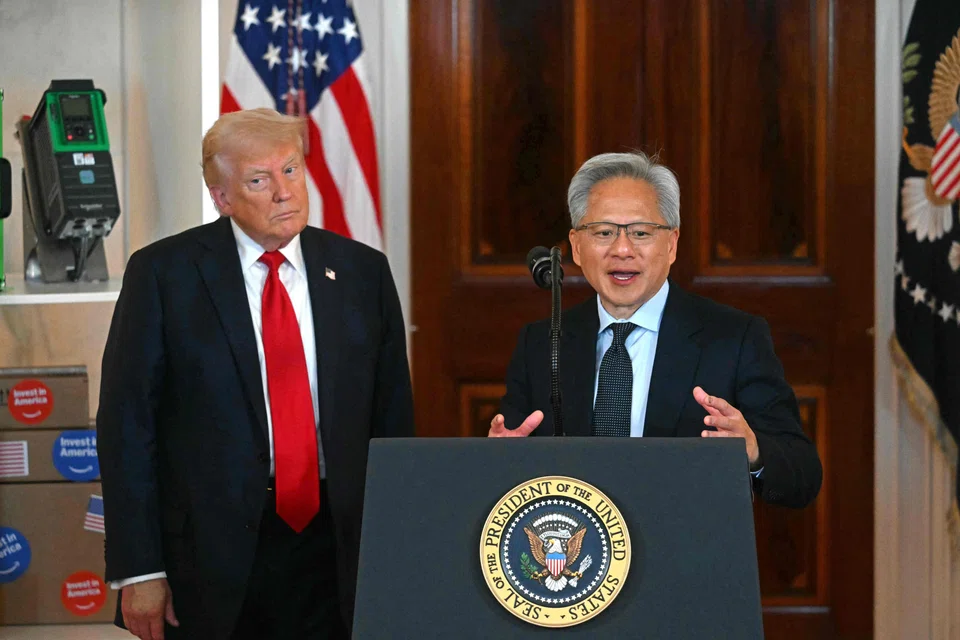
THE relationship between the Trump administration and Nvidia has emerged as one of the most consequential and controversial corporate-government partnerships of 2025.
What began as potential antitrust scrutiny has transformed into an unprecedented arrangement that raises fundamental questions about national security, constitutional authority and the growing intersection of business interests with presidential power.
At the centre stands Jensen Huang, Nvidia’s chief executive officer, who successfully lobbied US President Donald Trump to reverse export restrictions on artificial intelligence (AI) chips to China. The policy shift represents a dramatic departure from previous efforts to maintain American technological superiority through export controls.
The deal
On Dec 8, Trump announced that Nvidia may ship its H200 chips to approved customers in China, with the US government receiving a 25 per cent revenue share. This arrangement, which also extends to AMD and Intel, marks an escalation from an earlier agreed 15 per cent split.
The H200 chips represent previous-generation technology, yet remain significantly more advanced than anything China can currently produce domestically. Technology policy experts estimate that China is at least 18 months away from developing its own equivalent to the H200 chips, making access to these semiconductors critical for Beijing’s AI ambitions.
For Nvidia, the stakes are equally high. China represents a potential US$50 billion market that could prove essential for meeting investor expectations in an increasingly competitive AI landscape.
The administration frames this as a win-win scenario. Trump claims the policy “will support American jobs, strengthen US manufacturing, and benefit American taxpayers”, while Nvidia maintained that sales to vetted commercial customers strike a thoughtful balance benefiting American interests.
Constitutional concerns
Yet beneath the rhetoric lies a thicket of legal complications. The US Constitution’s export clause explicitly prohibits taxes or duties on exports, creating questions as to whether this arrangement constitutes an unconstitutional export tax disguised as a voluntary business partnership.
Legal scholars note that framing these payments as voluntary is dubious when companies cannot obtain export licences without agreeing to the revenue sharing. The arrangement transforms a regulatory function into a monetised transaction, setting a precedent for future government-business relations.
The government would share upside profit with no downside risk. This structure creates perverse incentives and opens doors to potential corruption, as firms might use political influence to secure exceptions unavailable to rivals.
The access campaign
Nvidia’s success did not happen by accident. The company hired a Republican lobbyist, who reportedly passed through Ivanka Trump’s entourage and focused the debate on exports while bypassing industry associations.
Huang cultivated direct presidential access through multiple channels, including attendance at a US$1 million-per-plate dinner at Mar-a-Lago and donations to Trump’s White House ballroom project.
The company joined a consortium promising to invest US$500 billion in the US over four years, checking the domestic production box that has become essential currency in Trump’s transactional approach.
This multifaceted strategy demonstrates Huang’s understanding that in this administration, personal relationships and visible commitments matter as much as policy arguments.
Trump revealed the evolution of his thinking at an AI summit in July, acknowledging that he once considered breaking up Nvidia before learning more about Huang and the company. This candid admission underscores how personal proximity can reshape policy outcomes in ways that traditional regulatory processes might not permit.
National security concerns
The national security debate surrounding this arrangement has become increasingly heated.
Senator Elizabeth Warren characterised Trump’s decision as selling out American national security, calling for Huang and Commerce Secretary Howard Lutnick to testify before Congress. Defence hawks from both parties worry that providing China access to advanced chips will accelerate Chinese military modernisation and surveillance capabilities.
Critics argue this is akin to selling the Soviets’ nuclear technology after World War II, representing security malpractice at a moment when the US should be maximising its technological lead. The House Select Committee on the Chinese Communist Party warned that China would reverse-engineer the technology and eliminate Nvidia as a competitor.
Nvidia and its defenders offer a different narrative.
The company’s spokesperson argued that blocking H20 shipments cost America billions, while foreign AI chip firms stepped in to fill the gap. From this perspective, export restrictions simply cede market share to non-American competitors without actually slowing China’s AI development, making the controls self-defeating.
This argument reflects a broader tension in technology policy between maintaining absolute advantages through restriction versus preserving competitiveness and market dominance through continued sales. Whether export controls effectively limit adversary capabilities or merely disadvantage American firms remains genuinely contested among experts.
Broader implications
The Nvidia arrangement suggests a vision where the government acts as business partner rather than neutral arbiter, a model with far-reaching implications for how American capitalism operates.
For Nvidia, the immediate benefits are clear: access to an enormous market and resolution of export uncertainty. For the Trump administration, the arrangement generates revenue while claiming to support American jobs and manufacturing. But the longer-term consequences – constitutional, competitive and strategic – remain deeply uncertain.
As AI reshapes global power dynamics, the relationship between the Trump administration and Nvidia will likely be remembered as a defining case study in how America navigated the tension between economic opportunity and national security; corporate influence and democratic governance.
Whether this path proves wise or reckless may not be clear for years to come.