Nvidia’s Jensen Huang fallout is a gift to billionaires Ambani and Adani
The saga may have cleared the way for India’s richest men to rise as trusted gatekeepers of US tech
SILICON Valley’s nightmare week is turning into a windfall for India’s largest conglomerates.
With Jensen Huang ousted from Nvidia following a scandal involving the chipmaker’s Singaporean cloud partner, Washington is slamming the door on South-east Asian data centres suspected of funnelling computing power to China.
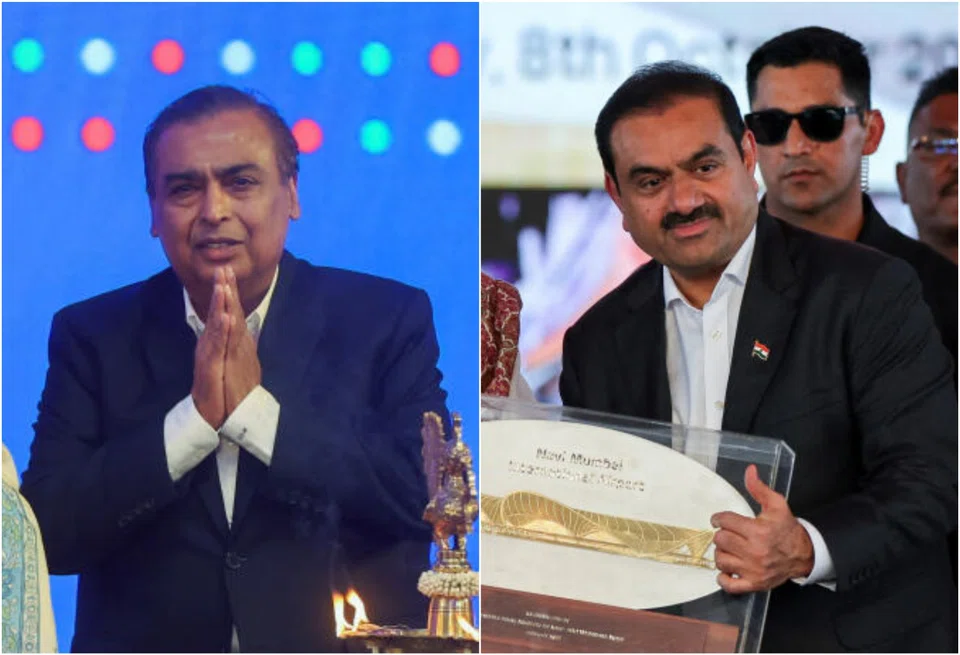
The crackdown could hand Mukesh Ambani and Gautam Adani an unexpected prize.
The tycoons have pledged more than US$200 billion to build artificial intelligence infrastructure, including vast data centres for US tech giants, and are now suddenly positioned as trusted Asian custodians of cutting-edge Western technology.
If their facilities can comply with Washington’s Pax Silica initiative – a cornerstone of US Secretary of State Marco Rubio’s economic statecraft aimed at China-proofing the AI supply chain – they stand to be among the biggest beneficiaries of the Commerce Department’s new interim rule governing access to advanced semiconductors.
By subjecting Singapore, Malaysia, Thailand, and Indonesia to case-by-case export licensing for high-end chips – and capping remote access for Chinese-linked entities – the US Bureau of Industry and Security has plugged much of the regulatory arbitrage that fuelled the region’s data centre boom.

India, meanwhile, joined Washington and other Indo-Pacific partners in signing the San Francisco Declaration underpinning Pax Silica, and is absent from the list of high-risk destinations suspected of diverting compute to China.
That gives a leg-up to Ambani, whose Reliance Industries has made a 10 trillion rupee (US$107 billion), seven-year commitment to a gigawatt-scale AI hub.
Not to be left behind, the Adani Group has unveiled a US$100 billion data centre bet by 2035.
SEE ALSO

Between them, the pair are turning the arid deserts of Kutch on the India-Pakistan border into some of the world’s largest green energy projects.
While Adani’s solar park is five times the size of Paris, Ambani is developing a complex three times the area of Singapore.
Adani controls the power and transmission infrastructure needed to feed energy-hungry data centres, while Ambani has more than 500 million telecom subscribers, a potential market for AI services.
Yet local enterprise demand is too small to absorb the projected growth in AI data centre capacity.
Worse, the billionaires’ ambitions will have to jostle for space with neoclouds selected under the government’s IndiaAI Mission.
The programme’s participants, including Yotta Data Services, Tata Communications and E2E Networks, already host more than 44,000 graphics processing units, or GPUs.
AdaniConneX will support the mission by renting data centre space to CoreWeave’s AI cloud.
To prevent billions of dollars of high-end silicon from sitting idle while domestic demand catches up, New Delhi allows state-supported cloud operators to sell spare capacity abroad – effectively exporting AI tokens by running inference and training workloads for overseas customers.
But there is a catch. US authorities suspect Alice Huang, a former executive at Singapore-based Megaspeed International who had a romantic relationship with the ousted Nvidia boss, of spying for China.
The affair has turned exporting compute from Asia into a geopolitical minefield.
While US export controls classify silicon by processing density rather than product vintage, Nvidia’s flagship Blackwell processors hit Washington’s new remote-access ceiling with far fewer servers, subjecting even modest clusters to the strictest scrutiny.
That gives the tycoons another advantage over standalone neoclouds scrambling for customers whose leases may require individual vetting.
Ambani and Adani’s AI hubs are being built around American partners and supply chains from the outset.
Adani has anchored his Visakhapatnam centre on India’s eastern coast with Alphabet’s Google – which is landing subsea cables there – and agreed to form an equal joint venture with Florida-based Jabil to manufacture AI servers and cooling systems locally.
On the western coast, where Meta Platforms is routing intercontinental fiber, Ambani is building a 168 megawatt (MW) data centre for the social media behemoth, alongside a separate US$100 million partnership to sell the US company’s Llama AI enterprise software across India.
Silicon Valley’s direct involvement is meant to reassure Washington about where the compute ultimately goes.
A third player to watch is the Tata Group.
The Mumbai-based conglomerate will build a 100 MW facility for OpenAI, with an option to scale it to one gigawatt.
Unlike US neoclouds that rely on vendor financing from Nvidia, large Indian groups can bankroll chip purchases off tens of billions of dollars in annual cash flows from oil refining, telecoms, ports, utilities, and – in Tata’s case – software exports.
Washington has taken notice.
Trump 2.0’s punitive tariffs and immigration curbs may have soured bilateral ties, but now the China hawks want to draw India’s industrial titans back into their orbit.
During his swing through the South Asian nation in October, Rubio sat down with Adani and Tata Group chairman N Chandrasekaran in Mumbai before flying to Gujarat for a tour of Ambani’s Jamnagar complex.
From refining Venezuelan crude to hosting AI hardware, the hub can serve US interests across sectors.
Whether the embrace holds will be tested after US President Donald Trump’s high-stakes meeting in Shenzhen with Chinese President Xi Jinping.
All eyes will be on how firmly the White House defends Pax Silica, and whether Trump trades away any of the chip-and-compute guardrails in pursuit of a broader trade truce with Beijing.
Even if the US and China reach a détente in their war for tech supremacy, Ambani and Adani cannot afford to treat their server farms as neutral real estate.
Foreign data centres are now legally expected to conduct deep know-your-customer audits on every tenant’s corporate ownership to ensure no shell company tied to China or Macau breaches the remote-access ceiling.
US domestic politics adds another wrinkle.
Democratic Senators Elizabeth Warren and Richard Blumenthal have previously questioned how the Department of Justice dropped the bribery indictment it had brought against Gautam Adani and his nephew in the final months of the Biden administration. (The Adani Group has consistently denied wrongdoing.)
With congressional Democrats set to regain subpoena power in January, scrutiny of a tycoon with close ties to Indian Prime Minister Narendra Modi could return.
Still, the Nvidia saga may have just cleared the decks for India’s richest men to emerge as trusted gatekeepers of American tech. Keeping that franchise will require proving they can enforce Washington’s red lines. BLOOMBERG
Decoding Asia newsletter: your guide to navigating Asia in a new global order. Sign up here to get Decoding Asia newsletter. Delivered to your inbox. Free.
Share with us your feedback on BT's products and services