The Paragon paradox: CapitaLand’s upscale retail mall scoop is a win – but for whom?
Just a year ago, investors were told that Paragon needed a massive makeover – but that narrative has been flipped entirely

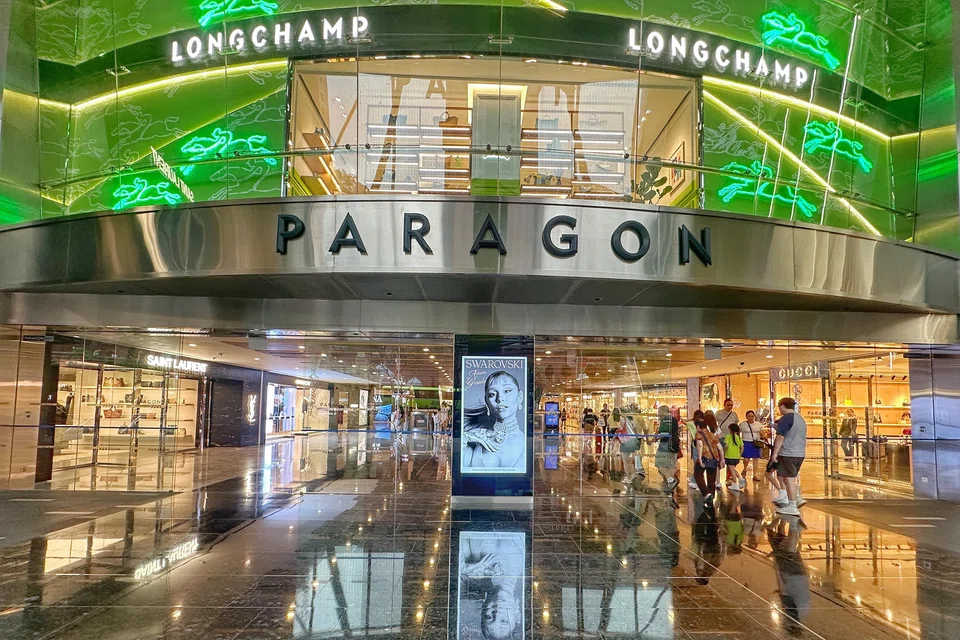
[SINGAPORE] When Cuscaden Peak took Paragon Real Estate Investment Trust (Reit) private in the first half of 2025, the narrative delivered to retail investors was stark.
The trust’s crown jewel, Paragon mall, needed a massive, critical makeover to stay relevant in a brutal retail landscape.
This was estimated to take up to four years to complete, with a potential capital expenditure totalling up to S$600 million, or up to 21 per cent of Paragon’s FY2024 appraised value of S$2.9 billion as a 99-year leasehold property.
Unitholders were warned that staying on board meant enduring a painful period of construction dust, execution risks and a heavily crushed distribution per unit (DPU).
Faced with that bleak outlook, many Paragon Reit unitholders logically took the S$0.98 per unit cash offer and walked away.
Fast-forward a year, and the script has been flipped entirely.
The manager of CapitaLand Integrated Commercial Trust (CICT) on Monday (Apr 20) announced it was buying Paragon mall for S$3.9 billion – now on a freehold basis. And just like that, the supposedly daunting overhaul is now pitched to the market as an exciting growth catalyst.
But why would Singapore’s largest commercial real estate giant pay a massive premium for a mall staring down a costly renovation? Part of the answer lies in the cold, efficient mechanics of scale.
“Beyond the retail floors, CICT is buying a structural moat. A huge chunk of that S$3.9 billion price tag is justified by the medical suites upstairs. Retail can be a fickle game, completely at the mercy of consumer whims. Medical tenants, however, are incredibly sticky. ”
What served as a fatal DPU shock for a small, concentrated trust is merely a speed bump for a giant. With a massive, diversified portfolio across Singapore, Sydney and Frankfurt, CICT can easily absorb the downtime of an Orchard Road upgrade.
For a trust of this size, an asset enhancement initiative is a routine value-add opportunity, rather than an existential threat. It has the balance sheet to fund the works, and the sheer size to mask the temporary income loss.
No overhaul after all?
Then, there is the fine print of the acquisition announcement, which reveals a rather amusing pivot.
CICT stated it will “explore” asset enhancement opportunities, noting that Cuscaden Peak’s preliminary estimate – some S$300 million to S$600 million – “may differ” from CICT’s own eventual plans.
This is classic corporate speak for leaving the back door wide open. It strongly hints that CICT might not undertake the massive overhaul at all, or at least nowhere near that intimidating scale.
If CICT eventually decides a lighter touch is sufficient, it will confirm every market cynic’s suspicion: The terrifying existential threat used to justify taking Paragon Reit private was simply a very effective narrative to clear the room.
Once the asset safely crossed over to the institutional side, the urgent need for a massive overhaul suddenly became a highly flexible option subject to “detailed feasibility studies”.
This adds to the brilliance of the capital swop. CICT is partially funding this mega purchase by simultaneously selling Asia Square Tower 2 to Malaysia’s IOI Properties for roughly S$2.5 billion.
Effectively, it is unloading a mature office asset at a very tight 3 per cent exit yield, representing a healthy premium to its last valuation. That capital is instantly recycled into Paragon at an estimated 3.9 per cent yield.
This is a highly effective corporate manoeuvre, swopping a peaking office tower for a freehold retail trophy in the heart of the shopping belt.
Beyond the retail floors, CICT is buying a structural moat. A huge chunk of that S$3.9 billion price tag is justified by the medical suites upstairs.
Retail can be a fickle game, completely at the mercy of consumer whims. Medical tenants, however, are incredibly sticky.
An ageing population and the steady flow of regional medical tourism provide a defensive income stream, and anchors the more volatile retail floors below.
Controlling the belt
With its massive concentration of prime real estate, CICT is effectively turning Singapore’s shopping district into a real-life Monopoly board.
The manager notes that the acquisition anchors its presence from Orchard Road MRT station all the way to City Hall. When you string together ION Orchard, Paragon, Plaza Singapura, The Atrium@Orchard, Raffles City and Funan, CICT essentially owns the downtown footprint.
The Reit manager has explicitly declared that the purchase cements the trust’s position as the largest owner of private retail stock in Singapore, reinforcing its leadership as the ultimate proxy for the city’s high-quality commercial real estate.
The management calls this “defensive positioning” and “market relevance” in a precinct with limited new supply. In plain terms, this level of dominance hands the landlord immense pricing power.
Retailers seeking premium foot traffic have very few alternatives. When lease negotiations come around, a dominant landlord can squeeze tenants for higher rents and a larger cut of their sales. Shoppers will ultimately absorb these higher costs through pricier cups of coffee and more expensive clothes.
Left out in the cold?
Ultimately, this sequence of events is a masterclass in how structural incentives dictate market moves.
The building on Orchard Road remained exactly the same. But the incentive structure of its owners changed.
Temasek-backed Cuscaden Peak – a joint venture controlled by Mapletree Investments subsidiary Mapletree Fortress and Adenium, a subsidiary of CapitaLand’s CLA Real Estate – bought the asset. They held it briefly, and are now passing it to CICT.
While the narrative has changed, the property still sits in the broader CapitaLand and Temasek universe.
Meanwhile, retail investors might find themselves on the periphery of these massive institutional wins.
To lock in the deal quickly, the manager has launched a S$600 million private placement, aimed squarely at large funds. While the institutions secure a discounted entry point into a blue-chip vehicle, retail investors are unable to participate and wake up to a slightly diluted ownership stake.
To be sure, the manager’s defence is mathematically sound. The deal is projected to be DPU-accretive. Retail investors own a smaller slice of the pie, but the bakery is now much larger, meaning their total payout should theoretically increase.
Clearly, though, the mom-and-pop investors are unlikely to see themselves as the true winners of the Paragon deal.
They may get the defensive stability of a giant portfolio. But they will be paying for it by taking on the execution risks of the new asset, and the sting of immediate dilution – all for a trophy retail asset that was deemed not too long ago to be in desperate need of an overhaul.