Peddling hope in India elections and economy
The ruling BJP is set to sweep the polls this month, with many party leaders casting their gaze at winning more than 400 seats
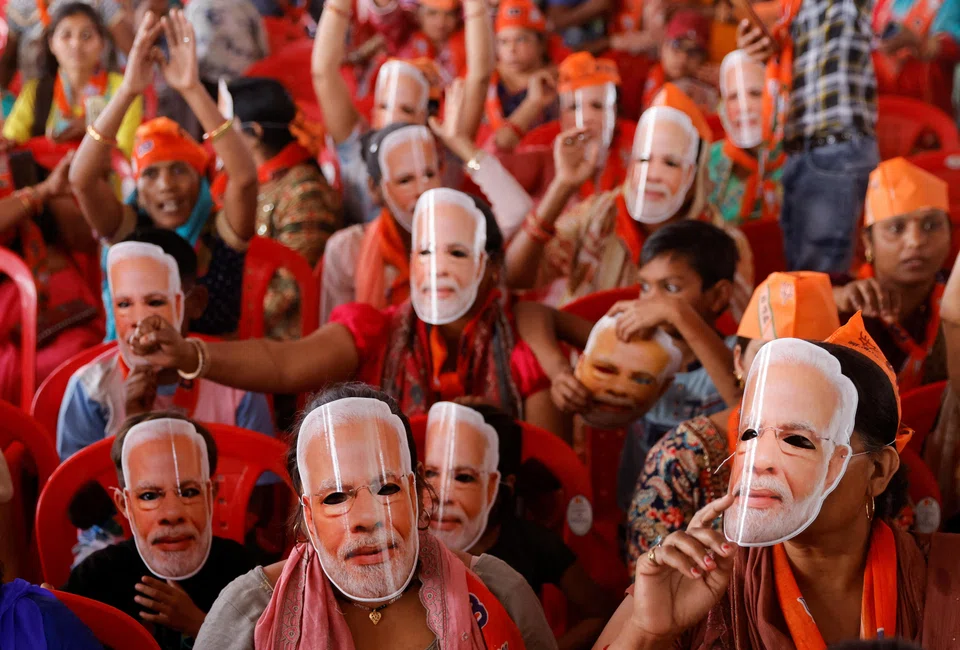
PERSUADED by the promise of better days ahead, India’s rich upper-crust and teeming poor seem all set to elect Prime Minister Narendra Modi to a third term, as opinion polls show him winning the upcoming parliamentary elections slated to be held from Apr 19 to Jun 1.
Modi is confident of victory, and has set a target of doubling the size of the economy and exports in the remaining years of this decade. He has issued a guarantee of making the economy the third-largest in the world, up from its present fifth position.
Many Indians are buying into the hope the ruling Bharatiya Janata Party (BJP) has raised. “Modi has given the country stability and that has made the stock market and mutual funds soar,” a businessman in Kolkata told me, adding that his “investments are thriving”.
A management graduate in her 20s said: “My salary is still very low compared to what my colleagues working abroad are earning. But I hope, with the doubling of our economy, my pay will increase.”
A labourer who works in a jute mill in West Bengal state, representing the bottom rung of the ladder, said: “We live only on hope. I get free rice from the government, but I also hope for better days.”
Unbalanced gains
The promise of “Better Days” or “Acche Din” was the slogan that brought Modi to power in 2014. To be fair, the prime minister has ensured political stability that the markets crave; this has resulted in the value of India’s stock market growing three times since he first came to power, and the national economy has almost doubled in that period.
The growth of Indian stocks is fuelled by the rise in the number of Indians with wealth and appetite for risk to nearly 5 per cent of the population, from about 2 per cent a decade ago.
The New York Times quotes market strategist Chris Wood warning that if Modi were not re-elected this year, Indian markets could crash by 25 per cent or more. His remark signals the faith the markets have in the stability that Modi represents.
According to a Reuters report, Modi has ordered officials to finalise plans by around May 2024 to expand the economy to US$6.69 trillion in nominal terms by 2030, from around US$3.51 trillion at present. When he was re-elected for a second term in 2019, he had pledged to grow the economy to US$5 trillion by 2024, but he has missed the target due to the massive disruption caused by the Covid pandemic.
Meanwhile, young and poor Indians are waiting for their incomes to rise. According to Modi’s current plans, he aims to raise per capita income to US$4,418 from around US$2,500 at present. This target may be achievable if the economy grows at a good clip.
There needs to be more clarity on the growth trend, though. Krishnamurthy Subramanian, India’s executive director at the International Monetary Fund (IMF), recently predicted that the Indian economy could grow at an 8 per cent pace till 2047, if the country adhered to the good policies it has implemented over the last 10 years and accelerate reforms.
The IMF, however, clarified that Subramanian’s statements were made “in his role as India’s representative at the IMF”. In its latest report, the Washington-based organisation said “growth in India is projected to remain strong at 6.5 per cent” in both 2024 and 2025, “reflecting resilience in domestic demand”.
The trouble with the Indian economy is its historic lopsidedness. Economic growth is largely powered by wealthy Indians and big companies, both of which are the main beneficiaries of economic gains. Around 90 per cent of the population of 1.4 billion people is left out, and survive on less than US$3,500 a year.
It is a small miracle that the poor have survived at all. They had traditionally been beneficiaries of welfare policies under earlier Congress Party governments that have grown under Modi. The poor receive free foodgrain and cooking gas. It is a pity that the poor are not benefiting along with the rich. Some analysts doubt that even a doubling of the Indian economy will improve the lives of most Indians.
Nonetheless, the country is set to rise in global power. India became the fifth-largest economy in 2022, surpassing the United Kingdom. It is expected to overtake Germany and Japan to become the third-largest economy around 2030, placing it just behind the United States and China.
One year before the Modi government came to power in 2014, India ranked as the world’s 10th-largest economy. At the end of Modi’s second term, the country’s ranking has improved to fifth, behind the US, China, Japan and Germany.
The prime minister has “guaranteed” the country would rise to third place as he aims to achieve his vision of a “Viksit Bharat” or “Developed India” by 2047. India still has a way to go. The World Bank presently tags it as a “lower-middle income” country.
High confidence
Modi’s ruling BJP is expected to sweep the polls this month, according to an India Today survey that found the party and its allies could win 335 of the 543 seats in the lower house of parliament.
The BJP-led National Democratic Alliance coalition won more than 350 seats in the 2019 election. Yet, many BJP leaders are casting their gaze at winning more than 400 seats.
The survey showed that a political alliance of opposition parties known as “INDIA” – led by Congress and over two dozen regional parties – could win 166 seats. That would amount to a poor performance, and is indicative of the declining appeal of the opposition.
The BJP is riding a wave of recent electoral victories at the state level in Rajasthan, Madhya Pradesh and Chhattisgarh. It won those states by putting Modi at the centre of the state elections.
Ordinary Indians continue to hope and pray for better days. Their political leaders are promising a brighter and richer future that always seems out of reach.
The writer is editor-in-chief of the Rising Asia Journal (www.rajraf.org)
TRENDING NOW
Grab CEO’s wife Chloe Tong on life with Anthony Tan and finding her purpose
Income Insurance appoints former Manulife Singapore top man as new CEO
Incidence of civil servants buying property near unannounced MRT stations ‘a concern’, but may not establish misconduct: PSD
Three ex-employees of Envy group join Ng Yu Zhi in bankruptcy