Renting could beat buying private property if home loan rates rise
Equity used to buy a residence can be deployed to build a retirement nest egg of quality stocks

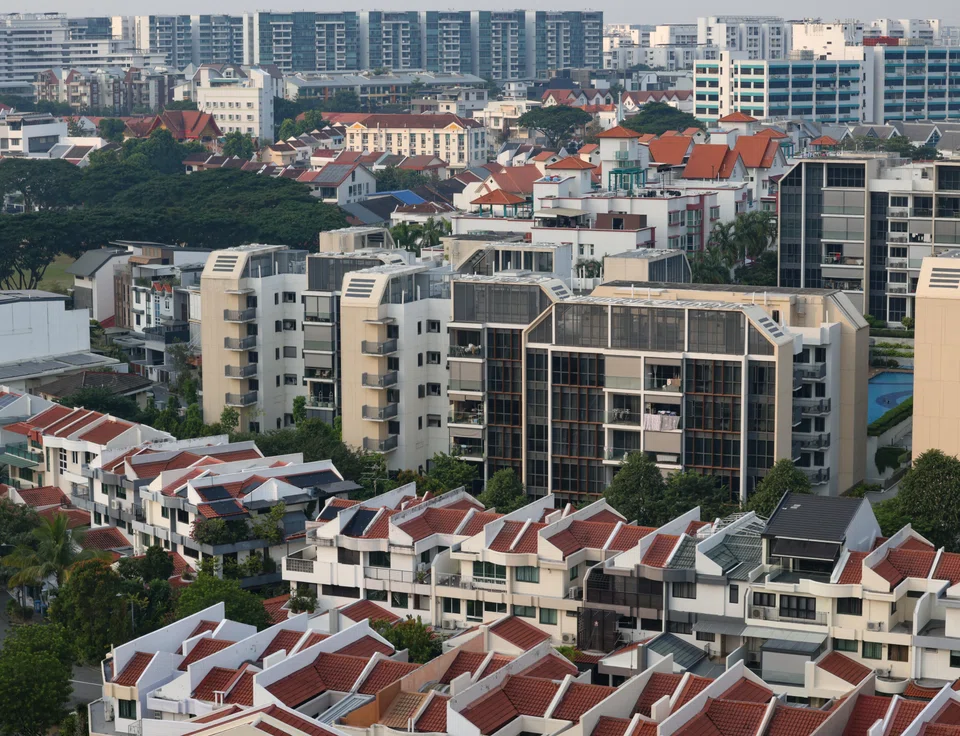
[SINGAPORE] Interest-rate movements in Singapore are not directly correlated with those in the US.
Still, could the US Federal Reserve’s hike of its benchmark overnight interest rate in mid-September with indications of further hikes in the coming months herald an era of higher interest rates over a prolonged period in many places including Singapore?
For sure, retirees here may welcome higher interest rates as they can get better returns from safe instruments such as Singapore-dollar fixed deposits or treasury bills.
On the other hand, borrowers will be hurt if interest rates rise and stay at elevated levels for a long time.
Potentially pricier home loans
Higher interest rates could adversely affect individuals who take on a new housing loan or refinance an existing one.
As at value date Oct 2, the three-month compounded Singapore Overnight Rate Average, or Sora, was around 1.2 per cent per annum, compared with about 3.7 per cent in early 2024 and 3 per cent in early 2025. Sora is commonly used to price housing loans here.
Consider the buyer of a S$2.5 million resale condominium unit who funds the purchase using equity and debt at a ratio of 25:75.
The monthly mortgage repayments on a 25-year loan for S$1.875 million are S$7,947, S$8,891 and S$9,897 based on annual interest rates of 2 per cent, 3 per cent and 4 per cent, respectively.
Over 25 years, the repayments for the loan would total about S$2.38 million, S$2.67 million and S$2.97 million, assuming annual interest rates of 2 per cent, 3 per cent and 4 per cent, respectively.
Certainly, for those who are eligible, buying a new Housing & Development Board (HDB) flat will likely continue to be a no-brainer even if home loan rates rise sharply. After all, new HDB flats are sold at subsidised prices.
In the June 2026 Build-To-Order (BTO) exercise, the indicative prices (excluding grants) of four-room flats at Sembawang Brook, a Standard project, ranged from S$302,000 to S$428,000. These were far lower than the transacted prices of S$600,000 to S$680,000 for comparable resale flats nearby with shorter remaining land leases.
Rental option
However, could higher interest rates bolster the case for renting a home instead of buying a private home?
Sure, paying rent represents an expense whereas servicing a home loan translates into paying for an asset whose value may grow over time.
Nonetheless, consider the opportunity cost of deploying S$625,000 in equity to fund the purchase of a S$2.5 million private home for owner-occupation.
The monies could be used to start a new business which generates a return that is many times the initial sum invested. Less excitingly, the S$625,000 could be used to buy equities to earn recurrent income from dividends and generate capital gains to ensure retirement financial adequacy.
Moreover, servicing a large multi-year home loan can be burdensome in an era of rising job market insecurity.
The Urban Redevelopment Authority’s flash estimate for the overall private housing price index for the third quarter rose 1.4 per cent quarter on quarter and 3.4 per cent year on year. For Q3, prices of landed homes rose much faster than non-landed homes.
Over periods of 10 years and 15 years, the compounded annual growth rate in private home prices were 4.9 per cent and 2.8 per cent, respectively.
Assuming the value of the S$2.5 million home rises by 3 per cent annually, the buyer who uses a 25-year loan of S$1.875 million to help fund the purchase, would see positive net cash flow from selling the home after 25 years less the equity injected and total loan repayments of S$2.23 million, S$1.94 million and S$1.64 million based on annual home loans rates of 2 per cent, 3 per cent and 4 per cent, respectively.
The above sums will be less if transaction costs are included or the cash flows are discounted to present value terms. Also, homeownership costs such as property tax and maintenance expenses have not been accounted for.
Compare the above scenario with that of renting a home and investing S$625,000 in equities that generate annual dividend yield of 3.5 per cent and price growth of 5 per cent per annum.
Further assume initial annual rental expenses of S$42,000, which increases at 3 per cent annually.
The home renter who invests S$625,000 in equities will see positive net cash flow of S$1.63 million after 25 years from gains generated by selling the equities and dividends received less total rental payments – a broadly similar outcome to the homebuyer when the housing loan rate is 4 per cent per annum.
However, the home renter’s positive cash flow will be much stronger should he consistently reinvest his dividends into buying more equities.
In short, it is plausible for the home renter who buys equities to easily outperform the private-homebuyer from a financial standpoint. And the home renter’s odds of doing better than the homebuyer financially increases when home loan rates rise.
Indeed, a young local couple who busts the monthly income ceiling of S$16,000 to buy a new HDB flat and S$18,000 to buy a new executive condo unit from a developer might consider renting a home for many years before buying their first home when the couple retires.
By buying their first home as retirees, the above couple could qualify to buy a new subsidised HDB flat and even enjoy priority in the BTO exercise, as well as possibly receive a housing grant.
Low mortgage rates have been a tailwind for private-housing demand. Might this tailwind become a headwind should home loan rates rise substantially?
Ultimately, while homeownership is deeply etched in the psyche of many Singaporeans, choosing to rent a home for numerous years instead of buying a private home could make sound financial sense as higher interest rates loom.
After all, money injected into buying a private home may be more productively used to build a sizeable nest egg for retirement by investing in high-quality listed equities.