

Republicans have become agents of political chaos
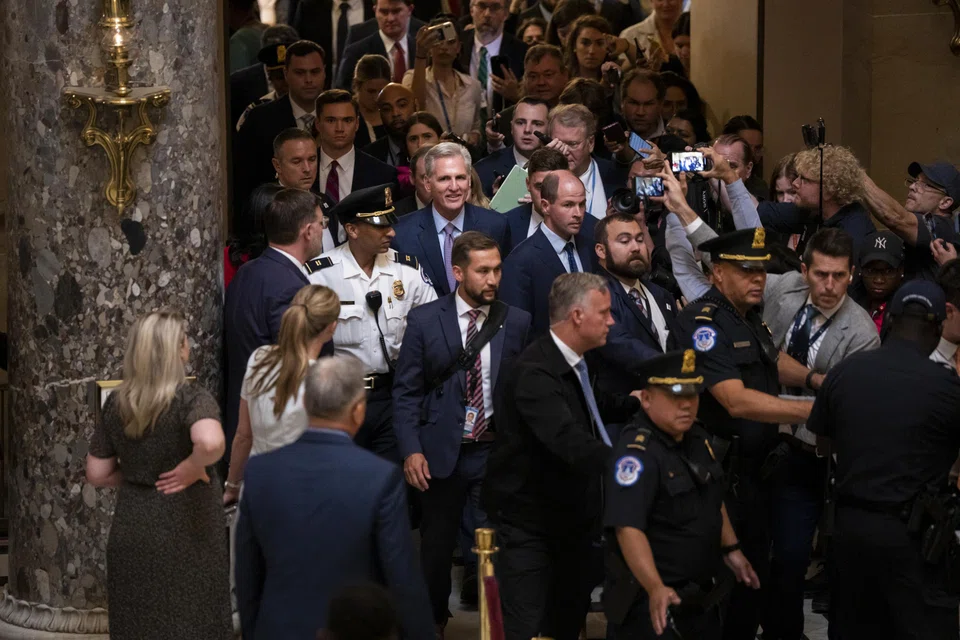
BACK in 2010, he was considered to be one of the rising stars in the Republican Party. Elected to the US House of Representatives from California’s 22nd district, Kevin McCarthy was hailed four years later as one of the party’s “Young Guns: A New Generation of Conservative Leaders”, that included Representative Paul Ryan, who went on to become Speaker of the House of Representatives.
But as Representative McCarthy and the Young Guns, who were seen as political disciples of former president Ronald Reagan and the darlings of the party’s establishment, were celebrating their rise in power in 2010, a new force of political hard-right populists was emerging in the Republican Party, in the form of the so-called Tea Party.
The members of this class of Republicans who challenged the basic tenets of Reaganism, advocating reducing the size of the federal government, ended up sweeping the ranks of the Grand Old Party (GOP) in Congress after the 2010 election.
Elected with the express purpose of sabotaging the gears of government, blocking legislation, and in a nutshell, stopping things from happening in Washington, the Tea Partiers were creating a sense of political chaos on Capitol Hill and pressing Representative McCarthy and other Republican leaders to cease cooperating with then-Democratic president Barack Obama or making any deal with the other side.
While initially the Tea Party was regarded as a challenge to Big Government and big federal deficits, its members gradually adopted a more populist agenda, embracing protectionism, rallying against free trade and foreign intervention, and calling for restricting immigration into the US.
Indeed, xenophobia and in some respects, racism, would become part of the ideology of these Republicans who would ally themselves with a then political outsider and New York celebrity – real estate executive and television host Donald Trump – and endorsed his allegations that former president Obama wasn’t born in the US but in Kenya and may have been a secret Muslim.
The Tea Party, in its new incarnation as the Freedom Caucus, emerged as a powerful force that defied the Republican Party’s establishment on numerous issues and helped change its ideological orientation.
And the GOP has steadily been transformed from a party committed to internationalist foreign policy, free trade, open immigration, and that was inviting to gays, Blacks, Hispanics, and Asian-Americans, into a political force drawn to isolationism, protectionism, and xenophobia.
It has become unwilling to reach bipartisan deals, especially when it came to approving the federal budget, even if that led to legislative deadlocks, an attitude that on some occasions resulted in the shutdown of the government and to threats to the financial credibility of the US.
The nomination of Trump as the GOP’s presidential candidate in 2016 marked the victory of the party’s rebels. As a candidate and later as US president, he reversed many of the party’s traditional approaches on domestic and foreign policies. Among other things, he called for the dissolution of Nato, picked up fights with America’s trade allies and partnered with Russia, the former Evil Empire.
The party of Ronald Reagan would become the party of Donald Trump, energising the populists and nationalists in the party while eroding the influence of traditional Reaganites, such as former presidential candidate and senator, Mitt Romney.
One of the first victims of these changes was House Speaker Ryan, who after growing weary from fights with President Trump and his supporters in the party, declined to run for re-election in the 2018 midterm elections, and was replaced in his position as House Minority Leader by his long-time political ally, Representative McCarthy from California.
The party’s Trumpists saw McCarthy as a member of the old establishment and didn’t trust him to advance their radical agenda. But the California congressman decided to try to work with them as well as with then-president Trump when he moved to run for the House Speaker position after the 2022 midterms.
But reflecting the opposition to him among members of the Freedom Caucus in the House, led by Representative Matt Gaetz from Florida, McCarthy succeeded in getting elected for the Speaker only on the 15th ballot.
Since then, the new Speaker has been performing a complex balancing act, initially joining the criticism of former president Trump for his conduct on Jan 6, 2021, and then implying that Trump was not responsible for what happened on Capitol Hill that day. Expressing support for most of the Trumpist agenda, he had hoped to win the hearts and minds of the Trumpists.
But after the Republicans lost the Senate and won the House by a narrow margin during the 2022 midterms, with most of the Trump-endorsed candidates losing their races, a weak Speaker McCarthy failed to provide the party with the cohesion and discipline they needed.
In a way, the last thing that Representative Gaetz and other Trumpists in the House were looking for was cohesion and discipline. Theirs was the strategy of chaos. Their goal was not to advance policy but to gain television time, dominate the social media and win support for the party’s pro-Trump electoral base.
From that perspective, the political drama that took place on Capitol Hill recently was waiting to happen. Speaker McCarthy continued his balancing act, promising cooperation to the Democrats but then started to advance a partisan legislative agenda, including by launching an impeachment inquiry into the Democratic president. He did succeed in averting a federal government default in May by making a deal with the White House – and then reneging on it.
More recently, McCarthy tried to pull the Republicans together to produce a spending bill, moving to pass a short-term spending bill through the House with the help of the Democrats that was then approved by the Senate, and avoiding a government shutdown at the last moment.
But that proved to be too much for Representative Gaetz, who triggered a “motion to vacate” that was supported by eight hardcore Republicans. The Democrats who could have saved Speaker McCarthy by voting against the motion decided that they had no interest in keeping him in his position and joined in supporting the vote to oust him.
All of that was happening at the same time that the Republican Party’s leader and most likely its 2024 presidential candidate, Trump, was sitting in a New York courtroom, on the opening day of the New York City civil case against him and his namesake company; and that in addition to the four other trials for criminal indictments that he is facing, and as he continues to argue that he had won the 2020 election.
But then, that a majority of Republican voters agree with the former president and are applauding the uncompromising position taken by the likes of Representative Gaetz, suggests that the party’s reign of chaos will continue for quite a while.
TRENDING NOW

Two Singapore-listed palm oil firms named in Greenpeace report on Indonesian plantation fires

Singapore Airlines flight returns to San Francisco after ‘unruly’ passenger incident

Singapore looking into which companies responsible for haze-causing fires: PM Wong

Deluge IPO 3.86 times subscribed ahead of SGX debut

