
Room for new ideas: Private-sector players eye opportunities in Singapore’s senior-living space
Options such as intergenerational co-living are emerging, but obstacles to take-up remain, say observers
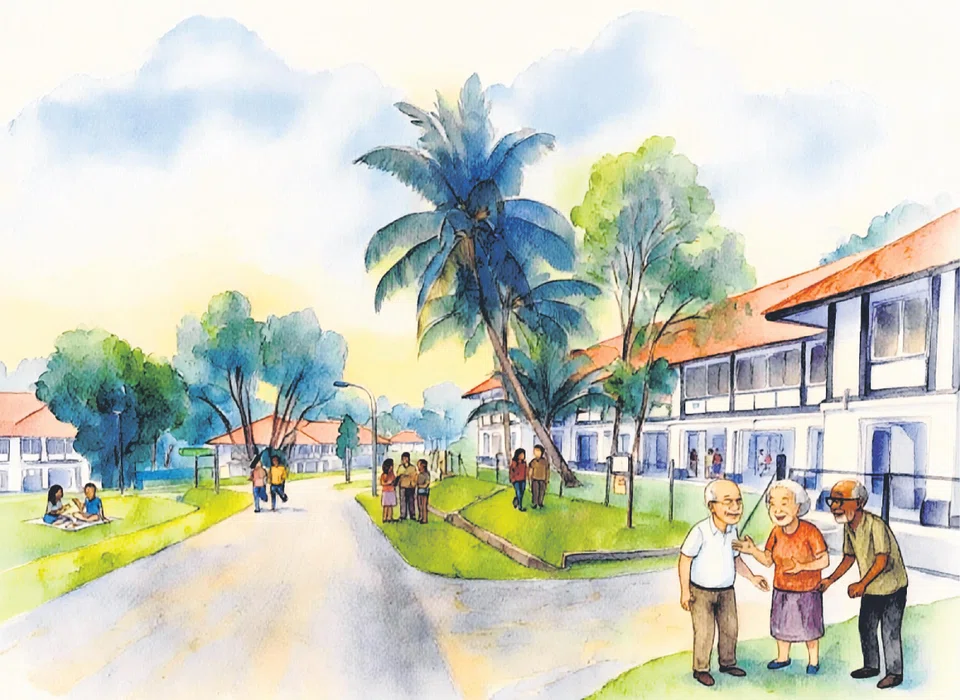
[SINGAPORE] As the Republic’s population ages, new private senior-housing models are emerging – including a recent project where colonial-era houses are being turned into serviced apartments.
Traditionally, Singaporeans have expected to grow old at home, whether alone, with their family or with domestic helpers. This remains the predominant expectation.
“Based on studies and public feedback, the majority of seniors prefer to age in their homes, where they can age actively, stay socially connected, and be cared for within their communities,” says the Ministry of Health (MOH) in response to queries from The Business Times.
To enable this, the government has increased community care options, adds MOH.
For seniors who do seek alternatives, new forms of public housing are available: Kampung Admiralty, which integrates flats for the elderly with community facilities; and community care apartments with assisted-living services.
Now, the private sector is also exploring assisted living and other models aimed at middle to high-income seniors.
Since 2024, the Singapore Land Authority (SLA) has allocated two land parcels for intergenerational co-living, where unrelated younger and older residents share community spaces.
The first state-owned property to be converted for this use was the site of the former Henderson Primary School. The new facility is called Commune@Henderson. The second such project is Admiralty Hills, a cluster of 20 black-and-white heritage houses in Sembawang.
“Both developments aim to support active and independent seniors who may consider co-living facilities on short-term and flexible arrangements,” SLA tells BT.
“They offer an independent living alternative for seniors who do not require medical care or mobility assistance, and who enjoy and can benefit from varied social interactions and community bonding.”
Hurdles to development
The Admiralty Hills tender was won by construction company Eco Energy, with a bid of S$56,000 a month.
“Tenderers were encouraged to propose concepts which provide senior-living accommodation with community programming, to support independent ageing and foster social connections,” says SLA.
It adds that bids “were assessed on the strength of their co-living models and placemaking proposals”.
Dr Sing Tien Foo, provost’s chair professor at the National University of Singapore Business School’s department of real estate, notes: “Operators that bid for this property would have to bring in new ideas that can be a proof of concept.
“This may be one objective of SLA. Rather than simply leasing based on the best price, they probably want to look at ideas.”
The project is due to open for rental in June, subject to clearance. Of the 20 houses, 18 are approved for serviced apartment usage and two for retail.
The residential houses are subdivided into studio apartments, with monthly rents of S$1,200 to S$2,400 for each unit. An entire house can be rented for S$10,000 to S$12,000 per month.
“When we tendered, we were also mindful that there are quite a lot of challenges we need to overcome to make this attractive for senior co-living,” says David Tan, general manager of Eco Energy.
Originally built in the 1920s and 1930s for British naval officers, the colonial properties all have staircases. Conservation guidelines limit the structural changes that can be made for barrier-free access, adds Tan.
Only three houses offer relatively flat access suited for tenants with limited mobility. Serviced apartments on the first floors of these will be set aside for seniors.
“Another challenge is that seniors prefer familiarity and convenience, which Admiralty Hills inherently lacks as it is not located near heartland amenities,” notes Tan.
“We will start to market this option carefully and modestly to seniors.”
Eco Energy plans to work with grassroots organisations in Sembawang GRC. Says the general manager: “Seniors within this constituency are more likely to consider Admiralty Hills as a co-living option.”
In any case, Admiralty Hills is not positioned for long-term stay. Tan expects two-fifths of tenants to be Singaporeans seeking transitional housing. They could include seniors – whose own homes might be undergoing renovation, for instance.
Another two-fifths are expected to be foreign professionals, with the remaining fifth being foreign students.
Seniors aged 60 and above form around 10 per cent of the tenant mix at Eco Energy’s other projects.
“Given the spacious location and the more affordable rates, I believe we can attract more than 10 per cent (to Admiralty Hills),” notes Tan.
No units have been retrofitted with amenities such as grab bars or anti-slip flooring yet, with these to be installed upon request.
This is a deliberate commercial decision, as visible eldercare fixtures could deter prospective tenants, he adds.
An earlier example
Commune@Henderson opened last June. A joint venture between developer TS Group and listed co-living operator The Assembly Place (TAP), it brings together seniors and foreign students.
This approach to fostering engagement “has to be curated”, says TAP chief executive officer Eugene Lim.
Seniors and students may have differing lifestyle preferences – such as bedtimes – and cultural practices, he notes. But, the inclusive space can also lead to interactions that both groups can benefit from.
In one initiative, senior residents get the chance to lead activities for youth with similar interests: for instance, a senior artist might hold calligraphy classes.
“We want our seniors to think that… they can share whatever they have learnt and somebody appreciates it,” says Lim. “And the young people look at the seniors and say… there are so many things they can learn from them.”
Commune@Henderson now houses about 200 students – mostly aged between 18 and 25 – from more than 20 countries. They stay on the second to fourth storeys, and occupancy is at around 90 per cent.
Most opt for a bed in a four-person room for S$1,028 per month, with a lease of six to 12 months. Single or twin studios are available from S$3,300 to S$4,100 each, with a similar lease duration.
The first floor houses 10 to 15 seniors, who pay S$4,500 to S$5,000 per month, inclusive of meals and some caregiving services.
Commune@Henderson aims to have around 30 senior residents by the fourth quarter of 2026.
The goal is to shift public perception of senior-living developments, says Lim. “This is an asset class on its own.”
He adds: “Sending our parents to a nursing home is still taboo in today’s society, unless there is really no other option.
“But if we can create a facility that a senior actively wants to go to… we hope that by 2030, this becomes a natural transition that removes the uncomfortable conversation between parents and children.”
How far can this go?
However, scaling up intergenerational co-living beyond these pilots may be tough. Observers say the biggest challenge is demand.
Professor Paulin Tay Straughan, the director of the Centre for Research on Successful Ageing at Singapore Management University, points out that research does show that there are benefits when people of mixed ages live together.
“Therefore, the million-dollar question is: Are the young and old willing to give it a try?”
She believes that Commune@Henderson works because the younger people are foreign students who are drawn by the relative affordability of the facility.
“But if you’re talking about young families buying a home or investing in (this option), I think you would be hard-pressed to expect them to want to move into a dedicated space where they have to co-share common spaces with older, unrelated persons.”
An alternative would be to pair those in their 70s to 90s with younger seniors in their 50s and 60s, rather than involving youth, she suggests.
The young are not the only ones who may be reluctant. Associate Professor Kelvin Tan, a gerontology expert at the Singapore University of Social Sciences, says another challenge is convincing seniors to take the leap.
Moving away from familiar surroundings requires seniors to carefully weigh the duration of their stay and underlying reasons for doing so, observes Prof Tan.
“Rationally, probably very few would do this,” he adds. “But there is a demographic of people seeking a temporary change, perhaps during a period of grieving.”
Commercial concerns
There are also other reasons for both tenants and operators to be cautious.
One is lease uncertainty. Prof Tan notes the short tenures of the pilots: five years initially, with the option to renew the lease for another four years, for Admiralty Hills; and four plus three years for Commune@Henderson.
“The uncertainty is always a challenge for business owners and that is passed on to whoever is going to stay there,” he says, adding that most seniors would likely want to avoid the stress of relocation.
As for operators, Wong Xian Yang, head of research for Singapore and South-east Asia at Cushman & Wakefield, says: “The projects can still be economically viable, though (shorter leases) might limit the amount of capital expenditure that operators would be willing to commit to the project as they would have to recover their fit-out costs over the lease period.”
Longer-term options
Co-living is aimed at independent seniors seeking short-term or flexible housing. The long-established option of nursing homes is for seniors with complex healthcare needs.
For those in between, there is assisted living, with private options on the rise.
“Different Singaporeans aspire for different lifestyles,” notes Prof Tan.
Emily Fell, senior director for living sectors within Savill’s Asia-Pacific capital markets team, says private assisted living fills “a specific gap for higher-income seniors who prioritise autonomy, service and high quality”.
The target market is upper middle-class to affluent seniors aged 70 to 85, or “sandwich generation” children who are willing to pay more.
She adds that assisted living also serves the “missing middle”: seniors who are too frail to live independently, but whose conditions are not acute enough for nursing home admission.
Last year, Singapore’s first private assisted-living development, Perennial Living, was launched with 200 fully furnished apartments.
Among the broader assisted-living options is shared stay-in senior caregiving services, where seniors share living quarters with staff who support them.
There are 56 such residences as at April 2026, says MOH.
These include units operated by Red Crowns Senior Living, across 33 public flats, two condominium units and one landed house.
For middle to higher-income families who do not qualify for subsidies, private assisted-living facilities can be cheaper than nursing homes, says Red Crowns’ chief care officer Phern Tan.
Private assisted living also has the advantages of higher care ratios and flexible visiting hours, she adds.
Most of Red Crowns’ Housing & Development Board units are five-room flats, with around six residents and two caregivers in each. Monthly fees range from S$2,590 for independent living to S$3,890 for residents who need cognitive care, such as those with dementia.
The social enterprise opened in 2021, and occupancy at its facilities hovers around 90 per cent. After adding two flats in 2025, it has been adding one or two flats each month since the start of 2026.
“I think the demand will always be there as family units become smaller,” notes the chief care officer.
Further expansion depends on the availability of units, she adds, “because not all landlords are very open to converting their (property) for assisted-living purposes”.
Another example is St Bernadette Lifestyle Village, which runs assisted-living facilities across eight locations, housing around 100 seniors. It has an average occupancy rate of 80 per cent.
This year, it plans to add four units at its Temasek Polytechnic facility and possibly a five-room flat in Choa Chu Kang.
For assisted living, monthly fees range from S$3,000 to S$6,000, inclusive of rent, meals and some caregiving services. St Bernadette also has a separate nursing home, where monthly fees range from S$4,200 to S$6,200.
“Assisted living provides socialising opportunities which living alone or with a helper does not afford,” shares Dr Belinda Wee, co-founder of St Bernadette Lifestyle Village.
Structured companionship in such facilities “significantly helps stave off loneliness and depression”, she adds.
Both operators have seen an uptick in inquiries from childless seniors. But demand remains driven by family members, many of whom live overseas or prefer the concierge service offered by assisted living.
Attracting capital
Ultimately, senior housing is relatively niche, says Fell of Savills.
She attributes this partly to Singapore’s “heavy reliance on domestic helpers as a cheaper care alternative”.
She argues that for private senior-housing models to become a mainstream alternative asset class, there must be clearer planning of use classes; incentives for public-private partnerships such as healthcare-linked housing; and subsidies.
“The demand fundamentals are clearly there given the demographic trends, but for it to institutionalise as an asset class, the market needs clearer pricing benchmarks, scalable operating platforms and greater policy clarity.”
Greater yield clarity is needed to attract investors, as there is currently “too much variability in operating markets with no consistent benchmark”, she adds.
For private assisted living, investors typically seek stabilised and risk-adjusted yields of around 5 to 7 per cent for core-plus capital, she points out.
This falls between “higher-risk and higher-yield” nursing homes, and community care apartments that are driven by policy rather than yields.
Operators that have replicable models and are integrated into the healthcare systems could attract investments to the sector, says Fell.
Still, even if this becomes a recognised alternative asset class, it will likely stay mid-sized as “Singapore will always anchor care provision in the public system”.
Wong of Cushman & Wakefield says that for intergenerational co-living to become a mature, investable asset class, “investors would need to see sustained occupancy rates, clear pricing power and evidence of market liquidity”.
He adds: “Investors would also need to understand the achievable yields and whether there is sufficient market depth, currently or in the future, to support an eventual exit.”
But these senior-housing models have significance beyond commercial viability, say academics.
“The core discussion should not merely be about commercial worth, but rather alternative value measurements,” says Associate Professor Jawn Lim, from Singapore Institute of Technology’s business, communication and design cluster.
There can be value in peer-support networks for the elderly, or even if there is a reduction in emergency or nuisance calls, he adds.
MOH says it will continue to ensure a range of housing and care options for seniors, “taking into account their long-term care needs, preferences to age in place and Singapore’s land constraints”.
Prof Straughan sees a “clear need” for senior-targeted alternatives, adding: “Without conscientious planning, all of these needs will fall on the state and that’s when healthcare costs will go up.”
“Rather than mass-producing options, we should approach ageing with grace, which means (creating) opportunities for variety.”
TRENDING NOW
Fed hike throws Singapore banks a margin lifeline; UOB most likely to feel impact
He built the Vingroup empire. Now South-east Asia’s richest man is handing some key roles to his sons
Real-estate veteran Desmond Sim quits from CEO roles at Realion, ETC
Chagee, Mixue and Luckin won the market. Sustaining their edge is the harder part



