

Rooting out the scam scourge in South-east Asia
Beyond physical raids, can authorities successfully target the finances of syndicates based in the region?


[SINGAPORE] In the past year, every day, Cambodian authorities inspected 78 suspected scam centres and raided two on average. In Laos, officials carried out seven such operations per month in the first half of this year. Over five days in June, Timor-Leste police hit three scam farms.
Yet, for all these crackdowns, South-east Asia’s multibillion-dollar cyberscam industry has proven remarkably resilient. After the dismantling of one scam centre, two more may emerge – under different guises and in different jurisdictions.
Where raids fall short, the solution may lie in clogging the financial plumbing of these illicit networks instead, say analysts.
“Defenders are now focusing on where it hurts criminals more: their finances,” says Aaron Bugal, field chief information security officer for the Asia-Pacific and Japan at cybersecurity solutions provider Sophos.
He expects that targeting monetary flows will eventually be “the only way to deter those who want to take up a criminal operation”.
The tactics that make scam groups so immune to physical raids – dispersion, decentralisation and diversification – may prove less effective against financial efforts.
Dispersion: where they operate
Dispersion involves physically relocating operations, while preserving management structures, financial networks, capital and equipment.
Analysts identify four broad trends.
First, operations are spilling out of the Mekong region – Cambodia, Laos, Myanmar, Thailand and Vietnam – and into maritime South-east Asian countries such as Malaysia, Indonesia, the Philippines and Timor-Leste.
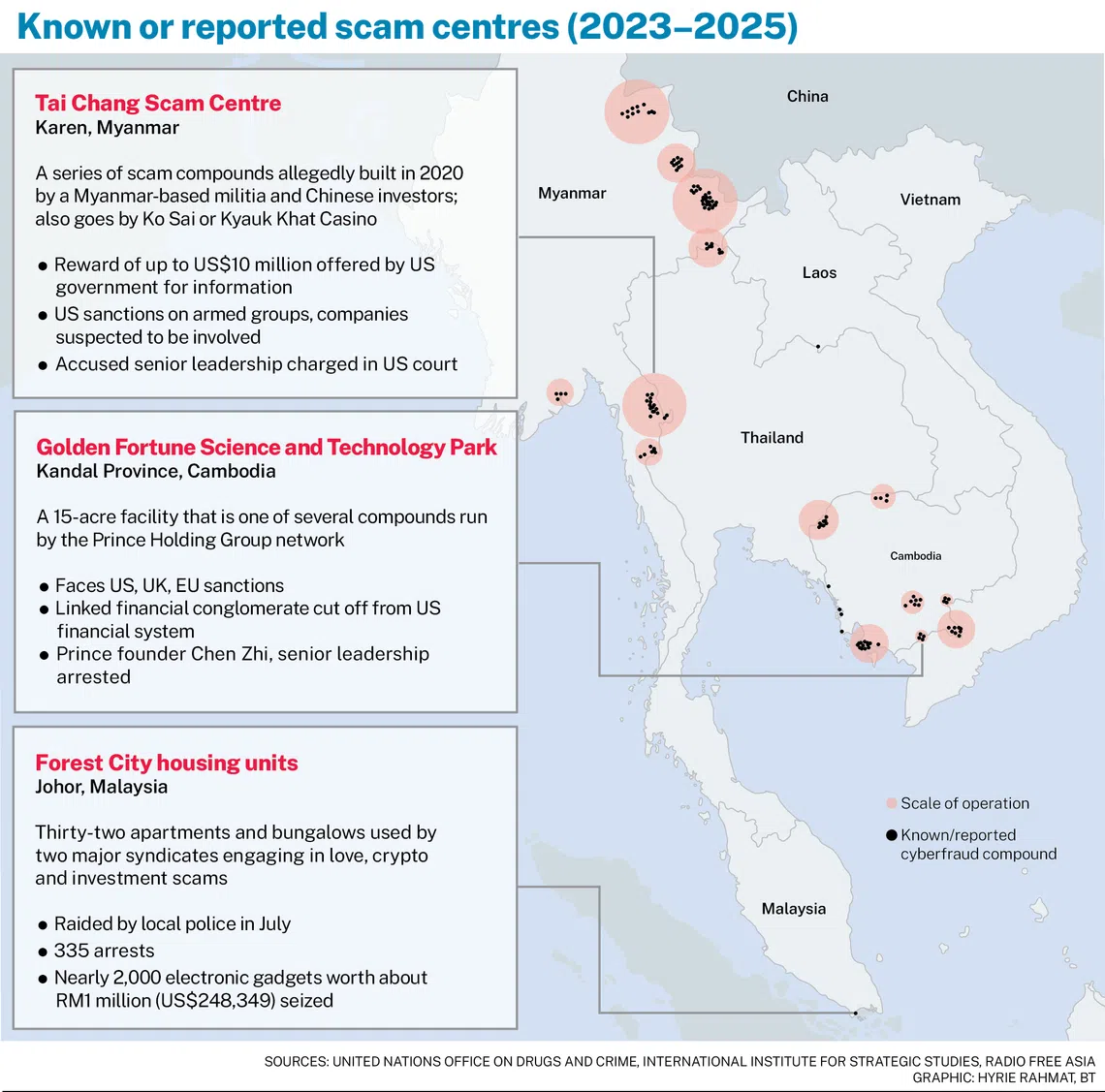
Second, instead of standalone compounds, operators are opting for more inconspicuous settings such as apartments, offices, hotels and luxury residences. Scam bases hit in recent raids include housing units in Malaysia’s luxury waterfront estate Forest City and a hotel in Timor-Leste’s Oecusse enclave.
Noting that Forest City sits within the Johor-Singapore Special Economic Zone (SEZ), Aizat Shamsuddin, founder and executive director of the Malaysia-based Initiative to Promote Tolerance and Prevent Violence, says that SEZs attract cyberscam syndicates for the same reasons they appeal to legitimate investors.
“SEZs remain particularly vulnerable because of eased visa arrangements, easier access to property and weak scrutiny of the sources of investment funds,” he explains.
“The pressure to attract foreign investment and expatriate residents can also create regulatory blind spots and weaken preventive enforcement.”
Third, growing vigilance in hot spots is forcing some operators out of border towns into quieter areas – a trend highlighted by both Aizat and Cambodian activist Mu Sochua.
Mu, a former minister who now lives in the US, tells The Business Times: “Within Cambodia, there is now growing evidence that operations have moved from the previously concentrated hubs of Sihanoukville and Kampot towards more remote areas, including settlements in and around the borders with Laos and Vietnam.”
Fourth, some players are expanding out of South-east Asia into the Pacific, the Middle East or Africa, while maintaining regional command structures in Cambodia, Laos and Myanmar.
Decentralisation: how they organise
Another evasion tactic is decentralisation: distributing criminal tasks, capital, infrastructure, and “foot soldiers” in different nodes.
Instead of concentrating operations in a single fortified compound, syndicates may spread their workforce across resorts in Cambodia, jungle compounds in Myanmar, or apartments in Malaysia, says Jason Tower, a senior expert at the Geneva-based non-governmental organisation Global Initiative Against Transnational Organized Crime.

“They’re very spread out, and they’re relying more on a network modality where they’re carefully communicating with one another, coordinating work across borders,” he tells BT.
Tower notes that with decentralisation, syndicates retain economies of scale but gain some immunity to law enforcement operations that are often on a country-by-country basis. They have generally diversified their risk enough that a raid in one territory is unlikely to make much of a dent in overall operations, he adds.
Mu also points out that decentralisation allows for individual compounds and low-level managers to be sacrificed without disrupting the wider business model.
Diversification: how they operate
Another tactic involves diversified operating models, which Tower has seen in Myanmar.

One structure involves massive border compounds that may house more than tens of thousands of scammers. These face intense scrutiny from international law enforcement, as illustrated by the US State Department’s April offer of up to US$10 million for information on a series of scam compounds, collectively known as the Tai Chang Scam Centre, located along the Burmese-Thai border.
Such efforts flushed these compounds further inland and dispersed them, giving rise to the second model that started to proliferate between late 2024 and early 2025: relatively smaller scam farms spread out across the country, each some 3,000 to 5,000 people strong.

The third model, which Tower calls “scams 3.0”, involves even smaller syndicates set up in remote jungle locations. They use satellite Internet communications and modular set-ups that let them establish makeshift worker camps in days.
Describing their synergies, he says large border compounds “provide more of the scam-adjacent service offerings: money laundering, entertainment, technology, sales, logistics”.
Smaller inland compounds, which allow groups to consolidate a large workforce feature “a lot of the forced criminality” – human trafficking victims coerced into scamming others.

Meanwhile, jungle bases are very hard to detect and can be redeployed quickly if spotted.
Aside from evasion tactics, analysts have identified structural factors that enable syndicates to regenerate with ease.
Crackdowns by authorities have undoubtedly raised operational costs for scam syndicates, says Mu. “But they have not fundamentally altered the incentives of structures that allow the industry to regenerate elsewhere at speed.”
Raids target the front-facing aspects of the scam industry: destroying compounds, rescuing trafficked individuals and arresting foot soldiers, she adds.
Corruption is another structural factor that analysts cite for scam networks’ resilience.
Aizat notes that syndicates may offer bribes in exchange for protection, advance warning for raids, leaked intelligence, interference with investigations or the dropping of charges.
“Weak governance and anti-corruption systems allow (graft) to operate on a much larger scale and reach senior levels,” he says. In such a system, scam operators could become more impervious to law enforcement action.
Blockchain networks
On the digital front, cyberscam operators are using cryptocurrencies to shift funds.
Research by blockchain data platform Chainalysis shows that blockchain-based money laundering tactics are now being used alongside traditional methods such as real estate investments, according to head of investigative strategy and collection Peh Xue Yin.
The so-called “on-chain” money laundering ecosystem grew to more than US$82 billion in 2025, from some US$10 billion in 2020; Peh attributes this largely to the emergence of Chinese-language money laundering networks. These networks now account for an estimated one-fifth of all known crypto laundering activity.
Peh notes that cryptocurrency might be traded at informal over-the-counter desks that lack know-your-customer (KYC) checks, as well as on black markets and online gambling platforms.

Anchoring these money laundering networks are “guarantee platforms” – online communities, largely based on Telegram, that serve as illicit escrow-backed marketplaces for fund transfer and money laundering services, and also provide cybercriminals with the software, data and scripts needed to carry out scams.
To make matters worse, these platforms adapt well to disruption.
Xinbi Guarantee, which has processed about US$24.2 billion since it emerged in 2022, was slapped with sanctions by the UK in March. But when Telegram removed its channels, the marketplace swiftly moved to another messaging platform, SafeW, and launched its own payment app there.
Peh says that criminal networks must be prevented from accessing funds across all asset types – which requires closer collaboration among different financial providers.
“Blockchain technology firms, cryptocurrency exchanges and stablecoin issuers each hold critical pieces of the picture,” she says.
The most impactful disruptions to scam operators’ financial networks that Chainalysis has observed came when these players were able to share financial intelligence with law enforcement agencies in a coordinated and timely way.
Notably, fintech firm Tether froze US$225 million of its US dollar-pegged stablecoin in 2023, after a joint investigation with the US Department of Justice and crypto exchange OKX revealed alleged links between affected cryptocurrency wallets and a South-east Asia-based human trafficking syndicate behind international love scams.
Follow the money
While raids alone may be of questionable efficacy, South-east Asia is finding some success in choking off the financial flows to fraud factories.
Compared with changing operating models and methods, scam groups find it harder to switch up the financial infrastructure they use: money-mule networks, shell companies, cryptocurrencies, bank accounts and payment gateways.
Bryan Keasberry, Asia-Pacific head of market development at finance software firm Fenergo, argues that by making it harder, slower and more expensive for criminal enterprises to access scam proceeds, financial institutions can squeeze the very margins that make the trade so lucrative.
Anti-money laundering efforts and KYC processes could thus play a critical role in targeting the business models of cyberscam operations, he says. Artificial intelligence can help by providing the scale, speed and depth needed to flag increasingly sophisticated attempts to move illicit funds.
Another advantage of AI-led systems, he adds, is their ability to connect seemingly innocuous activity across hundreds or even thousands of accounts – patterns that may be invisible in isolation.
Beyond the formal banking system, illicit platforms for cryptocurrency laundering such as guarantee marketplaces host much of criminal networks’ monetary flows. But Sophos’ Bugal argues that these key financial choke points have barely been addressed regionally.
He believes that the technology needed for more effective crackdowns already exists, but “the will and drive might not”.
What success looks like
At the end of the day, analysts say a multi-pronged approach is needed to take down the scam scourge, with cooperation both across borders and between the private and public sectors.
To take down the Cambodia-based Prince Holding Group – a business conglomerate accused of running a transnational fraud network and operating scam compounds – the US, UK and EU imposed financial sanctions; the US and UK also seized billions of dollars in Bitcoin and other assets.
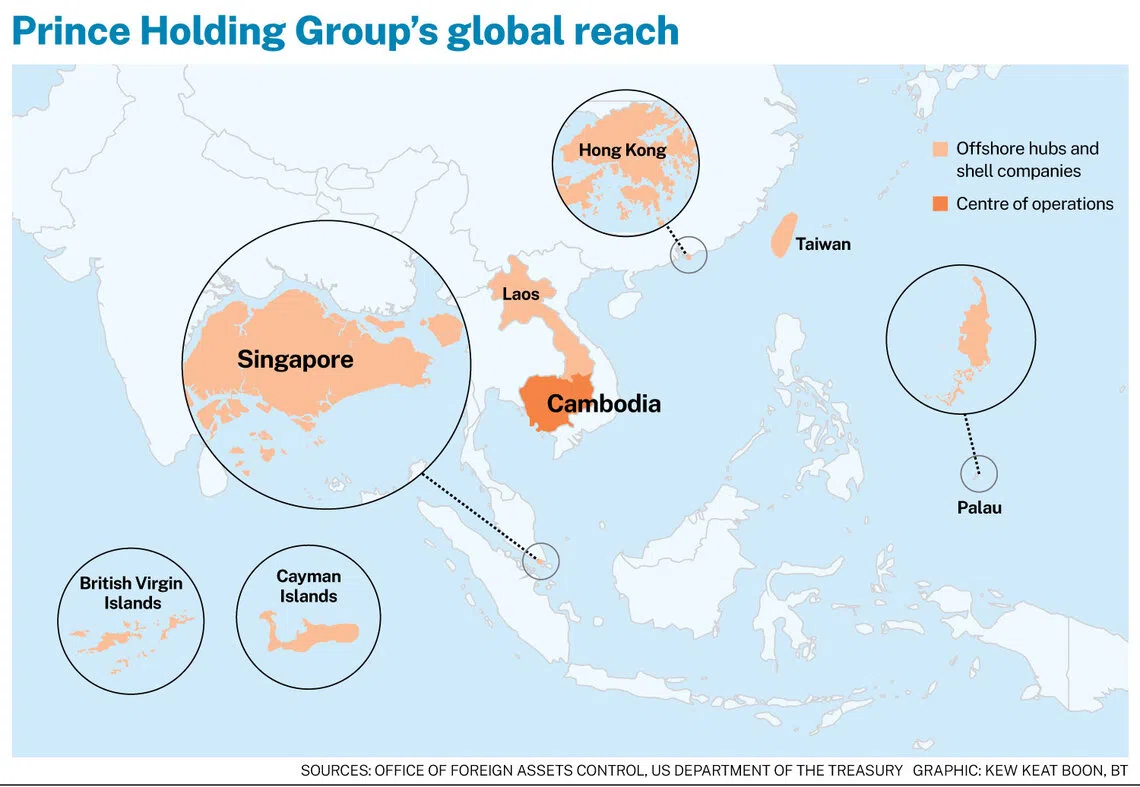
Huione Group, a Cambodia-based financial conglomerate accused of serving as a critical node for laundering proceeds of cyberscam syndicates such as Prince, was cut off from the US financial system.
This penalty triggered the collapse of a suite of financial entities – which operated a guarantee platform, digital payment and banking app, and virtual currency exchange platform – and choked off the flow of billions in illicit proceeds.
Law enforcement remains essential to combat scams, as do financial intelligence and other technical measures, says Asean Foundation’s executive director Piti Srisangnam.
But he also notes that education can further complement these efforts by equipping the public with the skills to detect warning signs of scams, as a first line of defence.
The foundation has launched a regional initiative aimed at not only raising public awareness of scams, but also heightening cooperation among governments, banks, tech companies, telcos, community groups and other sectors.
Dr Piti tells BT that a regional approach will allow South-east Asia to build a more coordinated response to a problem that does not stop at national borders.
In Tower’s view, a successful anti-scam effort requires governments to take ownership and dictate the pace of the response, rather than acting only under external influence.
Mu also argues that Cambodia must disrupt the political, financial and institutional structures that have long allowed the industry to thrive.
“This,” she says, “means holding not only compound operators, but politically allied facilitators and financiers to account.”
TRENDING NOW

DBS, OCBC, UOB rout lops billions off STI as inflation, rate concerns spook investors

Grab CEO’s wife Chloe Tong on life with Anthony Tan and finding her purpose

OCBC sheds S$8 billion in value as shares close nearly 6% down; analysts cautious on banks

Deal between tycoon friends sparks scrutiny of Philippine power sector

