

Second Trump stint in White House would see return of his vindictive economic policy
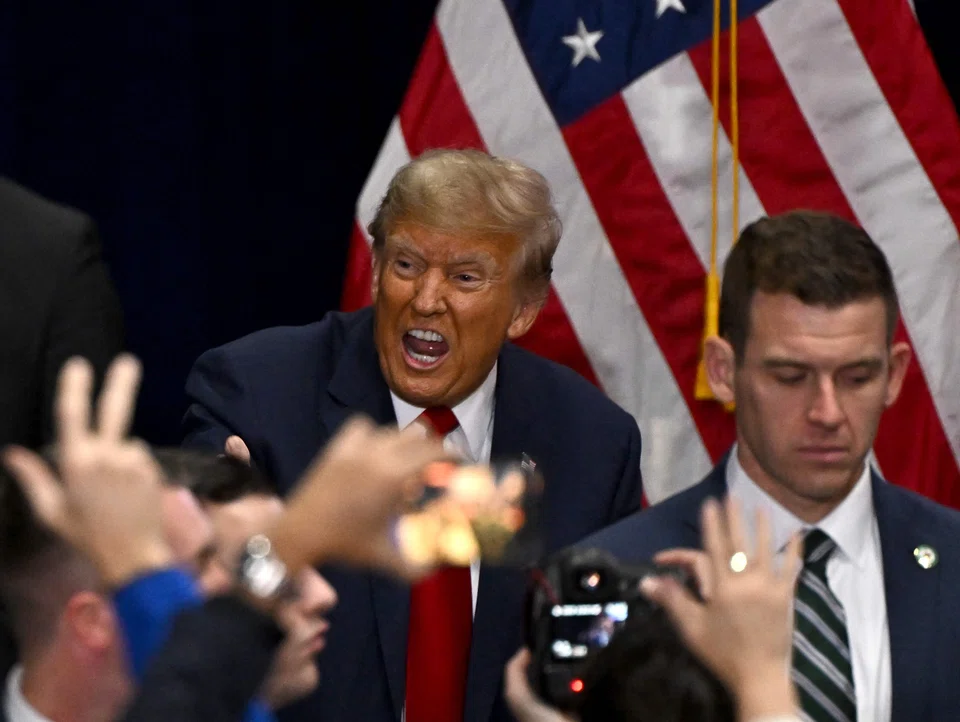
MANY political analysts see the United States sleepwalking towards a second Donald Trump presidency later this year, something that they say will place American democracy and global economic growth in serious jeopardy.
Economic policy is one of the few things that are predictable when it comes to Trump, the 77-year-old who is on course to secure the Republican Party’s nomination for the US presidential election in November.
On Monday (Jan 15), Trump clinched a resounding victory in the first 2024 Republican presidential contest in Iowa, a result that gave him greater command over the party, even though he faces numerous criminal charges ahead of an expected election rematch with President Joe Biden.
Clear battle lines
In this economy policy sphere, the battle lines are clear. Trump – who served four tumultuous years in his first term until January 2021 – would likely wage an all-out economic war on China and his predecessors in the interest of US corporations, oil drillers and wealthy individuals.
Biden, however, would likely continue with his current stance of maintaining a cold economic war with China, experimenting with sustainable economics and funnelling stimulus to the middle class.
Trump is known for being embittered against the Biden administration, and has vowed vengeance for his electoral and legal humiliation since he lost to Biden at the last election in November 2020.
Vindictive economics is nothing new to Trump. Until the onset of the Covid-19 pandemic in early 2020, the first Trump administration’s economic policy was largely a systematic dismantling of the work done by his predecessor Barack Obama.
Laissez-faire policy
Fast forward to the present, and where Biden has sought to strengthen antitrust enforcers at the Federal Trade Commission, Trump will weaken them. And where Biden has done much to police bank activities more tightly, Trump will set Wall Street loose. Where Biden has sought to tax the rich, Trump will instead lighten their financial burden.
“A Republican administration would typically be more laissez-faire than a more regulatory oriented Democratic one,” said JD Joyce, president of financial advisory Joyce Wealth Management.
“While there could be major differences in tax policy if a Democrat is elected or re-elected, it’s fairly likely you’re going to see higher taxes.”
On taxes, Trump’s strategy has always been brutally simplistic. He will cut taxes until the cows come home. Unlike other Republican politicians, the Trump administration never even pretended to balance the books.
For years, Republicans criticised Obama, Biden and other mainstream Democrats as “tax-and-spend liberals”. Under Trump, however, they became “don’t-tax-and-still-spend populists”.
The major tax cuts that Trump instituted during his last administration will be enshrined in US law forever if he regains power. Biden, on the other hand, is likely to allow those cuts to elapse, at least for the wealthiest – who were by far the largest beneficiaries.
Incentives for energy production
On energy policy, it is a similarly stark choice for voters. In his first term, Trump defanged the Environmental Protection Agency, which Obama had equipped to lead the US emissions-control effort. If Trump has a second term at the White House, he is likely to exert much of his executive power to roll back incentives for electric vehicles (EVs) and solar power.
By incentivising more energy production, Trump sees a chance to stoke chest-thumping patriotism. The US is already producing more oil and natural gas than any other country in history, thanks to the powerful, mile-long “straws” that energy companies have succeeded in placing under the earth in regions such as the Permian Basin in West Texas, vacuuming up carbon liquids long thought to be out of the reach of mankind.
Trump may open up more federal lands to this enhanced oil recovery. He is also likely to throw the government’s weight behind proposed marriages such as ExxonMobil’s multibillion-dollar acquisition of Permian Basin leader Pioneer Natural Resources.
In contrast, the Biden administration has laid the groundwork for a global carbon market, one that could make it financially lucrative for major manufacturers to convert to carbon-neutral business practices or to invest in “offsets” – carbon-neutralising projects outside their spheres of business.
Trump will almost certainly try to undermine that burgeoning market. Following the Obama administration’s role as an architect of the deal, Trump pointedly quit the Paris Agreement, which sought to make climate change a matter for global treaties rather than national economic policy.
EV adoption has stalled in the US, a development that lends itself to Trump’s brand of mockery as political rhetoric. Massive tax credits and price cuts by Tesla and others have not been enough to conquer “range anxiety”, as most Americans have the impression that their freedom would be curtailed by the limited number of charging points for EVs.
For a cynic like Trump, it will be easy to push the argument that there is no future for electric cars if years of hefty incentives and mass marketing campaigns have failed to spur widespread adoption.
Of course, the adoption of new technologies never happens in a straight line; the only thing that could stop the gradual but inevitable shift to electric cars might be short-sighted economic policy.
Populist measures
Both the Trump and Biden economic teams employ “handouts” to bolster their popularity among voters. What was once frowned upon as reckless use of government funds is now de rigueur.
The Biden administration’s populist measures have sought to pinpoint the have-nots rather than the haves. Since Biden took office in January 2021, many municipalities have launched universal basic income programmes.
Should he win a second term and carry with him a congressional majority, Biden might make another attempt at expanding federal welfare payments to those below the poverty line. Failing that, he is likely to expand other fiscal stimulus programmes targeting the lower and middle class.
“Biden continues to find loopholes in student loans,” said Quincy Krosby, chief global strategist at brokerage LPL Financial. “What he suggests to the electorate is: ‘I’m going to keep doing this for you.’”
The Biden administration has sought to keep petrol prices affordable by drawing down the Strategic Petroleum Reserve and pressuring Saudi Arabia and others to increase their production.
It is clear that Trump’s policies would do long-term damage to the outlook for global growth, if only because it would hasten climate change. Biden’s tax policy could cause a hit to Americans’ wallets, which would otherwise make it worse for the global economic outlook in the short term.
China dilemma
The wild card, however, is the next US leader’s policy on China. There is a complex balance of preventing Beijing from stealing a march on the development of generative artificial intelligence technology while keeping trade between the world’s two largest economies flowing.
This is a perfect assignment for the wonks and career diplomats that comprise the Biden administration. The kooks and extremists that Trump surrounds himself with would almost certainly barrel into this new tech cold war with policies that hurt China, the US and the rest of the world.
And that is if American democracy does not collapse into civil strife should Trump be re-elected, as some strategists fear could be the case.
TRENDING NOW

Once staunchly pro-China, Malaysian Chinese businesses are now distancing themselves from Beijing

Britain’s mansion tax shows the difficulty of targeting wealth

Three hats, one goal: How Ng Kian Swan runs sustainability at NUHS
COE review: The gap between luxury and mass-market cars isn’t the only one worth bridging

