

Shooting jolts US presidential race
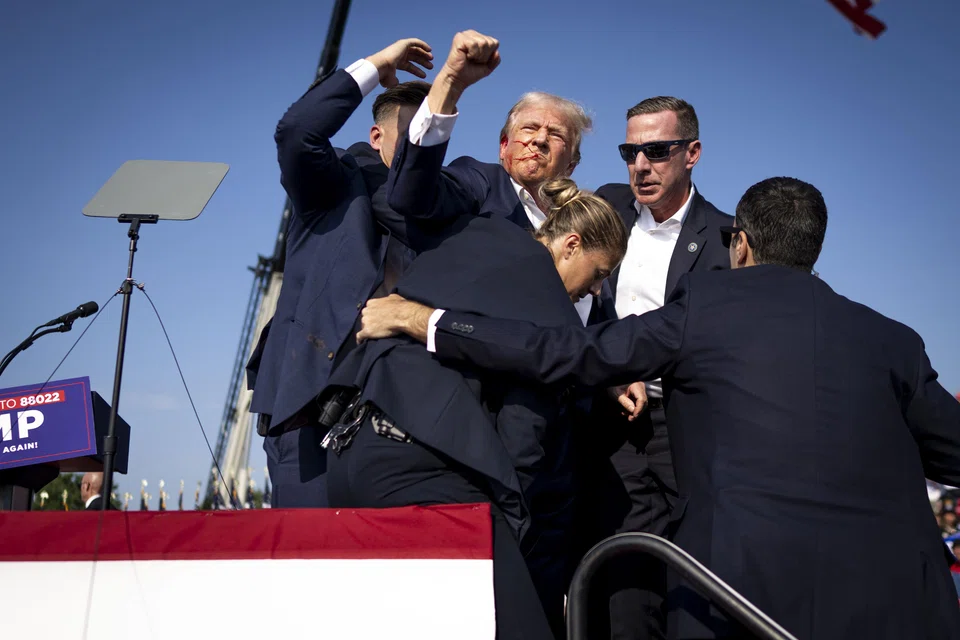
A bloodied Trump pumping his fist becomes a defining image of the election
ON OCT 14, 1912, former US president Theodore Roosevelt was campaigning for the presidency in Milwaukee, Wisconsin, when an assassin shot him. A bullet lodged in Roosevelt’s chest after penetrating his steel eyeglass case and passing through a 50-page copy of his speech, folded over twice in his breast pocket.
Roosevelt then assured the crowd he was all right, and ordered police to take charge of his assassin and make sure that no violence was done to him.
“Friends, I shall ask you to be as quiet as possible,” he told his enthusiastic, if shocked, supporters. “I don’t know whether you fully understand that I have just been shot, but it takes more than that to kill a Bull Moose.” (The Progressive Party that candidate Roosevelt led was popularly nicknamed the Bull Moose Party.)
Although he was injured, he continued speaking and delivered his speech before being taken to the hospital.
One-hundred-and-twelve years later in Butler, Pennsylvania, another former president campaigning for the presidency was also shot by an assassin. He was addressing the crowd when, amid an ensuing cacophony of gunshots, screams and chaos, he suddenly put his hand to his right ear – the upper part of which was grazed by a bullet. He ducked, crouching to the ground.
Moments later, former president Donald Trump – his white shirt undone, blood streaking across his face – was back on his feet, surrounded tightly by a scrum of Secret Service agents.
As they pressed their bodies against his, Trump raised his right fist defiantly and mouthed, “Fight! Fight! Fight!”, with the crowd responding in chants of “USA! USA! USA!”. Trump then lifted his arm higher, and pumped his fist in the shadow of an American flag.
After arriving at the hospital, Trump immediately put out a statement thanking the Secret Service, expressing his condolences to the other victims, and recounting the moment on social media.
“I knew that something was wrong in that I heard whizzing sounds, shots, and immediately felt the bullet ripping through the skin. Much bleeding took place, so I realised then what was happening. GOD BLESS AMERICA!” he wrote.
The former television talk show host demonstrated once again – and in what may be one of the most dramatic moments in recent American history – that he was a master of contemporary media.
In a way, the image of that moment – of a bloodied Trump pumping his fist – would probably become iconic in the long run. And in the short run, it could upend an already turbulent race for the White House.
Indeed, contrast these two scenarios: Former president Trump, having just survived an attempted assassination, projecting a sense of power and strength, arriving at the Republican National Convention in Milwaukee, Wisconsin, announcing his running mate, and unifying his party and nation behind him.
And then there is President Joe Biden and his halting presidential debate performance, exuding fraility and a sense of cognitive decline, if not incompetency altogether, raising questions about his ability to run an energetic campaign, let alone do the job for four more years. And facing mounting calls from Democrats and party supporters to withdraw from the race and be replaced with a younger candidate, plunging the party into turmoil.
A Democratic narrative of disarray compared with the new Republican narrative of unity.
Allies of Trump are already accusing Biden and his supporters of using rhetoric that led to the assassination attempt in Butler, Pennsylvania.
Senator JD Vance, a Republican of Ohio and a leading contender to be Trump’s running mate, said in a post on social media that the shooting was “not just an isolated incident”, claiming that the Democrats’ rhetoric depicting Trump as “an authoritarian fascist” led directly to the attempted assassination.
Biden and other leading Democrats condemned the shooting and called the nation to unite against political violence.
And the Biden election campaign decided to pause commercials that included attacks against Trump. They have yet to come up with a new campaign strategy, and are probably waiting for the results of new opinion polls gauging how the shooting may have affected the presidential race.
Even before the Jul 13 assassination attempt, there were clear signs that in the aftermath of a disastrous debate performance, Biden was trailing Trump both in national polls as well as in races in key electoral states, such as Pennsylvania, Michigan, Arizona and Nevada.
In fact, the polls suggested that Biden’s position was precarious even in “purple” states, such as Virginia, New Hampshire and Maine, that the Democrats were counting on winning in November.
The conventional wisdom is that this trend would probably accelerate in the aftermath of the assassination attempt, and that a resurgent candidate Trump would now be in the position to win the support of many independent voters – and even of Republicans who had been reluctant to vote for him.
The possible good news for Biden is that the Democratic leaders who were considering challenging him may now be unlikely to do so as they expect a victory by Trump – perhaps even by a landslide – in November.
TRENDING NOW

ComfortDelGro appoints two new independent directors

Once staunchly pro-China, Malaysian Chinese businesses are now distancing themselves from Beijing

NoonTalk needs continued financial support from CEO Dasmond Koh, auditors warn

DP Architects sets the benchmark for sustainability disclosure and design

