Should stock market indices represent the market or the economy?
While the Hang Seng expands to mirror Hong Kong’s economy, the Straits Times Index narrows its focus, raising questions about the purpose of a national index
USING an index to represent a large universe is widely accepted as a simple means of understanding how that universe behaves.
The consumer price index, for example, places common goods and services that resident households commonly purchase, such as utilities, food and transport, into a basket. Then, as the value of the basket moves up or down, inflation is said to rise or fall.
That much is straightforward. Yet, when it comes to constructing indices to represent the stock market, things are not so simple, with the biggest problem being whether an index should represent the market or the economy.
This is apparent in the case of the Straits Times Index (STI), which started in the 1960s as the simple price-weighted Straits Times Industrials Index (STII) with 30 components that were selected to represent the economy. At the time, these were mainly manufacturing-based.
In 1998, the word “Industrials’’ was dropped, the three banks were brought in, and the STII became STI. The thinking then was to move the index away from reflecting the economy to representing the market instead.
Market capitalisation replaced price as the weighting method; the index was expanded to 55 stocks; and a new requirement of liquidity was introduced to reflect market interest.
Most notably, the revamp coincided with the entry of the Jardine stable of companies, which had exited Hong Kong following the 1997 British handover to China, and whose main businesses are outside Singapore.
Initially, only Jardine Matheson Holdings was included, but by 2018, four other Jardine companies were in the STI – Jardine Strategic, Jardine Cycle & Carriage, Hongkong Land and Dairy Farm International.
In time, more non-Singaporean companies such as Thai Beverage, Emperador and Yangzijiang Shipbuilding were included, though Philippine company Emperador was dropped last year.
Between 1999 and 2003, the most obvious victim of the market cap and liquidity requirements was the hotel sector, which was – and still is – a mainstay of the local economy, but not of the market.
So, Shangri-La, Hotel Properties Limited, OUE and Marco Polo Developments were gradually phased out of the original list of 55 companies, for failing to satisfy either the market cap or liquidity requirement, or both.
Another sector to suffer from the new criteria was manufacturing, which saw then illustrious names such as Chartered Semiconductor and Creative Technology depart the index. Today, only Venture Corp remains as the sole true representative of this important sector of the local economy.
In 2008, the size of the STI was reduced to 30. Having fewer components inevitably led to stocks with large market caps dominating. Unsurprisingly, the three biggest constituents – DBS, UOB and OCBC – have been the prime index drivers for several years now.
But are the three banks truly representative of the local economy, which is largely composed of thousands of small to medium-sized enterprises and for which hotels and manufacturing are significant?
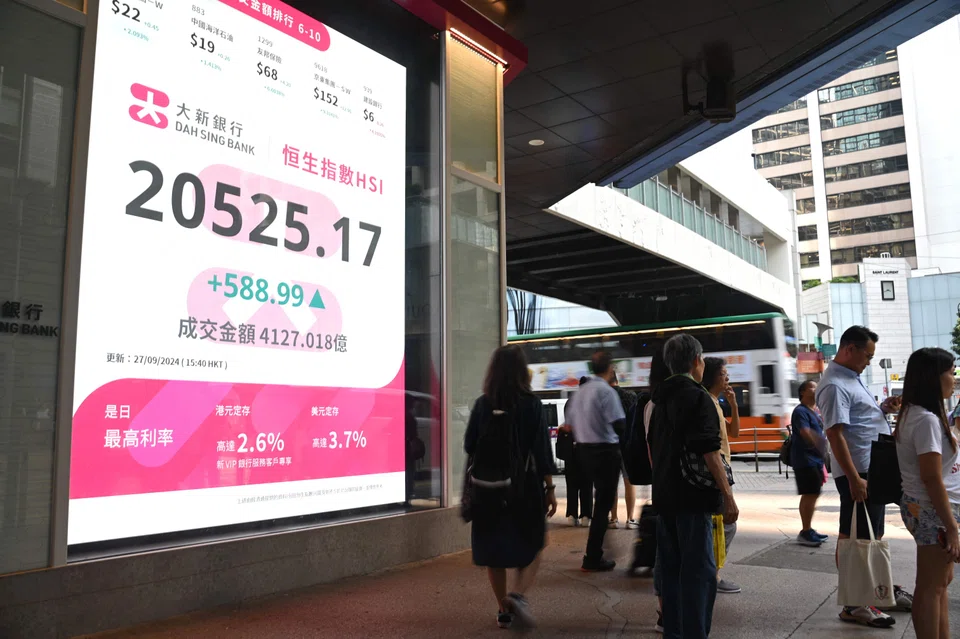
Over in Hong Kong, the Hang Seng Index was revamped in 2021 to reduce the influence of the banks by limiting the weighting of each stock to 8 per cent. The revamp also sought greater sector – and therefore economic – representation by expanding the index’s size from 52 to 80 constituents and eventually 100.
Clearly, Hong Kong’s aim was for its index to represent the economy. For now, the STI is more a benchmark for the market than the economy. It will certainly be interesting to see if this will ever change.