The Silicon Valley-Singapore bridge: bringing AI to the world
The moment to define the next decade of artificial intelligence deployment in Asia is now
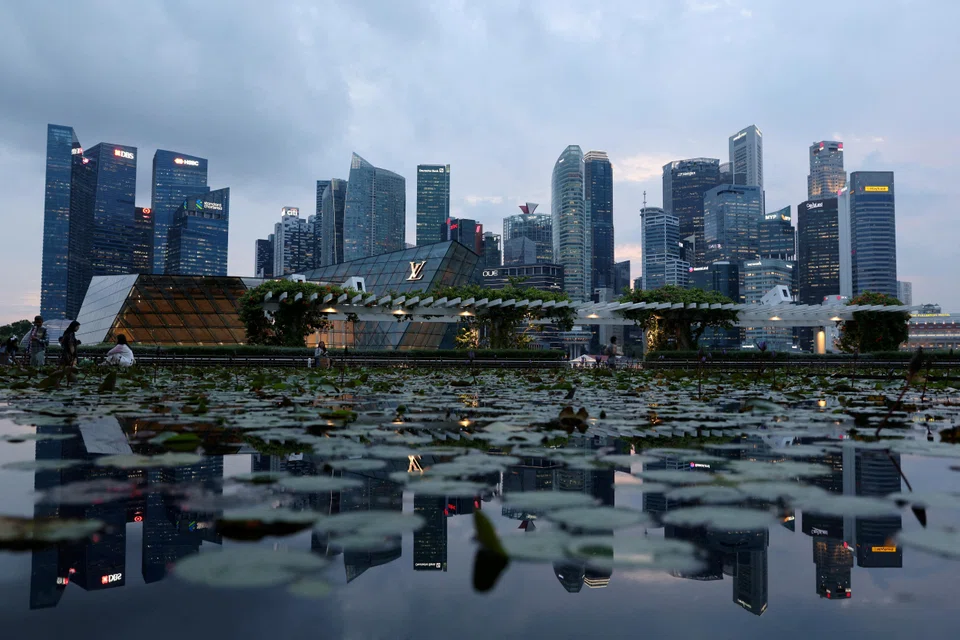
[SINGAPORE] One evening in early April, I hosted a dinner at a long table in San Francisco. Three Singaporean chefs produced a tasting menu – layered courses that most of the room would taste for the first time.
Around the table sat a representative from an American chipmaker preparing a double-digit billion-dollar initial public offering (IPO) and its first Singapore expansion.
The representative sat alongside others from global frontier artificial intelligence labs, a Malaysian sovereign wealth fund invested in data centres and the Singapore Economic Development Board (EDB), as well as a policy adviser from Standard AI.
Several of the guests had never met, despite many living within 3 km of one another.
This is the gap Singapore is uniquely positioned to close.
In the four weeks leading up to that dinner, I saw an ecosystem of extraordinary velocity in the San Francisco Bay Area.
However, it is one that operates inward by design.
CB Insights said that the US holds 65 per cent of global unicorn market capitalisation, up from 44 per cent in 2020.
The San Francisco Bay Area alone accounts for 91 per cent of the world’s AI private-market capitalisation, all within a one-hour radius.
The concentration continues to deepen, yet the work of bringing this technology to the rest of the world is still fragmented and up for grabs.
Meeting point
I had three different encounters, which captured the way Singapore is putting itself in prime position to win this opportunity.
The first was a meeting with EDB, held in the Transamerica Pyramid in San Francisco.
Singapore is running the most coherent AI coordination playbook I encountered anywhere during the trip.
It maps which American frontier builders should visit the country next, matching them with the institutional reliability that no other neutral ground can offer at scale.
EDB has been building this infrastructure for years.
The second was a conversation with an operator running sovereign-scale data centre capacity in Johor.
Malaysia has deployed roughly 900 megawatts of infrastructure ready for graphics processing units (GPUs), but utilisation sits below half of that.
Silicon Valley startups, meanwhile, face compute backlogs until 2027 and pay premium rates for what they can secure.
Most of the American founders I met on this trip had never visited South-east Asia. Several had never heard of Johor before the dinner.
The third was at Raise SG 3 in Santa Cruz, organised by the Ministry of Digital Development (MDDI).
Josephine Teo and Jasmin Lau, the minister and minister of state for MDDI, respectively, had convened researchers, founders, operators and investors for several days of unvarnished conversation about the direction in which AI is heading and its implications for home.
Singapore had brought its coordination layer to the San Francisco Bay Area.
The signal this sends to American builders – that the other side of the bridge is serious, institutional and already operational – is itself a strategic asset few other jurisdictions can deploy.
In these three encounters, the pattern was consistent – Singapore is already building the bridge.
A time-bound opportunity
The question beneath the gap is one of sovereignty – where compute physically sits, whose law governs it, whose capital backs it, and whose ground is neutral enough to host the table where all parties meet.
Singapore has spent years building its answer.
The result is a sovereign convening layer, anchored by EDB, MDDI, the Infocomm Media Development Authority and Singapore Global Network.
This makes the country the one place in Asia where global labs, Middle Eastern sovereign capital and Asean enterprise buyers can sit in the same room with minimal political friction.
However, the opportunity is time-bound, with a window of 12 to 18 months reflecting a specific confluence of factors. The GPU supply backlog clears in 2027 and rolls into 2028.
Demand shifts towards sovereign energy capacity, as the bottleneck migrates from chips to power. And the institutional appetite for neutral convening grounds continues to intensify, while the global AI landscape matures.
Whoever builds the durable coordination layer during this window, including the institutional scaffolding and technology stack that keeps connections warm across time zones and borders, could define the next decade of AI deployment in Asia.
Trust and speed
Silicon Valley will remain the first mover on frontier research, though Singapore is moving rapidly to carve its own niche.
In January 2026, the Singapore AI Research Week convened by Dr He Ruimin, chief AI officer and deputy government chief digital technology officer at MDDI, assembled the country’s AI research community into a coordinated programme.
Shenzhen and Beijing will continue to advance on foundation models. Singapore’s edge is what it has always been – the trust of everyone at the table.
The city-state can build the institutional rooms where trust can compound over time. It can host the one-to-100 deployment work that Silicon Valley is structurally unsuited for.
For Singapore’s business and policy leaders, the question of whether to engage the American AI ecosystem has been settled. The operative question now is one of speed.
My invitation is simple: commit.
That means moving beyond study trips and exploratory conversations.
It means dedicated leadership attention, budget, deployment pathways, and recurring rooms where Singapore’s business and policy leaders can work directly with the AI builders shaping the next decade.
Treat Singapore AI Week as a coordinated national platform – a moment when government, enterprise, capital, infrastructure providers, researchers and frontier builders are all in the same market with a clear mandate to move from conversation to deployment.
The jurisdictions and leaders that do this the fastest – and at the highest institutional quality – will set the terms for the location of the construction of AI deployment in Asia.
The writer, co-founder of SuperAI and Token2049, is based between Singapore and San Francisco. SuperAI, part of Singapore AI Week, will run from Jun 10 to 11 at Marina Bay Sands.
The commentary is based on the writer’s own experiences, observations and argument. AI tools were used for ideation, structuring and drafting. The writer remains fully accountable for the commentary’s accuracy, originality and final form.