Singapore and Japan’s role in a changing Indo-Pacific
Renewed cooperation between both countries would remind others that respect for international law need not be defended through confrontation alone
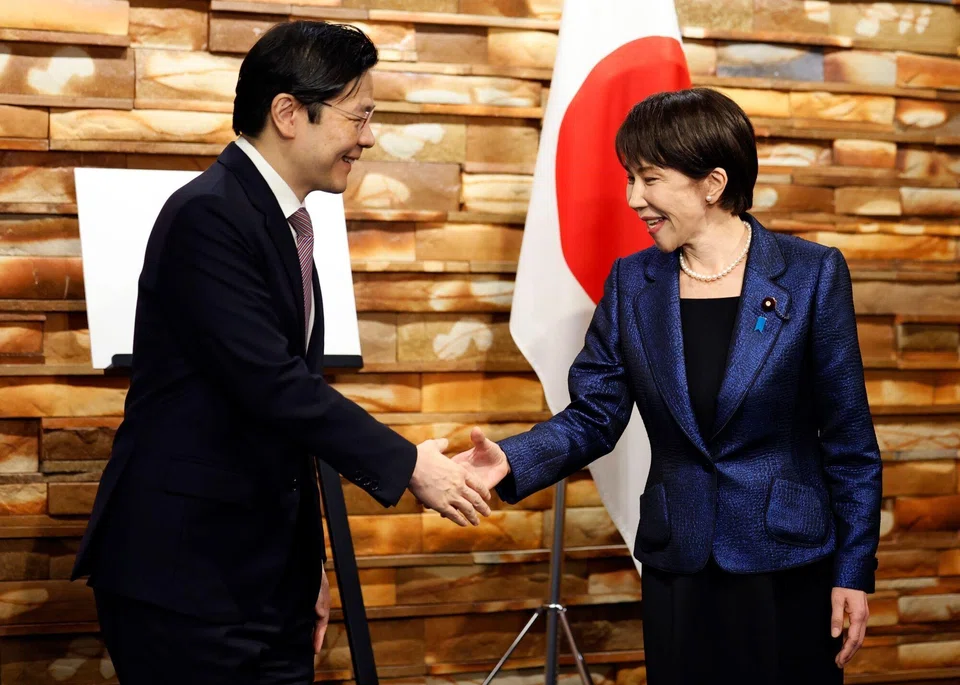
AMID one of the most complex economic and security environments that the Indo-Pacific has seen in decades, Prime Minister Lawrence Wong met his Japanese counterpart, Prime Minister Sanae Takaichi, on Mar 18.
The visit culminated in a historic step forward in bilateral ties, with Japan and Singapore upgrading their relationship to a strategic partnership and providing a framework to deepen and expand cooperation.
Just one day later, Prime Minister Takaichi travelled to Washington, where she met President Donald Trump at the White House, spearheading the Indo-Pacific’s engagement with the US.
At the meeting, both leaders confirmed their commitment to regional security, including supporting peace and stability across the Taiwan Strait and pursuing the complete denuclearisation of North Korea.
These back-to-back meetings highlight Japan’s evolving foreign policy under Takaichi: while the US remains its most important partner, it is actively seeking closer ties with other like-minded partners in the region.
Ties between Tokyo and Singapore have long rested on robust bilateral trade. The 2002 Japan-Singapore Economic Partnership Agreement which saw tariffs on imports abolished was the first such accord that Japan has formalised with another country in the modern era.
By the nature of their geographies and global economies, both states owe their economic prosperity to an Indo-Pacific order that safeguards open sea lanes and the high volume of maritime trade critical to their economic models.
That order, however, is under unprecedented strain, not only from disruptions in the Middle East, but from intensifying pressures closer to home.
Beijing’s escalating military pressure in the Taiwan Strait, repeated incursions into the waters surrounding the Japan-administered Senkaku Islands, and intensifying confrontations with the Philippine Navy in the South China Sea are symptoms of a deteriorating security situation in the Indo-Pacific.
For Japan and Singapore – two deeply trade-dependent states – any erosion of freedom of navigation across the waters poses both economic and national security concerns. Takaichi’s renewed emphasis on deterrence has therefore come at a critical moment.
Tokyo and Singapore share broadly aligned strategic visions for managing the pressure that China’s growing aggression is posing.
Japan’s Free and Open Indo-Pacific vision, first articulated under Shinzo Abe, frames the region as a single connected space anchored in open sea lanes and respect for international law. Singapore’s approach aligns closely: advocating openness, inclusivity and Asean centrality – all the while carefully managing its diplomatic balance with Beijing.
Closer bilateral security cooperation to protect the regional status quo serves both sides.
Where they differ appears to be in tone, rather than objective.
Takaichi has been explicit, warning in her first post-election address to the National Diet of growing Chinese “coercion”.
On Tuesday (Mar 31), Japanese officials confirmed that long-range missiles had been deployed for the first time, located at Camp Kengun in Kumamoto prefecture. Defence Minister Shinjiro Koizumi confirmed that the deployment “demonstrates Japan’s firm determination and capability to defend itself.”
Singapore has been careful to protect its deep economic and trade relations with Beijing. Yet, it is no less attentive to the security situation.
The Republic’s “Total Defence” framework looks to enable Singapore to withstand the uncertainties of an unstable Indo-Pacific. “Total Defence” spans six pillars, designed to improve Singapore’s resilience to any threat: military, civil, economic, social, digital, and psychological.
Prime Minster Lawrence Wong confirmed in this year’s budget announcement that Singapore was to maintain its defence spending at 3 per cent of GDP, preserving fiscal headroom should further expansion be required at short notice.
Both nations are reacting to a more febrile neighbourhood – the question now is how this cooperation manifests in practical terms.
Closer strategic cooperation, guided by shared visions for the region, make clear strategic sense.
Together, Singapore and Japan can raise the cost of maritime pressure by Beijing to preserve the freedom of navigation and trade upon which their open economies depend. Singapore sits astride some of the world’s busiest and most economically vital sea lanes.
These arteries of global trade require credible naval capabilities to keep them secure from aggression. Japan’s rapid push for military and naval modernisation would provide this strength.
But just as important is the signal that such cooperation would send to the wider Indo-Pacific region. At a time when unity is being deliberately tested, renewed cooperation between Japan and Singapore would remind others that respect for international law need not be defended through confrontation alone. They can be upheld through cooperation and preparation.
For Singapore, a more proactive Japan offers a capable security partner without sacrificing diplomatic flexibility or endangering economic ties with China.
For Japan, Singapore’s location and shared outlook make it a natural partner in preserving the maritime rules that have sustained regional stability for decades.
Expanded security cooperation could be the stabilising force that the region so desperately requires – and now is the time to do it.
The writer, the founder and chief analyst of consulting firm Indo-Pacific Solutions, is a professor of political science and international relations at the University of Southern California. He is also a non-resident senior fellow at ISEAS – Yusof Ishak Institute.