THINKING ALOUD

Singaporeans should keep watch as Australian politics turn right

Is anti-multiculturalist politician Pauline Hanson gaining ground Down Under?
Summarise
    • Pauline Hanson’s party, One Nation, is the most popular in terms of primary support, a poll shows.
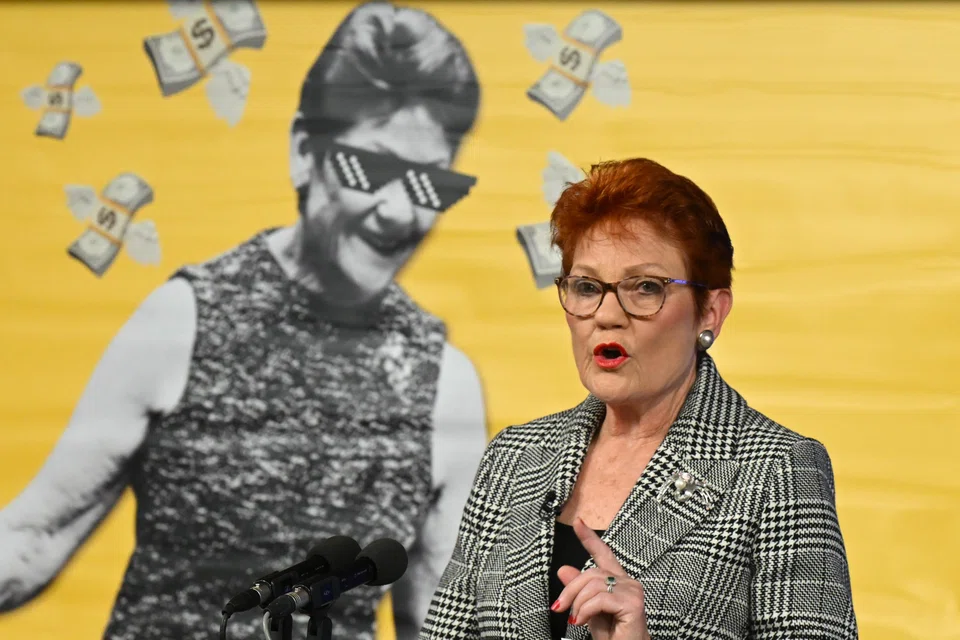
    • Pauline Hanson’s party, One Nation, is the most popular in terms of primary support, a poll shows. PHOTO: EPA
    Mohan Kuppusamy
    Published Wed, Jun 24, 2026 · 07:00 AM

    IF RECENT opinion polls are any guide, radical right-wing Australian politician Pauline Hanson tops the popularity charts, ahead of even Prime Minister Anthony Albanese, the ruling Australian Labor Party (ALP) leader.

    A Roy Morgan poll, reported earlier in June, shows Hanson’s party, One Nation, as the most popular in terms of primary support.

    This means that, as a percentage, more voters would select One Nation as their first preference over any other if an election were held now. Other opinion polls support this finding.


    This is a huge turnabout for Hanson. One year ago, she was a fringe politician, far behind the both the ALP and the National-Liberal Party coalition, the traditional alternating parties of the Australian government.

    The upsurge in cost of living, because of soaring oil prices, has had an effect. The recent Budget proposals, with adverse changes to capital gains and financial trusts, have also alienated a section of the voters.

    Moreover, Hanson seems to have used social media to successfully tap into a general sense of unease that has gripped several Western societies.

    In Britain, Nigel Farage’s radical Reform Party is ascendent as is far-right politician Marine Le Pen in France. In Germany, the Alternative for Germany party is gaining ground.

    And of course, US President Donald Trump and Italy’s Giorgia Meloni have drawn on such sentiment to win support. In every case, immigration has been a key issue.

    Francesco Sisci, an Italian sinologist now with China’s Renmin University, may have put his finger on the source of Western angst when he wrote: “The migration pressure sweeping through the Western world carries more than people.

    “It’s a different phase of modernity, in which the white man no longer roams the world and settles it as he did for the past five centuries... The automatic reaction can be: If we are not settling it, we are being settled by new waves of people we had colonised.”

    Does all this matter? Consider this: Singapore was the sixth-largest investor, with A$145 billion (S$130.6 billion) put in Australia in 2024. In 2025, Singapore investors reportedly poured A$7.1 billion into property in Australia.

    More than 5,700 Singapore students attend Australian universities, according to Australia’s Department of Education. Singapore has extensive defence ties with Canberra, as all national servicemen who have trained in Queensland can attest.

    Hanson denounced immigration and called for monoculturalism in a speech on Jun 17.

    One Nation has advocated for withdrawing Australia from international bodies such as the United Nations and World Health Organization. As think tank The Australia Institute notes, the party’s anti-immigration rhetoric remains a cause for concern.

    To be clear, there are obstacles on Hanson’s way to winning government.

    Unlike the US and British voluntary voting first-past-the-post system, Australia has both compulsory as well as preferential voting. A lead in primary vote is not the same as winning an election. Australia’s system favours centrists.

    That said, there is always the chance of a freak result. The current opposition coalition may decide to come to an electoral arrangement with Hanson to provide the numbers for a parliamentary majority.

    The next Australian general election is not due until May 2028, and a lot can change before then. But those with skin in the game should keep close watch.