BRUNCH

Singles’ inferno: Social mixer scene heats up in Singapore as dating apps get cold shoulder

Companies organising novel dating events have sprouted in the last few years to tap Gen Z and millennials’ craving for offline connection

Summarise
Tessa Oh
Published Fri, Feb 14, 2025 · 02:00 PM
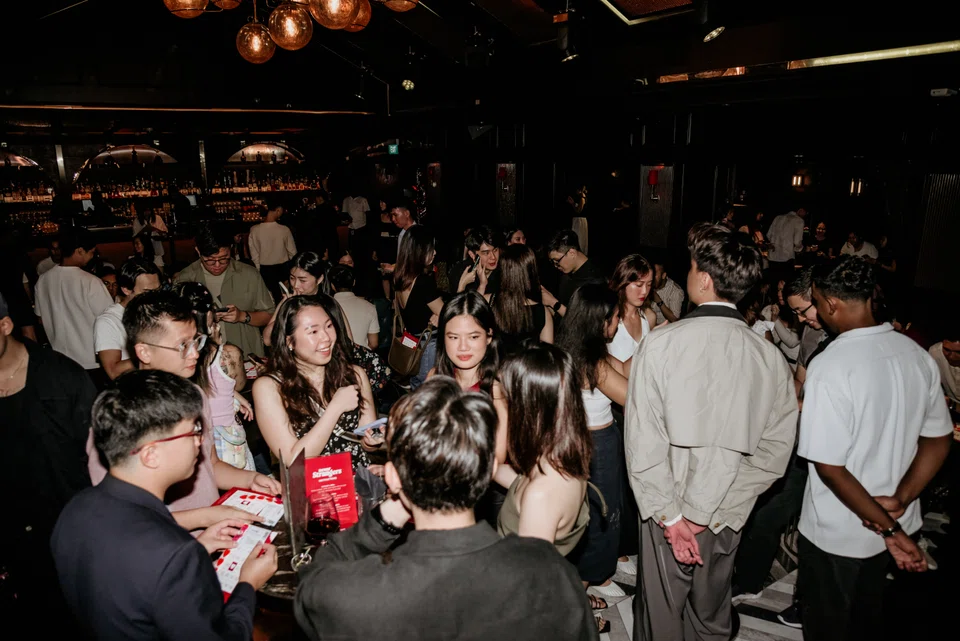
    • Entertainment company Unfiltered Presents ventured into the social events space last August with a new concept called Never Strangers.
    • Entertainment company Unfiltered Presents ventured into the social events space last August with a new concept called Never Strangers. PHOTO: NEVER STRANGERS

    IMAGINE a mixer in the style of American reality television show Shark Tank, but instead of entrepreneurs making business pitches to angel investors, friends pitch their eligible bachelor and bachelorette friends to other singles looking for a soulmate.

    Or an intimate dinner with 10 to 15 other strangers where the guest list is not curated by age, occupation or hobbies, but rather answers to questions such as “describe yourself as a music genre” and “describe a recipe that is very close to your heart”.

    These are some ways in which a new wave of event organisers, both locally and abroad, are putting a modern twist to in-person dating events, which have made a big comeback in the last year or so.


    According to data from Eventbrite, an online event and ticketing platform, twice as many people have attended singles or dating events in Singapore each year since 2022.

    In 2024, the number of dating events hosted on the platform ballooned to 240, from just 30 events in 2022, the year in which most pandemic-era social restrictions were lifted.

    This comes as online dating is slowly losing its appeal among young adults in the post-pandemic era, with many now bemoaning “dating app fatigue”.

    As more Gen Z and millennial singles crave curated experiences to meet new people in a more casual and organic setting, companies are seeing this as the next big business opportunity.

    But as businesses join in the mix to play Cupid in real life, will romance be able to pay the bills or is this simply the next fad?

    Keeping it casual

    To be sure, dating events as a concept are not new. Speed dating, for instance, emerged in the 1990s and has become a staple in the matchmaking industry.

    Yet these mixers tend to be brusque and awkward, as singles are often put on the spot to have meaningful conversations with multiple potential partners in hopes of finding “the one” within a limited time.

    Businesses such as Timeleft now give their social mixers a different spin to remove the pressure.

    The app, created by French entrepreneur Maxime Barbier in 2020, aims to help strangers connect.

    Participants are asked to fill up a short questionnaire, and the answers are then used by a matchmaking algorithm to connect them with five other individuals for dinner. Timeleft selects the restaurant and helps to facilitate the meeting with conversation starter games.

    While the platform is not advertised as a dating service per se – in fact, it calls itself a “non-dating app” – singles still see it as a good avenue to expand their dating pool by meeting new people.

    However, some prefer such settings over events or platforms which are explicitly for dating.

    Yoga teacher Cheery Ng, 28, who has attended similar events hosted by other organisers, says she prefers such social mixers to dating apps because they allow for a more casual and organic way to meet people.

    “Unlike meeting someone through an app and arranging a date, there are no expectations on how the meetings should go,” she says.

    “These events focus on just getting large groups of people together to mingle, with the chance you might meet someone – but there’s no pressure (for there to be a romantic outcome).”

    Ng has also attended a few dating-specific mixers but enjoyed those less. “I felt it reintroduced a little bit of the social pressure and expectations that I was trying to avoid,” she says.

    Timeleft seeks to forge social connections by matching a group of strangers for dinner. PHOTO: TIMELEFT

    Timeleft’s concept has certainly resonated with other individuals besides Ng. In five years, the app – which launched in Singapore last July – is currently available in more than 60 countries and over 250 cities.

    “We saw a growing demand for curated social experiences, events that go beyond just networking or dating, but focus on authentic human connection,” says Timeleft Singapore country manager Kimberly Kiew.

    She notes that urbanisation and digital connectivity in the region’s cities have not necessarily translated to deeper in-person connections, with many young people looking for ways to overcome urban loneliness.

    “Singapore’s diverse and international crowd also made it the perfect test bed for a concept like Timeleft, where strangers come together over dinner in a structured but relaxed way.”

    Breaking the ice

    Besides international imports such as Timeleft, local companies have sprouted in the social events space with their own concepts.

    Entertainment company Unfiltered made a foray into hosting social mixers last August, under the name Never Strangers.

    “We also throw nightlife parties, and that side of the business is very community-based, so we wanted to create another way for people to meet,” says the group’s co-founder Angelo Wan.

    Initially, Never Strangers was conceptualised as a dating mixer – given that it was a successful format and there seemed to be an appetite for more such events – but the team soon realised there was an even bigger market of people looking for platonic connections.

    “We received feedback from people who say that they are attached but would love to attend mixers like this. There were also participants who said they would prefer an event for meeting friends because it is less pressurising,” says Wan.

    Never Strangers now runs two editions of its events each month – a “friends” edition and a “dating” edition. It also splits its events based on age, with one for those aged 20 to 30 and a separate one for those aged 30 to 40.

    For each event, the team curates a group of 80 to 100 people from a pool of registered participants. A host from Unfiltered helps to get the ball rolling and break the ice with structured activities and games.

    Towards the end of the night, participants are matched in pairs based on values and beliefs, says Wan. Unfiltered does this through an algorithm developed by a company in the United States, to whom it pays a 20 per cent cut of revenue per event to use.

    Participants are currently charged a fee of S$47 for each event – though Unfiltered is exploring a subscription model, similar to the one offered by Timeleft.

    Icebreaker games are played at Never Strangers’ events to help participants mingle and loosen up. PHOTO: NEVER STRANGERS

    Another company dabbling in social events is Offline Singapore. Co-founders Jarell Low and Weiyue Dong started the company in 2022 as they saw a dearth of social mixers that were not dating-related in Singapore. Both have been working on the business full-time since.

    Similar to the other events, Offline shortlists a group of 40 participants through a short “vibe check” phone call and basic questionnaire. This is to ensure that the parties have a good mix of people, says Dong, adding that around three to five applicants are rejected per event.

    “If you want the people who are more vocal and more fun-loving, then there are certain people we might have to reject,” she says.

    The events also follow a structured format, with a host to ensure everyone is having a good time. For Offline’s events, there are two games played at the start and end of the event respectively to mix the groups up and ensure everyone gets to mingle.

    Participants pay S$75 per event to attend, though Offline is currently reconsidering its prices for 2025. Offline’s event schedule is more sporadic – sometimes hosting events once or twice a month, or once in six weeks.

    A lucrative opportunity?

    As to how much can be made hosting these events, both businesses say the profit margin for each event is about 20 to 30 per cent.

    Unfiltered and Offline are also exploring scaling the business by hosting more overseas events. Unfiltered has already done two separate ones in Bali and Kuala Lumpur, while Offline has done one in Kuala Lumpur and one in Jakarta.

    “One thing that we are exploring is whether the brand could sit overseas and have somebody run it for us,” says Offline’s Low. “But of course we need to find the right people to host the events.”

    With major dating apps such as Match Group’s Tinder and Bumble seeing a falling number of subscriptions and users, is there money now to be made in offline events?

    Some certainly think it is a lucrative space, as seen in the various attempts to replicate the format in hopes of business success.

    Other companies which provide more traditional dating services, such as Kopi Date, are also considering venturing into the offline events space. Founded in 2018, Kopi Date curates one-on-one dating experiences with the aim of forging long-term romantic connections.

    Events are not Kopi Date’s primary business, but the demand for curated in-person dating experiences prompted the company to host a pop-up group dating event and relationship workshop in Jakarta a few months ago – which was oversubscribed.

    “From the event, we realised that people really need the connection and intimacy offline, and that is something that apps cannot really provide for other people,” says co-founder Lee Jing Lin.

    Given this interest in in-person experiences, Kopi Date is exploring the possibility of hosting more events in Jakarta or Singapore.

    Tinder – a brand synonymous with online dating – hosts in-person events in various locations, including Singapore. Match Group’s Asia chief executive officer Malgosia Green says it is always exploring “creative, inclusive ways to bring people together in real life”.

    Bumble is also exploring offline events as part of its offerings. It recently partnered with run club Urban Milers to host a run, hosting hundreds of singles who share a love of sports, says Apac communications lead Meihui Chen.

    Non-dating-related businesses are also taking notice and expressing interest in partnerships.

    Fishbowl – an event where friends can pitch their single friends to other romantic hopefuls – has received interest from oat milk brand Oatly and bar Tipsy Flamingo for a possible collaboration, says co-organiser Joell Tee, who runs the event as a passion project.

    “Businesses are looking to do fun little things that are a bit more ground-up, and I feel that is probably where a little bit of the money is,” she says.

    Fishbowl co-organisers Joell Tee (left) and Nicole Lim (right). PHOTO: JOELL TEE

    Curation is key

    While early movers such as Timeleft have already secured a berth in the industry, newer entrants might struggle to establish themselves, with companies citing scaling costs and an oversaturated market.

    For one thing, hosting a successful social mixer is not as simple as throwing a random group of people in a room, say the Offline co-founders, who cautioned against seeing such events as an easy way to make a quick buck.

    Organising social mixers requires event management know-how as well as experience in public speaking and hosting a large crowd.

    While participants are keen for novel experiences, there is also a limit to how much they would be willing to pay for such an event.

    “My take is – because this is quite a new product… it’s very hard to price them. (Participants) don’t know what the benchmark is, so they will just choose the cheapest experience,” says Low.

    Keeping concepts fresh is another challenge, since novelty is a big part of the draw for such events.

    This curation work takes time and effort, says Tee, who also organises Dinner with Strangers, another side project of hers. The event, as the name suggests, brings together a group of strangers over an intimate dinner to help individuals meet new people.

    To curate each group of strangers, she comes up with quirky and interesting questions, beyond the usual ones about jobs, aspirations and hobbies, to get participants to bring out different aspects of their personalities.

    This is all done manually – not by an algorithm or artificial intelligence. “Dinner with Strangers is me. I read through everyone’s responses and I try to get a sense of who they are based on how they’ve answered the questions,” says Tee.

    She then uses her own judgement to pick out which people would make a good dinner group. This is something which is difficult to replicate with technology, she says.

    For instance, an algorithm might match individuals based on similar answers and keywords, but this does not guarantee a good evening. “I don’t want it to be the case where people are just meeting people like them,” says Tee.

    Unlike the dinners by Timeleft, she sits in as the host for all the events. “For me, I pride myself in being there to curate and host every single group, just so I can make sure that everyone’s comfortable and having a good time.”

    While time-consuming and tedious, Tee intends to keep the curation work manual, as she believes this is what makes her events unique and special. This also means that scaling and monetising the business would be challenging, so she has no plans to monetise it further at the moment.

    So while love may not cost a thing, organising events to find it certainly does. Those in the industry persist out of passion, and say that opportunistic entrants to the scene may be disappointed.

    Tee, who works full-time as a project manager at a bank, used to not charge anything for hosting Dinner with Strangers; participants simply paid the restaurant for their dinner. But recently, she has begun asking for a S$20 to S$30 admin fee per participant to compensate for the time put into organising the event.

    Offline is considering diversifying its offerings to grow more sustainbly. PHOTO: OFFLINE SINGAPORE

    Meanwhile, Offline is exploring diversifying the business further to expand revenue and keep things financially sustainable, such as through selling merchandise or hosting events for a wider demographic. It currently only accepts participants aged 25 to 35.

    The challenges in making social events a viable full-time business make the company less sanguine regarding the future of the industry.

    “One thing we realised over these two years (of operating) is that many people have come and gone,” says Offline’s Low. “Many people who have tried to start have stopped, or given up halfway after six months to a year, which is a sign that it’s a very tough business to make money.”

    In contrast, Timeleft is more upbeat, believing that there is still room for growth in the market.

    “Many people are just starting to explore alternatives beyond traditional networking events, speed dating, or casual meet-ups,” says Kiew.

    “The key challenge for new entrants will be differentiation – what makes their experience unique, sustainable and consistently engaging for attendees.”