
‘Slapped in the face’: Hyundai Georgia raid tests US-South Korea alliance

The detention of over 300 South Korean nationals in the EV plant could chill future Korean investment and undermine bilateral ties
Summarise
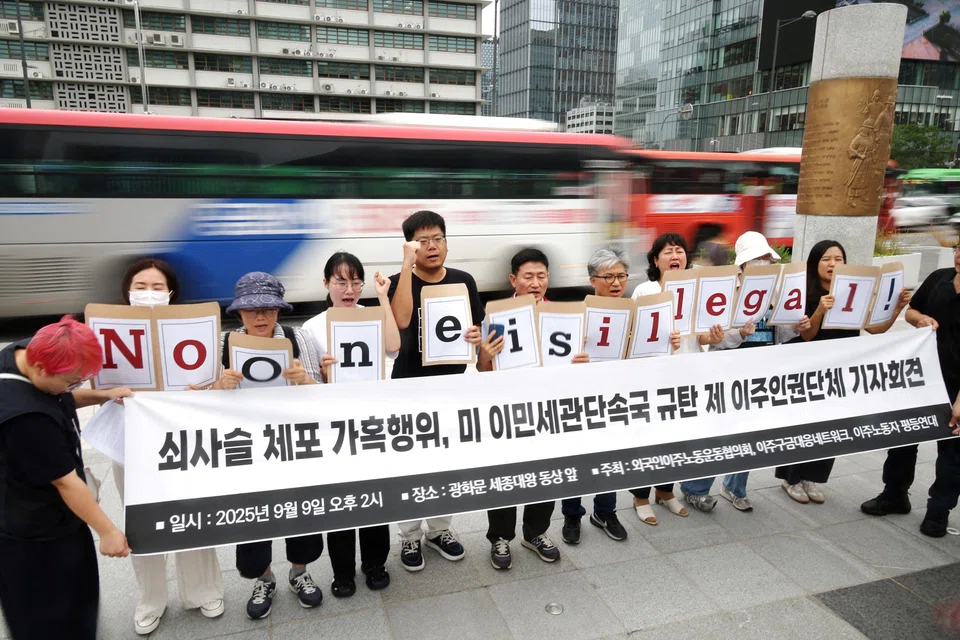
    • Activists bearing banners and chanting slogans in front of the US embassy in Seoul on Sep 9, to protest against the Sep 5 immigration raid at the Hyundai’s electric-vehicle manufacturing plant in the US state of Georgia. The US' enforcement of a domestic policy has created diplomatic friction.
    • Activists bearing banners and chanting slogans in front of the US embassy in Seoul on Sep 9, to protest against the Sep 5 immigration raid at the Hyundai’s electric-vehicle manufacturing plant in the US state of Georgia. The US' enforcement of a domestic policy has created diplomatic friction. PHOTO: REUTERS
    Published Wed, Sep 10, 2025 · 06:00 PM

    THE Sep 5 immigration raid at Hyundai’s electric-vehicle (EV) manufacturing plant in Georgia represents a significant diplomatic challenge between the United States and South Korea, one of America’s most important allies in the Asia-Pacific region.

    What began as a routine immigration enforcement operation has evolved into a diplomatic incident that threatens to strain the broader US-South Korea relationship at a time when both nations need strong cooperation on regional security and economic issues.

    The raid was unprecedented in its scale and execution. Federal agents from Homeland Security Investigations, Immigration and Customs Enforcement and other agencies took part in what officials described as one of the most extensive immigration raids in recent US history.


    A total of 475 individuals were detained, among whom more than 300 were identified as South Korean nationals working at the Hyundai-LG battery plant construction site in Ellabell, Georgia.

    The raid targeted suspected unlawful employment practices in the facility, which is part of Hyundai’s US$7.6 billion investment in Georgia’s EV manufacturing sector. The plant represents South Korea’s largest single manufacturing investment in the US, and is central to both companies’ North American expansion strategies.

    Seoul’s reaction has been swift and multifaceted, reflecting both the severity of the situation and the delicate nature of the US-South Korea alliance. The South Korean government characterised the raid as a potential “diplomatic disaster”, with opposition party officials questioning whether South Korea had been “slapped in the face after making huge investments” in the US.

    The South Korean foreign ministry issued a formal statement expressing “deep concern” over the arrests, and emphasised that “the economic activities of Korean investment companies and the rights and interests of Korean citizens must not be unfairly infringed upon during US law enforcement operations”. This language, while diplomatic, signalled significant displeasure with the way in which the operation was conducted.

    Most significantly, South Korea dispatched its top diplomat to the US and arranged for a chartered plane to facilitate the voluntary return of detained Korean nationals. President Lee Jae Myung pledged “all-out efforts” to protect Korean citizens, indicating the high priority Seoul has placed on resolving this crisis.

    The raid raises fundamental questions about the security of South Korean investments in the US. Hyundai’s Georgia facility represents the kind of foreign direct investment that American policymakers typically celebrate – a major manufacturing operation bringing jobs and technological expertise to American communities. 

    In response to the raid, the company has temporarily suspended all US business travel except for customer meetings, a defensive measure that could signal broader corporate wariness about American regulatory and enforcement environments. South Korean media coverage has framed the arrests as a “betrayal” and “harsh blow”, language that could influence public and corporate sentiment toward US investment opportunities.

    The diplomatic fallout illustrates the complex intersection between domestic policy implementation and foreign policy objectives. Its timing is particularly problematic, given ongoing regional security challenges. 

    South Korea is not just any trading partner. It is a treaty ally that hosts approximately 28,500 US troops and serves as a critical partner in containing North Korean threats and managing China’s rise. A deterioration in bilateral relations could complicate cooperation on these critical security issues, as Seoul’s reaction suggests concerns that extend beyond this single incident to broader questions about the US’ reliability as a partner.

    The incident also underscores a systemic failure: the need for better coordination between immigration enforcement agencies and foreign policy institutions. The scale of the arrests of the Korean nationals suggests either a significant oversight in pre-operation planning or a deliberate decision to prioritise enforcement objectives over diplomatic considerations.

    Both explanations raise questions about interagency coordination and policy prioritisation.

    Furthermore, the raid highlights the challenges of a US immigration system that may not adequately accommodate legitimate international business practices. Many of the detained Korean workers may have been operating under visa categories or employment arrangements that created legal vulnerabilities, even if their work was economically beneficial and technologically valuable. 

    Do current immigration frameworks adequately serve the needs of international companies investing in US manufacturing? The complexity of US immigration law may inadvertently criminalise practices that other developed nations accommodate more readily.

    Path forward

    The rapid negotiation of an agreement allowing the voluntary return of Korean nationals shows that both governments recognise the need for damage control. To prevent this incident from affecting broader bilateral cooperation, the US government should review its procedures for major immigration operations involving allied-nation citizens to ensure appropriate diplomatic consultation occurs beforehand.

    At the same time, both governments have an interest in reassuring Korean companies that this incident represents an aberration rather than a pattern. This may require policy clarifications or procedural changes to provide greater certainty for international investors.

    The Hyundai Georgia raid is thus a case study in how domestic policy implementation can create unintended foreign policy challenges. While the US has a legitimate interest in enforcing immigration law, the diplomatic impact of this operation illustrates the need for more sophisticated coordination between enforcement agencies and foreign policy institutions.

    The US-South Korea relationship is fundamentally strong, built on shared strategic interests that extend far beyond this single incident. However, the South Korean reaction demonstrates that even close allies can be significantly affected by American domestic policy decisions that appear to disregard diplomatic considerations.

    Both nations must establish mechanisms to prevent similar diplomatic friction in the future. The strength of the alliance depends on the political will to address the underlying coordination and consultation challenges that allowed it to occur.


