

Stablecoins are challenging Asia’s financial order
The rise of currency-backed digital tokens is putting pressure on institutions to rethink their financial plumbing


[SINGAPORE] Stablecoins are quietly issuing a challenge to Asia’s financial foundations.
These currency-pegged tokens are reshaping decades-old money systems, transforming payments, capital markets and even monetary policy priorities.
As the drive to modernise global finance accelerates, banks and regulators in the region are being pushed to rethink how money moves across borders.
Around 90 per cent of stablecoins are used for cryptocurrency trading, notes Chia Hock Lai, co-chairman of the Singapore-based Digital Assets Association.
But beneath the surface of mere speculative trading, a major shift in institutional and regulatory ecosystems is under way. The world is preparing for stablecoin’s place in global financial infrastructure, or the so-called financial plumbing.
Stablecoin’s market size has grown from US$200 billion at the start of the year to US$300 billion today, and Citi projects in a bull case that it could balloon to US$4 trillion by 2030.
What is a stablecoin?
At its heart, a stablecoin is a cryptocurrency designed to maintain a steady value. This is done most reliably through holding equivalent amounts of reserve assets in cash or cash equivalents.
“It’s a relatively simple concept,” says Vincent Chok, chief executive officer of Hong Kong-based stablecoin issuer First Digital. “It’s one dollar backing a one-dollar token, and this has to be held in deposits that are easily accessible and redeemable, so we can pay if the token is redeemed.”
Due to their volatility, cryptocurrencies such as Bitcoin have been largely unable to perform the function of “electronic cash”. But stablecoins have found utility because they can retain value while transacting on blockchains.
One of the token’s key advantages is that it can settle transactions nearly instantly on blockchains, unlike traditional payment networks such as SWIFT – the prevailing interbank cross-border payment network founded in 1973.
“Traditional cross-border wires take two to five business days and cost US$25 to US$50. Stablecoins settle in minutes for under a dollar,” says Ben Charoenwong, an associate professor of finance at Insead.

This makes them particularly compelling for cross-border payments, both between businesses and in remittances, he adds. This is especially for businesses making several small, low-margin transactions.
“Think: textile manufacturers in Bangladesh, business process outsourcing firms in the Philippines, or small and medium-sized exporters across South-east Asia,” he says.
“Stablecoins work best as a momentary intermediary rather than a store of value. You send Singapore dollars, (they convert to USDC in) fractions of a second while traversing borders, then (convert) to Philippine pesos on the other end.”
USDC is a US dollar-pegged stablecoin issued by Circle. In the majority of cross-border fiat payments between businesses, the greenback is the main – and most liquid – intermediary that parties’ local currencies are exchanged for.
This remains true along stablecoin rails – or payment infrastructure – where around 99 per cent of the stablecoin market is pegged to the US dollar. USDC and Tether-issued USDT make up around 80 per cent of these tokens.
While First Digital also issues a stablecoin pegged to the greenback called First Digital USD, the token’s availability for liquidity during Asian hours distinguishes it from USDC and USDT.
“We are a non-US-issued stablecoin, so the time zone plays an important role,” says Chok.

And for Singapore-based StraitsX, its local currency token presents opportunities to optimise payments made to merchants in the Republic.
Its XSGD token, which trades on Coinbase, is the only Singapore dollar-backed stablecoin to date that has been deemed “substantively compliant” with the Monetary Authority of Singapore’s (MAS) single-currency regulatory structure, which was finalised in 2023.
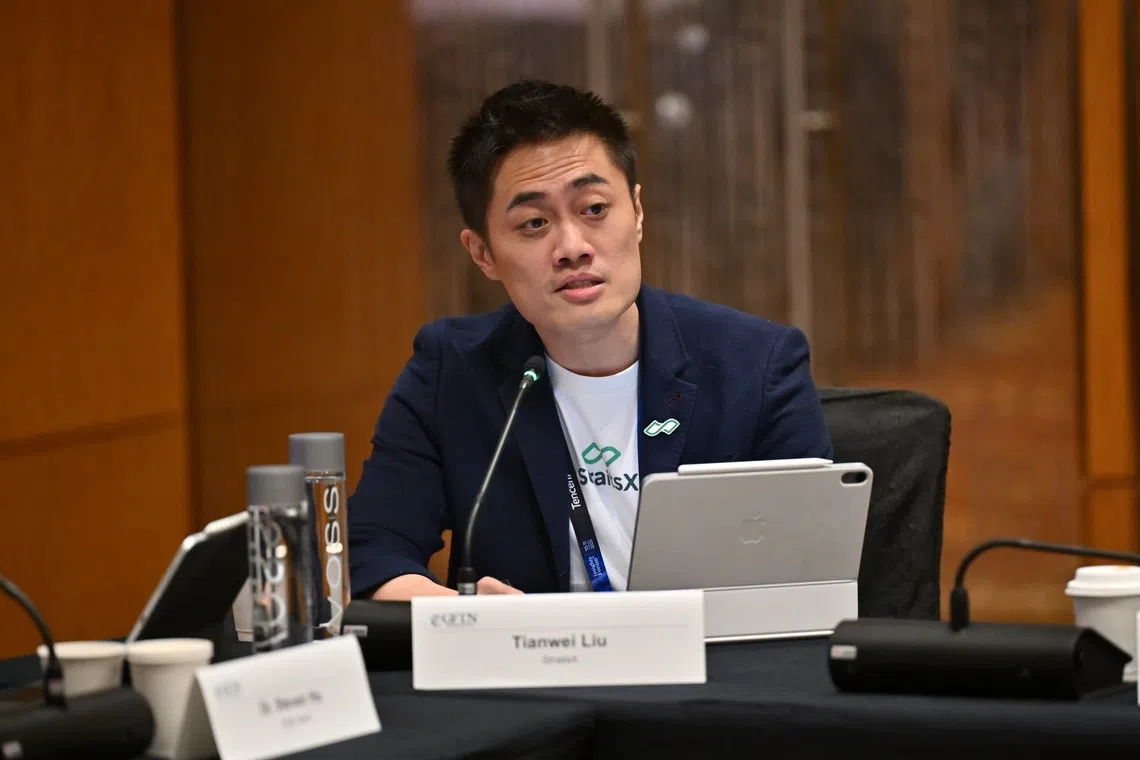
StraitsX CEO Liu Tianwei says: “The single largest use case for us is in cross-border payments like inbound tourism spending. There are many e-wallets, and many aren’t interoperable – a tourist in Singapore with a Touch ‘n Go or Alipay wallet cannot scan a PayNow QR code.”
To address this, he describes a network which lets tourists use their own wallet and pay in their native currency. That amount is instantly settled in XSGD, while the merchant still prices and receives payment in Singapore dollars.
“We can then settle in the back end so that the merchant receives Singapore dollars, without either the consumer or merchant needing to touch a stablecoin directly,” he adds.
But others are less optimistic about taking on the domestic retail payments sector with local currency-pegged stablecoins.
Chok, for instance, says: “In Hong Kong, the payments market is already strong with very good platforms – we have to consider whether we want to compete with them.”
These include the city’s Octopus smart card and e-wallets such as WeChat Pay and Alipay. “One extra stablecoin for Hong Kong dollar payments is not going to entice a user,” he adds.
Legitimacy through regulation
As interest in stablecoins grows, regulators worldwide are introducing legislation to manage their uses and risks.
“Regulators are now coming up with controls that will allow users to access this innovation and its benefits, while addressing the concerns that they have,” notes Liu.
Singapore has been a pioneer in this space. Its single-currency framework introduces a new category of “MAS-regulated stablecoins” with strong reserve backing, says Rachel Phang, an assistant professor of law at the Singapore Management University.
She tells The Business Times: “The introduction of the (regulatory) framework will, in Deputy Prime Minister Gan Kim Yong’s words, ‘distinguish well-regulated stablecoins from other crypto assets’ that pose risks to consumers due to their high volatility and lack of inherent value.”
“These are stablecoins that are pegged to the Singapore dollar or a (Group of 10) currency and issued in Singapore,” she adds.
“The narrative around fintech was that it would disrupt banks, but instead we’ve seen more innovation developing because fintech is around.”
StraitsX CEO Liu Tianwei
Having such legislation grants institutions “regulatory permission” to handle stablecoin transactions without compliance uncertainty, says Dr Charoenwong of Insead.
“It’s about legitimacy and institutional confidence, not technical capability.”
But within South-east Asia, regulatory development remains uneven. Nonetheless, StraitsX’s Liu thinks Singapore’s regulation can be a “beacon” for the region, setting the model for other countries’ regulators to develop localised frameworks.
Tanna Chong, chief policy officer at the non-profit Responsible Fintech Institute, notes that such knowledge-sharing and cooperation are especially needed in South-east Asia, where stablecoin payments are often used in money laundering for criminal activity.
“What you get are issues like human trafficking in the region where vulnerable communities suffer – the public sector has a huge stake in taking better care to avoid this,” she adds.

Tokenised markets
Tokenisation, or the digital representation of securities and real-world assets such as real estate, bonds and stocks, is part of the reason regulatory efforts are being pushed along quickly.
This has greatly accelerated the pace with which stablecoins are being adopted, as banks and other financial institutions work to develop digital asset market infrastructure.
Investors would be able to purchase financial instruments or parts of real-world assets on blockchains, using stablecoins as the payment method.
“For instance, Hong Kong dollar stablecoins can enable global users to access Hong Kong investment products – things like real estate that are hard to access without traditional (Hong Kong dollar-denominated) accounts in Hong Kong,” says Chok of First Digital.
“Think of an electric vehicle charger project in South-east Asia, for example. You can tokenise it such that you own the charger itself, or you can tokenise the income stream it produces,” Chong adds.
“It’s digital money that unlocks capital lines for such projects, and unlocks the potential in these emerging economies.”
Such tokenisation can even strengthen financial inclusion in the region.
Malaysia’s recent move to tokenise sukuk, or syariah-compliant Islamic bonds, will enable retail investors to fractionally purchase a product that has long put off all but institutional and high-net-worth buyers.
A modernising force?
But the technology of stablecoin itself isn’t revolutionary, notes Dr Charoenwong.
“It’s about market discipline – this is similar to how fintech forced traditional banks to improve mobile banking and reduce fees,” he explains.
Liu agrees. “The narrative around fintech was that it would disrupt banks, but instead we’ve seen more innovation developing because fintech is around.”
Stablecoin, therefore, is a “modernising force” for traditional banking and payment rails, he believes. “A lot of the work in stablecoin requires banks to be heavily involved.”
Sure enough, banks such as Standard Chartered are already exploring tokenisation and stablecoin payments, enabling more risk-averse traditional finance players to enter such transactions.
Standard Chartered’s global head of digital assets Rene Michau notes that clients are increasingly turning to the lender to help them enter and transact in digital or crypto assets.
“As client demand accelerates further, our goal ultimately is to offer clients a route to transact, trade and manage digital asset risk safely and efficiently within regulatory requirements,” he adds.
For Dr Charoenwong, the proliferation of stablecoins need not be an end in itself – alternatives exist in tokenised deposits, for instance, where traditional deposits are represented on blockchains in bank-issued stablecoins.
“If the threat of stablecoin disintermediation pushes SWIFT, correspondent banks and domestic players to deliver real-time, low-cost cross-border settlements through tokenised deposits, that’s a good thing,” he says.
Monetary policy consequences
But perhaps facing the biggest test are the titans of traditional financial systems – central banks.
Emerging markets in South-east Asia with tight capital controls are cognisant of the impact that stablecoins could have on currency markets.
With the majority of these tokens pegged to the greenback and issuers required to hold US dollar assets, stablecoins are a threat to the monetary sovereignty of many economies worldwide.
“Central banks in Indonesia, Malaysia and Thailand are wary of dollarisation and losing monetary policy control,” Dr Charoenwong says.
“They would likely resist the adoption of stablecoin in other currencies, unless they can implement capital controls or offer their own stablecoins.”
Liu believes that this is something local regulators will need to carefully consider. “It’s clear what the benefits are for enterprises and payments. Now it’s on the regulators to assess the pros and cons of greater adoption.”
And while stablecoins may not replace traditional finance just yet, they are putting pressure on the industry to evolve. For Asia’s banks and regulators, the challenge is how to reap the technology’s efficiencies without compromising monetary sovereignty or financial stability.
TRENDING NOW

Malaysian king buys stake in Singapore-listed mining firm expanding into rare earths

Grab CEO’s wife Chloe Tong on life with Anthony Tan and finding her purpose

Once staunchly pro-China, Malaysian Chinese businesses are now distancing themselves from Beijing
Longer wait times expected as S’pore healthcare institutions report system disruptions

