The surging Asian-American vote: Leaning Democratic, but not in anyone’s pocket
The demographic constitutes an important voting bloc in three battleground states: Nevada, Georgia and Pennsylvania
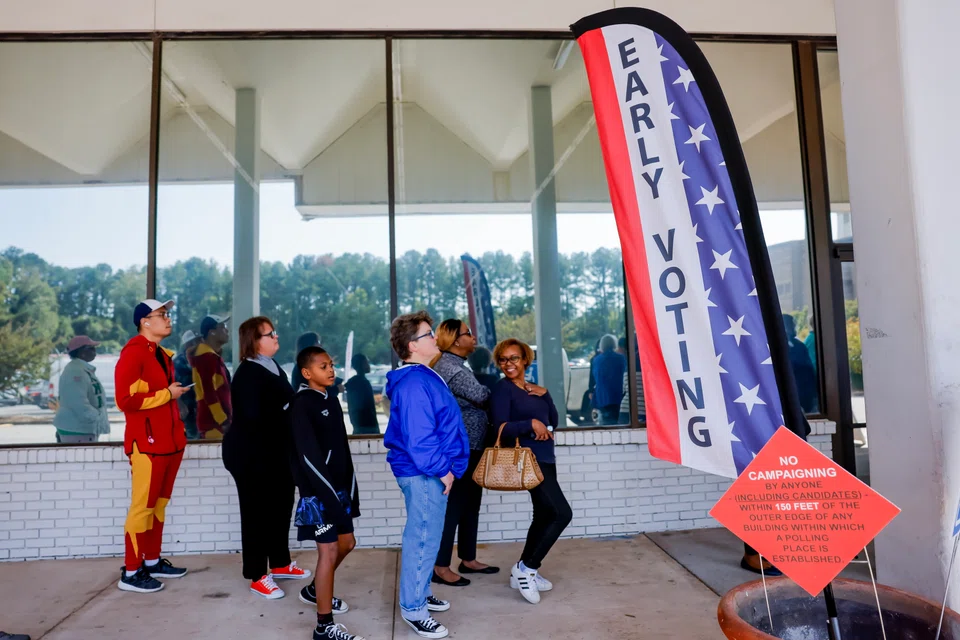
ASIAN-AMERICANS have been the fastest-growing group in the United States since 2020. In 2024, 15 million Asian-Americans will be eligible to vote in the presidential race, and because of their growing electoral power, they are expected to make a difference in at least three battleground states.
The number of Asian-Americans has grown by 15 per cent – or about two million eligible voters – in the past four years, according to the Pew Research Center, which notes that this surpasses the 3 per cent growth rate for all eligible voters, including Hispanic voters, during that time.
The highest share of Asian-American eligible voters is concentrated in two Democratic states – Hawaii, where they are the majority, and California. But they constitute an important voting bloc in three battleground states: Nevada, Georgia and Pennsylvania.
In Pennsylvania – which is expected to be a key determinant of the outcome of the Nov 5 election – Asian-Americans account for only 3 per cent of eligible voters. But with polls showing a tied presidential race there, their vote could prove to be crucial.
Indeed, President Joe Biden won Pennsylvania by a razor-thin margin in 2020, and since the majority of Asian-Americans voted for him that year, they probably proved to be critical for his win then.
Similarly in Georgia, where there are 253,000 eligible Asian-American voters who constitute 3.4 per cent of the electorate, they helped make the difference for the Democrats in the 2020 presidential race, as well as in the ensuing 2021 Senate election and the 2022 midterm races – all of which the Democrats won by narrow margins.
This suggests that Asian-Americans could help swing the close election in Georgia this year, too.
This demographic now accounts for roughly 10 per cent of the three million people who live in Nevada, and Filipino Americans make up half of that community. The number of Asian-Americans eligible to vote in the state grew by 35 per cent from 2010 to 2016.
Like in Pennsylvania and Georgia, these voters in Nevada could make a difference – as they did in the 2016 and 2020 presidential races when the Democratic candidates Hillary Clinton and Biden, respectively, won by fewer than 100,000 votes each.
Indeed, 70 per cent of Asian-Americans – who typically support Democratic candidates – voted for Biden in 2020, according to Pew.
Based on the 2024 Asian-American and Pacific Islander (AAPI) voter survey, 66 per cent of Asian-Americans plan to vote for Kamala Harris, the US vice-president and Democratic presidential candidate, who leads the Republican challenger Donald Trump by 38 percentage points.
The poll indicates that Vietnamese Americans are the most pro-Harris demographic (77 per cent), followed by Indian Americans (69 per cent), Filipino Americans (68 per cent), Japanese Americans (67 per cent), Chinese Americans (65 per cent), and Korean Americans (62 per cent).
In some respects, the Asian-American vote tends to reflect national trends. Asian-Americans with college degrees, younger voters and women tend to vote for Democratic candidates.
At the same time, former president Trump tends to win more support among older Asian-American voters, especially men and those with no college degrees.
The AAPI data also suggests that while Democrats can count on Asian-American voters, this growing demographic is not in their electoral pocket.
In fact, most Asian-Americans are not affiliated with either the Democratic or Republican party, and their support for Democratic candidates has been based on the issues they embraced.
Hence, the survey found that support for Democrats actually appears to be slipping among Asian-Americans. While roughly two-thirds of the group voted for Biden in 2020, that is below the mark of over 70 per cent who voted for Barack Obama’s re-election as president in 2012.
Indeed, growing concerns with crime in the large urban centres where they live may be leading some Asian-American voters to switch to the Republican side – as they did when the Chinatown area of Sunset Park, Brooklyn, once a Democratic stronghold, voted for Lee Zeldin, the Republican nominee for governor of New York.
Similarly in Texas, Governor Greg Abbott, the Republican incumbent, beat Democrat Beto O’Rourke among Asian voters 52 per cent to 46 per cent in the 2022 gubernatorial race. And while Democrats did win the majority of their votes in Georgia, a third of Asian-Americans voted for Republican candidates, substantially more than in previous elections.
If elected, Harris would be the country’s first South Asian president and the first Asian-American (as well as the first woman, and first Black female, to assume the role). Yet, it is not clear whether that fact is among the top reasons that Asian-Americans would vote for her.
Asian-Americans, like most Americans, place the economy high up on their agenda in this election. But there are certain issues that are of particular concern for them, according to the AAPI survey, such as racism and discrimination, abortion rights, crime and violence, and gun policy.