

In trade’s ‘law of the jungle’, the winners are clear
It is China and the US that prosper when power sets the terms for global commerce
BASED on one account of his early career, China’s Minister of Commerce Wang Wentao started out as the general manager of a photocopier sales department, before ascending the ranks of the Chinese Communist Party.
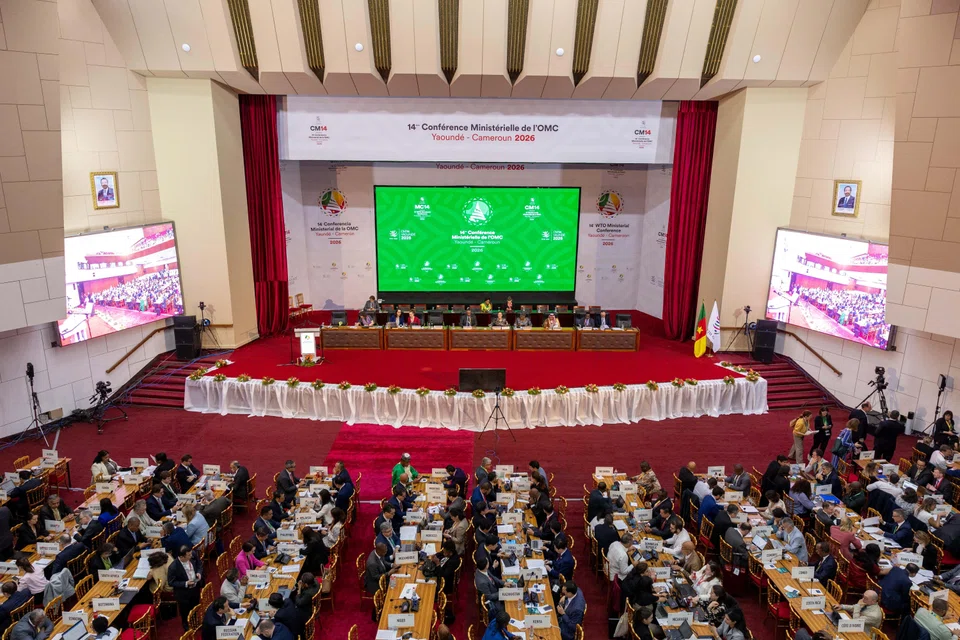
This week, in the Cameroonian capital of Yaounde, where the 166-member World Trade Organization (WTO) gathered, he was selling something altogether more nebulous: a plea for stability in a fracturing world.
At a time when US President Donald Trump is riding roughshod over the multilateral trading system, spraying tariffs in all directions, Wang warned delegates that “without WTO rules, global trade would return to the ‘law of the jungle’ where might makes right”.
Chinese diplomacy specialises in such straight-faced pieties. They make representatives of governments on the wrong end of China’s trillion-dollar trade surplus bristle when they hear them. “You feel like you’re being gaslit,” said one Western diplomat present in Yaounde.
But China’s strategy is subtler than getting up the noses of its Western critics. To extend Wang’s analogy, if the US is currently behaving like an elephant, crashing through the old guardrails of world trade, China presents as the tiger: stealthy, but with claws when needed.
Outwardly, China resolutely sticks to the middle path. Its interventions at the WTO conference for ministers – an event billed as a last chance to agree on reforms to stop the governing body for world trade sliding into irrelevance – were measured and constructive.
But that system, as the Trump administration correctly observes, has conspicuously failed to address Chinese overproduction and subsidies since China joined the WTO in 2001.
And Chinese subsidies, often delivered through soft loans not captured by existing WTO rules, are real. Firm-level analysis in the Organisation for Economic Co-operation and Development (OECD) finds that they run at three to nine times that of OECD members.
One senior US official in Yaounde said it would be absurd to pretend otherwise. “Because for them, there’s been no jungle? They’re all, you know, so ‘rules-based’? Oh yeah.”
In contrast to Wang’s emollience, US Trade Representative Jamieson Greer opened his account in Yaounde with an ultimatum, warning that the status quo had become “economically unworkable and politically unacceptable”.
Then, he set ministers a challenge: either make permanent a 28-year-old moratorium to avoid imposing tariffs on electronic transmissions, or – if WTO members failed to do this – accept that “no one can reasonably expect the WTO to deliver meaningful results in other sectors”.
The WTO failed the test. The “e-commerce moratorium” expired, and the reform road map was not adopted – one that, in theory, would have strengthened the WTO’s mechanisms for tackling unfair subsidies, among other things.
While very far from ideal, there is one clear characteristic of this new “jungle”.
Ultimately, it is the two big beasts of the world economy – neither of which wants to be constrained by multilateral institutions such as the WTO – that prosper most in a world where “might makes right”.
The true casualties are the smaller countries: the developing world but, as the UK and France are discovering, the middle powers too.
French President Emmanuel Macron called it the “unbearable unbalances” of world trade, in areas such as steel and green tech.
China’s trade surplus continues to balloon, even though its goods exports to the US are down nearly 30 per cent since Trump returned to the White House. It is the markets in South-east Asia, Africa and Europe that absorb the excesses.
As UK Secretary of State for Business and Trade Peter Kyle told the Financial Times in Cameroon: “There are only two ways this situation is corrected. Either through tariffs, to protect from it. Or access to their market, to balance it. And this is the world that we are entering.”
For little countries, it is tougher still.
As Barbados’ WTO ambassador Matthew Wilson put it: “We are disappointed. But we are also fearful – for every time the WTO and the multilateral system (are) knocked, we as small economies become more vulnerable.”
Wilson heads an 80-nation bloc of African, Caribbean and Pacific countries at the WTO.
It is a world where the founding principles of the WTO, which were based on equal treatment and protection for the less powerful, are visibly ebbing away. The situation, while long known, was brutally confirmed in Yaounde this weekend. FINANCIAL TIMES
TRENDING NOW

Once staunchly pro-China, Malaysian Chinese businesses are now distancing themselves from Beijing

Cliff Tan has 7 million followers and a 4-month waitlist. Why won’t he expand his business?

Could stablecoins be the future of money?

Grab CEO’s wife Chloe Tong on life with Anthony Tan and finding her purpose

