
Trump vows to ‘usher in the greatest and most successful era’ in America’s history. But is his honeymoon over?
Roughly even segments of the country approve and disapprove of his presidency, but the proportion of those who view him positively is expected to continue to drop
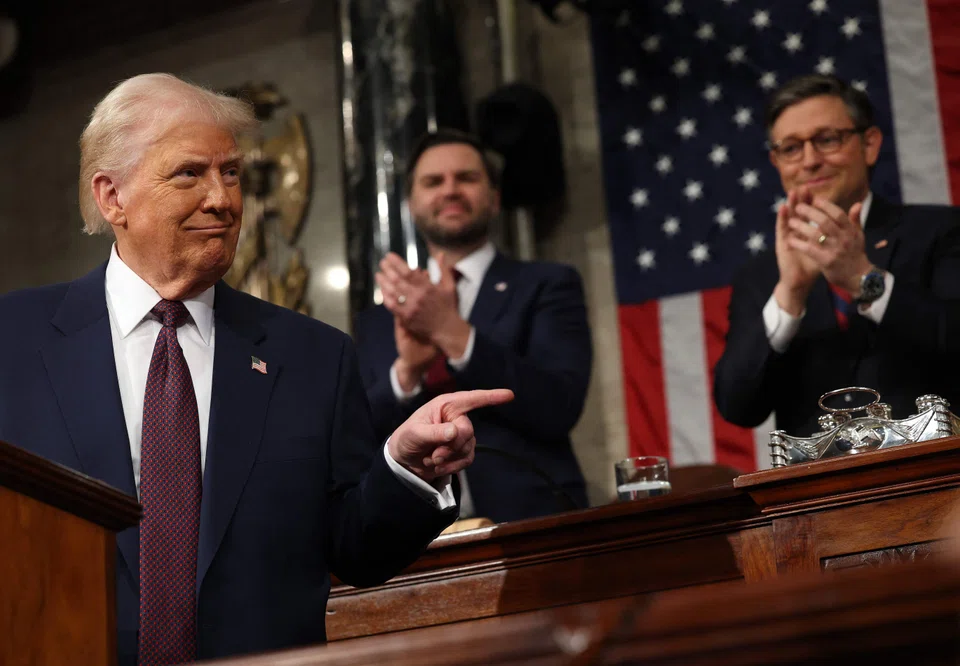
US PRESIDENT Donald Trump, in his address to Congress on Tuesday (Mar 4), celebrated the numerous changes he brought into the federal government. He suggested that a return to the “golden age of America” was underway, declaring that he was advancing a “swift and unrelenting action” to transform America that would “usher in the greatest and most successful era” in the history of the nation.
But the president seemed to disregard the many problems caused by the speedy action during his first six weeks in office, including the tense stock market, trade wars with partners and rivals, and uncertainty over the cuts to federal jobs and spending, not to mention the fact that prices remain high, and in particular the cost of eggs.
In fact, there are signs that President Trump’s honeymoon – the period after the inauguration during which he enjoyed higher than usual approval ratings, and when he issued dozens of executive orders in an attempt to remake the federal government and got a lot of appointments approved – may be over.
During his 100-minute speech, President Trump declared that “America is back”, referring to his actions, including cutting US foreign aid, declaring an emergency at the southern border, expanding energy production, and stripping money from schools that allow transgender girls to compete in women’s sports – all decisions that polls indicated were popular among Americans.
But many Republicans are concerned that President Trump, who campaigned on fighting inflation, is putting upward pressure through his tariffs programme and that his federal cutbacks are not popular with many voters.
Indeed, there are signs that Trump’s forceful start may have led to a marked decline in his approval ratings.
When he took office in January, President Trump’s approval ratings hovered at around 50 per cent. Recent polls suggest that those approval figures have slipped.
A Feb 19 Quinnipiac University poll found 49 per cent of voters disapprove of the way Trump is handling his job as president, while 45 per cent approve. By comparison, a Jan 29 poll found 46 per cent approved, while 43 per cent opposed.
Some other polls have also registered similar shifts. According to a polling average from RealClearPolling, President Trump’s approval rating on Jan 24 stood at 52 per cent, while his disapproval rating was 43 per cent. On Feb 27, these figures were about equal: 49 per cent versus 48 per cent, respectively.
Similarly, according to a FiveThirtyEight polling average, Trump’s approval rating on Jan 24 was 50 per cent, compared to a 42 per cent disapproval rating. On Feb 27, these stood at 48 per cent and 47 per cent, respectively.
More specifically, the public, as well as investors and economists, are beginning to question their earlier assumption that he would help boost the economy.
In fact, opinion polls indicate that a majority of Americans are losing trust in President Trump’s ability to wrestle with inflation. Recall that he had promised during the campaign to lower prices on day one of his presidency.
Indeed, according to Gallup tracking data, more citizens say economic conditions are getting worse. The share of Americans who think the state of the economy is “excellent” or “good” has dropped from 26 to 20 per cent.
According to the February Reuters/Ipsos survey, Americans think the economy is off-track. Majorities of Americans think that the cost of living is still too high, and only 39 per cent of them approve of Trump’s handling of the economy, with 47 per cent disapproving.
The latest NPR/PBS News/Marist poll shows more Americans think Trump and his economic policies will change the economy “for the worse” – 46 per cent say so, compared to 42 per cent who say they will change for the better.
And nearly 60 per cent of registered voters think that grocery store prices are going to get more expensive over the next few months.
At the same time, a consumer sentiment index published by the University of Michigan fell in February to its lowest since 2023, while a measurement of consumers’ expectations published by The Conference Board showed a similarly precipitous drop in February.
Topping the public concerns is the potential for a rebound in inflation stemming from President Trump’s tariff actions.
And, indeed, President Trump made it clear in his Tuesday address that he was not planning to lift tariffs on America’s trading partners, and exhibited a less than conciliatory attitude towards Canada, Mexico and China after imposing tariffs on them earlier in the day that roiled global markets. He has made it clear that he was preparing for extended trade wars.
“Whatever they tariff us, other countries, we will tariff them,” he declared. “Whatever they tax us, we will tax them,” he stressed. “If they do non-monetary tariffs to keep us out of their market, then we do non-monetary barriers to keep them out of our markets.”
Most polls suggest that Americans don’t like President Trump’s tariffs as well as his government cuts, in particular his shuttering of the US Agency for International Development (USAID).
The firings of large numbers of government workers is opposed by 19 points (58-39) in the Washington Post-Ipsos poll. The only proposal of President Trump’s that Americans seem to support is the 10 per cent tariffs on China.
Interestingly enough, Americans are sceptical of the influence of billionaire Elon Musk, who has unleashed firings of US federal government staff through the Department of Government Efficiency.
In a CNN poll, Musk’s prominent role in the administration is viewed as a “bad thing” by a nearly 2-to-1 (54-28) ratio. The Washington Post-Ipsos poll showed Americans disapprove by a similarly wide margin (52-26) of Musk “shutting down federal government programmes that he decides are unnecessary”.
It seems, therefore, that whatever honeymoon President Trump seemed to enjoy appears to be slipping away, dropping to the mid-40s, which had been normal for him during his first term in office.
In general, roughly even segments of the country approve and disapprove of his presidency. The proportion of Americans who view him positively is expected to continue to drop, with views on the economy, and Trump’s handling of it, taking a particularly negative turn.
President Trump seems determined to raise tariffs on friends and rivals alike, with a more aggressive tilt towards protectionism. That could lead to higher prices and weigh on consumption and manufacturing, slicing a percentage point or two from America’s growth rate and eventually from the president overall approval ratings.
TRENDING NOW
He built the Vingroup empire. Now South-east Asia’s richest man is handing some key roles to his sons
Can CDL become a powerhouse in fund management?
Canada is upping oil flows to Asia, but South-east Asia’s refineries aren’t ready to handle them yet
Data centre energy demand from Asean telcos not a ‘big risk’, says industry group



