Trump-Xi meeting: An economic truce born of mutual pain
The world’s two largest economies have discovered that neither can afford unlimited confrontation – at least for now
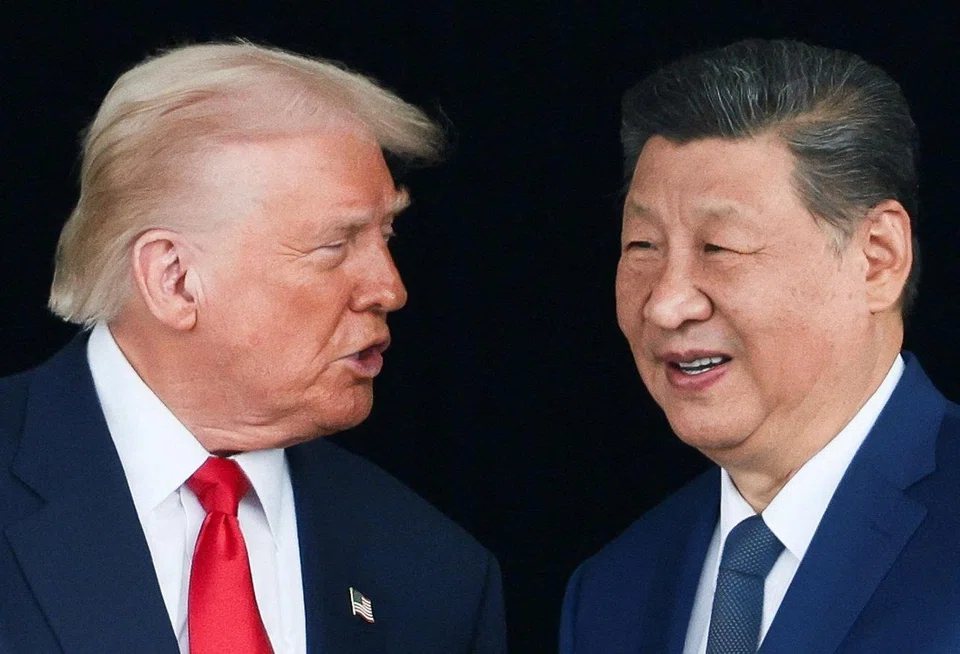
THE Trump-Xi meeting in South Korea on Thursday (Oct 30) represents a tactical pause in what has become an economically punishing conflict for both nations.
Senate Democrats warned ahead of the meeting that Trump was “losing a self-inflicted trade war” with China, leaving the US with a “weak hand”; yet, the outcome suggests both leaders found compelling reasons to step back from the brink.
The economic stakes driving this detente are enormous.
China bought US$12.6 billion worth of American soybeans in 2024, but just US$2.5 billion in the first half of 2025 before implementing an effective boycott, devastating heartland farmers who form a key Trump constituency.
Meanwhile, China’s benchmark Shanghai Composite Index surged this week above 4,000 points – the highest since 2015 – reflecting market optimism about reduced tensions.
The agreement to reduce fentanyl-related tariffs from 20 per cent to 10 per cent and China’s commitment to purchase “tremendous amounts”, as Trump claimed, of soybeans provides immediate relief.
More significantly for global supply chains, China agreed to postpone implementing export controls on rare-earth minerals – accounting for approximately 70 per cent of the global supply of these critical materials that are essential for high-tech industries from electric vehicles to defence systems.
Competing economic strategies: Escalation versus endurance
Analysts note that the US has the “louder” hand; China has the steadier one.
Washington can escalate, but Beijing can outlast.
This asymmetry defines the economic dimension of US-China competition. China has used the trade war to build muscle and resilience – it learnt to do everything faster, cheaper and at scale; it has also diversified its trade relationships, with South-east Asia overtaking the European Union as China’s largest trading partner since 2018.
Trump’s approach of linking market access to national security cooperation through recent trade pacts with Malaysia, Cambodia, and Japan creates an “economic security” framework that could reshape regional supply chains.
Yet, the American president’s tariffs have raised costs on farm inputs such as fertiliser and equipment, squeezing farmers already reeling from lost exports, demonstrating the domestic political costs of sustained confrontation.
Geopolitical tensions deferred, not resolved
The meeting’s most notable feature may be what wasn’t discussed. Trump stated that Taiwan “never came up” and “was not discussed”, despite considerable pre-meeting anxiety in Taipei and Washington about potential policy shifts.
White House aides had privately expressed concern that Trump might shift US policy on Taiwan, with Xi seeking a change from “the US does not support independence” to “the US opposes independence” – a seemingly subtle linguistic shift that would signal a fundamental realignment in regional security.
With the “Davidson window” – the assessment that Beijing could make a move on Taiwan by 2027 – drawing near, the decision to sidestep this issue suggests both leaders recognise the explosiveness of the topic.
Similarly absent from discussions were broader Indo-Pacific security concerns, such as Chinese military activities in the South China Sea and Beijing’s relationship with Moscow regarding Ukraine. This suggests the economic tensions may actually be suppressing, rather than exacerbating, security confrontations – at least temporarily.
The structural competition remains
Experts emphasise there is no expectation that this meeting was going to address some of the core structural issues in the US-China economic relationship, such as excess Chinese manufacturing capacity flooding global markets, unfair trade practices and intellectual property concerns.
The technology competition remains particularly acute, with US restrictions on artificial intelligence chip exports to China continuing and no discussion of lifting Nvidia’s highest-powered chip ban.
The mistrust is structural now; it’s built into how both countries think about power and security, making any lasting accommodation difficult.
China’s recently released five-year plan emphasises deepening technological self-reliance, while Trump’s administration continues linking economic access to security alignment with American allies.
Looking ahead: Managing competition, not resolving it
The Trump-Xi meeting represents successful crisis management rather than strategic reconciliation.
Chinese analysts have emphasised the need for “stability” and “mutual respect”, noting that businesses need to have certainty.
The planned reciprocal state visits – Trump to China in April, Xi to the US afterwards – create a framework for ongoing engagement.
However, the fundamental reality remains unchanged: The US and China are locked in systemic competition over economic models, technological supremacy, and regional influence.
The economic pain on both sides has created tactical incentives for cooperation on specific issues, but the strategic divergence continues unabated.
This meeting bought time and provided relief to farmers, manufacturers, and markets desperate for stability.
Whether it represents the beginning of managed competition or merely a temporary lull before renewed confrontation will depend on whether both sides can find sustainable ways to pursue their interests without triggering economically catastrophic escalation.
The world’s two largest economies have discovered – at least for now – that neither can afford unlimited confrontation.
That realisation, born of economic necessity rather than strategic trust, may prove the most durable outcome of this summit.