

Trump’s return to realpolitik
For the US president-elect, Greenland, Canada and the Panama Canal are geo-strategic assets
FOR the past several weeks, US president-elect Donald Trump has contemplated taking over Greenland, blustered about bringing the Panama Canal back under US control and proposed making Canada the 51st state of America.
One can assume that the president-elect is not planning to invade Greenland or Panama and that the majority of Canadians are clearly not interested, to say the least, in joining the USA now.
But with the collapse of the post-World War II liberal international order and the return to the realpolitik-style great power rivalry, Trump and his aides seem to believe that the international system would eventually be fragmented into spheres of influence. The US, therefore, needs to ensure that its geo-strategic position would be pre-eminent vis-a-vis China, Russia and other rising global players such as India and Brazil.
From that perspective, US northern neighbour Canada, permanently adjacent to America itself, benefits from American military protection but remains a mid-size military power. Hence, it doesn’t pull its weight in Nato, having pledged to hit the alliance’s spending target – 2 per cent of gross domestic product – by 2032.
Canada’s core national interests lie in ensuring continuing American global hegemony as opposed to committing itself to a vague sense of multiculturalism and globalism.
To put it differently, some sort of geopolitical merger with the US would place Canada in a position to shape the contours of the evolving international system, to be seated in the driver’s seat, and to participate in making the policies that would determine its own future instead of negotiating in the shadow of its neighbour.
A huge USA-Canada geo-economic and geo-strategic bloc, both nations with their roots in the Anglo-Protestant past, would be a major counterbalance to a surging China and assertive Russia. It would run contrary to the narrative those and other anti-status quo powers, such as Iran and North Korea, are promoting – that the US-led West is in decline.
When it comes to the Panama Canal, the incoming US president is reasserting the Monroe Doctrine, named after president James Monroe. The doctrine stipulated that any intervention in the political affairs of the Americas by foreign powers is a potentially hostile act against the United States, and proclaimed the Americas as a US sphere of influence.
In that context, the building of the Panama Canal, which was completed in 1914, ultimately provided a critical shortcut for maritime trade and military movement between the Atlantic and Pacific Oceans, solidifying US strategic and economic dominance.
Moreover, it helped lay the foundations for the so-called Roosevelt Corollary to the Monroe Doctrine, named after president Theodore Roosevelt under which the canal was built. It stated that not only were the nations of the Western Hemisphere not open to colonisation by European powers, but that the United States had the responsibility to preserve order and protect life and property in those countries.
After a long debate in Congress and the public, the US agreed in 1978 that the canal would revert to Panamanian control.
Now the president-elect is arguing that the canal’s handover to Panama was “a big mistake” and that “it is vital to our country”. Or as he puts it, “we built it, we paid for it, it’s ours…we are going to keep it”. He also said that he wouldn’t commit to not using military force to win back control of the canal.
Trump has alleged that China has established a military presence in the canal. “It’s being operated by China – China! And we gave the canal to Panama, we didn’t give it to China.”
There is no evidence to support the allegation that Chinese soldiers are running the canal. Trump’s rhetoric, however, seems to be part of an effort to project US geo-strategic power in its sphere of influence and reiterate US opposition to the military presence of foreign powers in the region.
At the minimum, the incoming president wants to ensure that Panama accedes to demands that it reduce shipping costs on US freight or perhaps that the Panamanian ports be managed by a third-party entity. On another level, he wants to turn Panama Canal into a nationalist Make-America-First symbol.
But if we need to take president-elect Trump seriously when it comes to Canada, but not literally when it comes to Panama, we perhaps need to take him both literally and seriously when it comes to Greenland.
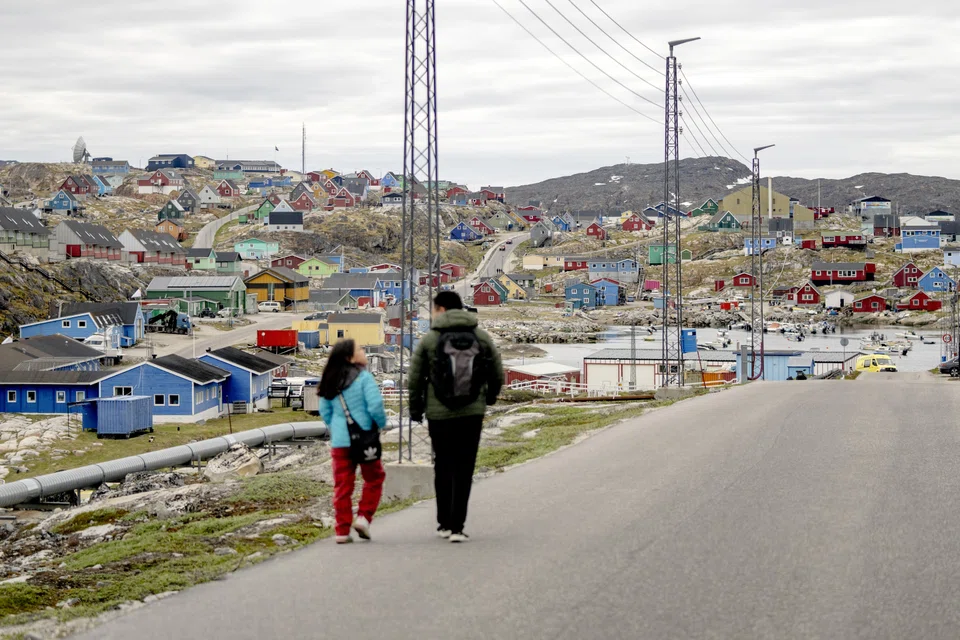
In a way, the ice-covered and sparsely populated island with a strategic location on the edge of the Arctic, not to mention that it is rich with minerals that are critical for new technologies and the military, makes it a geo-strategic focal point for the US and its arch rivals, China and Russia.
Greenland’s location makes it a prime area for missile warning systems, which the US already houses at the military base on the island’s north-west coast, which is home to some 200 US military personnel and 400 troops of allied forces.
Denmark, an old colonial power and a member of Nato, doesn’t have the military capabilities to protect the territory of Greenland against Russian or Chinese incursions.
And that certainly would be the case if and when the 56,000 residents of Greenland win independence.
There is no doubt that an American Greenland would be more successful in monitoring the access routes leading to and from the island.
So the question is under whose sphere of influence would Greenland fall in the coming years?
Indeed, Russia has opened several military bases in the Arctic as tensions with the US and the West over Ukraine have risen, while China has carved out shipping routes through the region and exploited the territory’s natural resources that include deposits of rare earth.
“We need it for national security,” Trump said, expressing his interest in purchasing the island from Denmark but refusing to rule out using military force to seize control of Greenland.
Yet, the idea of the US buying Greenland does make some sense. William Seward, US secretary of state from 1861 to 1869, considered buying the island around the same time that he negotiated the purchase of Alaska from Russia in 1867. More than 60 years earlier, president Thomas Jefferson bought Louisiana from the French, and doubled the size of the USA.
The Economist magazine calculated that Greenland is worth US$50 billion, or a 20th of America’s annual defence spending. Yet factoring in the value of the island’s immense resource wealth, including oil and rare earth, could raise the value of the island to the stratosphere.
This suggests that if the island’s population, enjoying the right of self-determination, seeks political independence, it’s unlikely that they would put Greenland up for sale.
Yet Trump’s aggressive posturing and Greenland’s security dilemmas may put pressure on Denmark, whose own military presence in Greenland is limited to 75 troops, to consider strengthening and formalising cooperation with the US on the island. That would allow for a larger American military presence on the island. It won’t make Greenland American, but it would bring it under US influence.
TRENDING NOW

ComfortDelGro appoints two new independent directors

Once staunchly pro-China, Malaysian Chinese businesses are now distancing themselves from Beijing

NoonTalk needs continued financial support from CEO Dasmond Koh, auditors warn

DP Architects sets the benchmark for sustainability disclosure and design

