Trump’s UK visit: An economic opportunity or political minefield for Starmer?
With leaders from Nvidia, Apple and more among the US delegation, the United Kingdom’s prime minister hopes to secure a crucial economic boost amid mounting domestic pressure
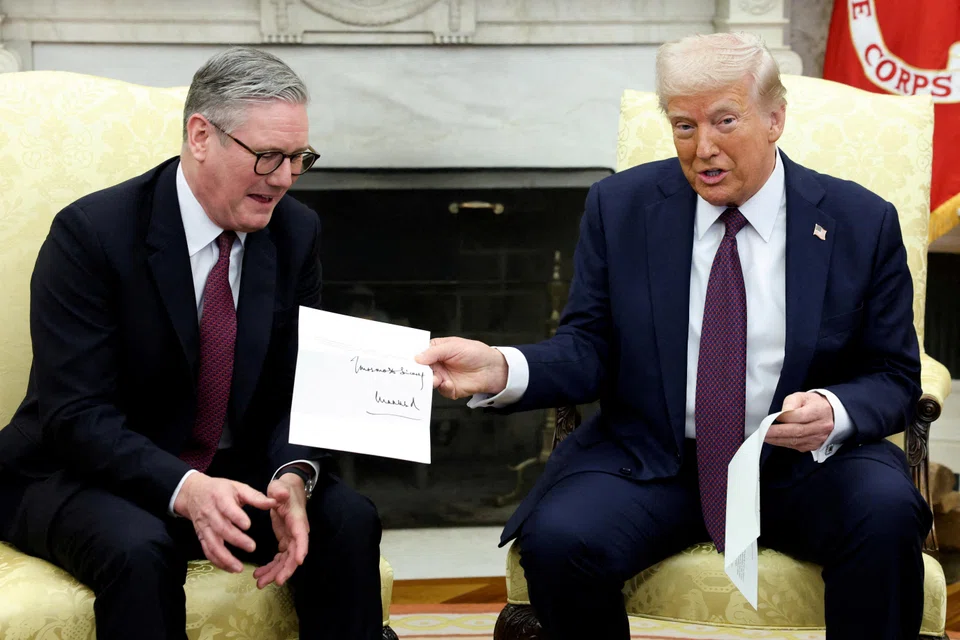
WHEN US President Donald Trump and First Lady Melania Trump arrive in the UK this week for an unprecedented second state visit, they will be met with the full force of royal pomp and political pageantry. Yet underneath the ceremony hosted by King Charles and Prime Minister Keir Starmer lies a deep business rationale.
The scale of the business delegation accompanying Trump underscores the visit’s economic focus. With Nvidia chief executive officer Jensen Huang, Apple CEO Tim Cook, OpenAI CEO Sam Altman and BlackRock co-founder Larry Fink in tow, significant investment announcements are expected.
These reportedly include a £500 billion (S$870.6 billion) Stargate data centre project by OpenAI and Nvidia, and an estimated £700 million investment from BlackRock, as part of a joint venture with Digital Gravity Partners focused on acquiring and modernising data centre infrastructure.
The UK government also hopes to announce investment and job creation figures comparable to the £60 billion it claims was raised at the 2024 International Investment Summit.
Beyond artificial intelligence and semiconductors, key drivers of this economic boomlet include telecommunications and quantum computing, with a new US-UK tech deal reportedly on the table. There will also be enhanced energy collaboration, including on modular nuclear reactors.
Politically, Starmer also hopes to move closer to an agreement with Trump on US tariffs – including on UK steel – and to smooth over tensions on drug pricing, where the president has pressured UK pharmaceutical firms to slash US prescription medicine prices.
To secure these gains, Starmer will harness the full might of British pomp, complete with a royal salute and a fly-past with UK and US F-35 fighter jets, in an attempt to impress the US president, who retains a deep affection for the nation of his Scottish-born mother.
The main formal business event at Windsor Castle will see the Trumps greeted by King Charles, Queen Camilla, Prince William and Princess Kate, followed by a state banquet.
The visit itself is a calculated exception to tradition. US presidents serving a second term are usually invited for tea or lunch with the monarch, as was the case with Barack Obama and George W Bush. The full state visit treatment for Trump, the first non-consecutive two-term president since Grover Cleveland, signals the importance of the visit’s possible outcome.
The urgency behind this is rooted in the UK’s precarious economic position. With 30-year borrowing costs recently hitting their highest levels since 1998, global investors are growing anxious about the UK’s ability to keep its finances in check amid slow economic growth.
With political pressure mounting on Starmer’s government, which is badly behind in the polls to the insurgent Reform UK party, speculators are increasingly betting on a fall in sterling’s value ahead of the Nov 27 Budget. Latest data from the Commodity Futures Trading Commission indicates there are around 30,000 net bets against sterling worth around £2 billion.
In the UK government reset earlier this month, following the resignation of former deputy prime minister Angela Rayner, Starmer bolstered his business team, appointing former Bank of England deputy governor Minouche Shafik as chief economic adviser. He moved Darren Jones, previously deputy to finance minister Rachel Reeves, from the Treasury into Downing Street, and added tech millionaire Jason Stockwood as a new investment minister.
Reeves was kept in post, reflecting her critical role. She, too, will meet Trump’s senior aides this week as she prepares for the Budget that will help define Starmer’s government into 2026.
Yet for all the potential upside, the risks cannot be ignored. The political atmosphere is already clouded by the recent sacking of UK ambassador to the US, Peter Mandelson, over his links to paedophile Jeffrey Epstein. The UK government fears that any renewed focus on Epstein, a former contact of Trump, could darken the mood of the visit.
Trump himself is no stranger to chaos. His last UK state visit in 2018 saw him declare the UK in “turmoil”. Even by his own standards of disruptive diplomacy, that trip was often off-message, undermining then UK prime minister Theresa May’s Brexit policy and praising her rival, Boris Johnson, who had just quit her Cabinet.
Starmer hopes a successful Trump trip will create a window of opportunity to get on the front foot, but he is dealing with a notoriously mercurial president who is hard to keep on message. The coming days will determine if the economic prize is worth the political risk.
The writer is an associate at LSE IDEAS at the London School of Economics