

Unlike horses and carriages, security cooperation and trade ties don’t always go together
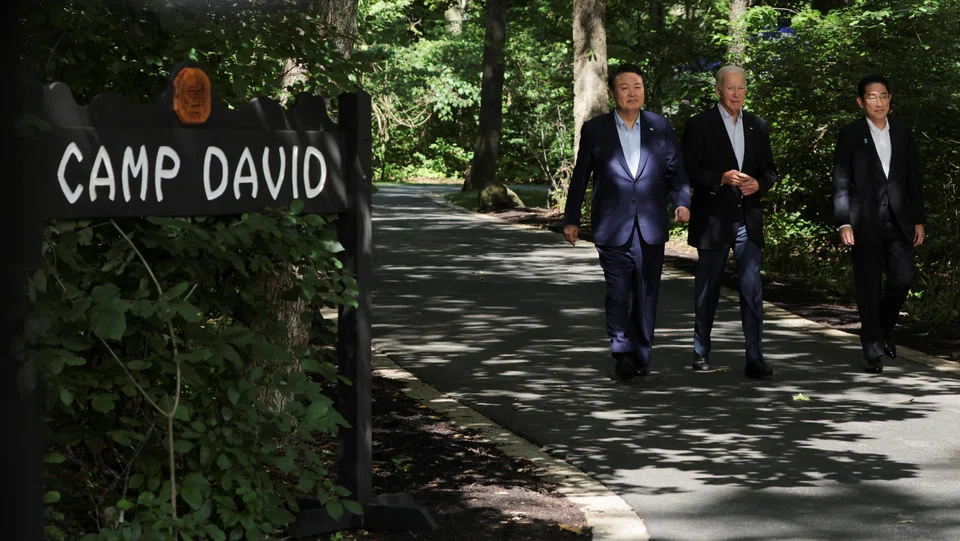
AT THE risk of being accused of “whataboutism”, let us first celebrate the recent American diplomatic success: last week’s trilateral summit with the leaders of South Korea and Japan. Yes! It’s great that President Joe Biden was able to persuade these two North-eastern Asian nations to overcome their historical enmities and join the US in reinforcing their deterrence capabilities vis-a-vis Pyongyang and Beijing.
But then let us also ask: What about the Biden administration’s economic policies, which have ignited tensions with Seoul and Tokyo? If cooperating in the military sphere with these two countries makes a lot of sense, what about the bonds that commercial ties create?
To put it differently, when it comes to US policy towards China, Washington has made it clear that it’s impossible to focus on the military tensions between these two powers without discussing their trade relationship, and vice versa.
According to this line of thinking, containing the rising global strategic power of China requires boosting America’s technological business sector and maintaining its pre-eminent position.
Yet the same foreign policy logic doesn’t seem to apply to the efforts to strengthen US strategic ties with South Korea and Japan, which dominated the agenda during last Friday’s (Aug 18) summit at Camp David, where Biden met with South Korean President Yoon Suk Yeol and Japanese Prime Minister Fumio Kishida. The latter two have invested much political capital in improving their relationship with each other, and in agreeing to follow US leadership in Asia.
But then, some of the economic policies pursued by the US administration are running contrary to those of South Korea and Japan. They anger domestic constituencies in both countries and could hurt the two leaders politically. What gives?
More specifically, some of the legislation approved by Congress last year as part of Biden’s climate bill includes restricting vehicle trade credits to electric cars assembled in North America. Other bills provide American subsidies for US-based semiconductor factories and impose export controls that target China – moves that could have major negative impacts on the economies of Japan and South Korea.
In a way, going into economic battle with China could, in the process, turn these two US allies into victims. This does not seem to align with the growing sense of unity and shared purpose with the US that they exhibited during the trilateral conference at Camp David.
Indeed, South Korea is a leading producer of memory chips, and both economies are carmakers and rely heavily on Chinese labour and markets. As they join America in dealing with security challenges posed by Beijing, they could lose the benefits they derived from their close economic ties with China, by, among other things, denying carmakers like Hyundai access to the tax credits stipulated by the new US laws.
The Biden administration has taken some corrective steps in response to the two governments’ complaints, including opening up more tax credits for carmakers in Japan and South Korea.
It is more difficult to deal with the dilemmas facing South Korean companies like Samsung and SK Hynix, which invested billions of dollars in building plants in China where they produce advanced chips. These firms are now facing American export controls that restrict China’s ability to produce such chips, a move that could force these businesses to pull out of China.
In response to the concerns of these South Korean companies, the Biden administration said that it plans to allow top semiconductor manufacturers from South Korea (and Taiwan) to maintain and expand their existing chipmaking operations in China.
And last October, after implementing curbs on China’s semiconductor sector, the US also provided one-year exemptions to several companies – including South Korea’s Samsung. The US is now saying that the exemptions will be renewed in the foreseeable future.
The move to extend these exemptions, instead of winding them down, suggests that US efforts to isolate China from high-tech products could be “mission impossible” in an integrated global economy. It also highlights the backlash from foreign governments that are irked by Washington’s growing interference in their business operations.
The reality is that the US is in a much stronger position to dictate the outcome of these unbalanced relationships they have with South Korea and Japan, whose survival – as they face China’s security challenges – depends on maintaining their defence relationship with Washington, but not vice versa.
In fact, Biden administration officials can argue that they can pursue what amounts to a nationalist economic agenda cost-free. If anything, its strategy is forcing Japanese and South Korean companies to invest in the American manufacturing industry, including semiconductor production plants. This helps create new American jobs, strengthen the country’s technological sector, and in turn help Biden win more votes in 2024. Meanwhile, the Japanese and South Korean leaders may be punished by voters upset by the costs of the economic ties with the US.
But then, one of the main reasons for the South Korean and Japanese leaders’ beeline to Camp David last week has to do with American politics. They rushed to buttress their ties with Washington before Biden could, by end-2024, be replaced by an economic nationalist and isolationist president who would make the current White House occupant look, in retrospect, like a raving internationalist.
TRENDING NOW

One-third of Singapore-listed firms at risk in severe AI downturn: MAS

‘Not done’: Keppel CEO Loh Chin Hua transformed the group, but says there’s ‘still a lot to do’

He built the Vingroup empire. Now South-east Asia’s richest man is handing some key roles to his sons

‘We don’t want to stay as we are’: CEO Patrick Ng builds a more resilient Huationg

