US ‘decline is over’, ‘golden age’ begins now: Trump
With a powerful political base, he is in a position to advance his ambitious agenda at home and abroad
 Add BT as a preferred source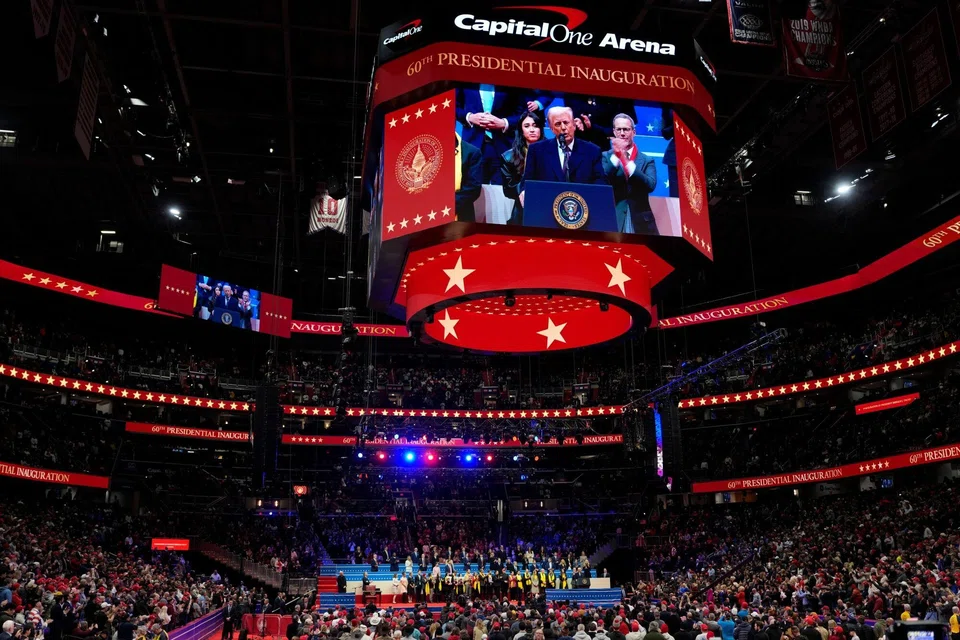
AFTER he was sworn in on Monday (Jan 20), President Donald Trump proclaimed in his inaugural address that “the golden age of America begins right now”.
“From this day forward, our country will flourish and be respected again all over the world. We will be the envy of every nation, and we will not allow ourselves to be taken advantage of any longer,” he said as he celebrated his remarkable political comeback. He insisted that he “was saved by God to make America great again”, vowing that the nation’s challenges would be “annihilated”.
Portraying the US government as failing, and railing against illegal immigration and responses to natural disasters, President Trump promoted his agenda that includes cutting the size of the federal government, high tariffs, mass deportations and reassessment of America’s role in the world.
“In the United States of America, as we gather today, our government confronts a crisis of trust,” he said. “For many years, a radical and corrupt establishment has extracted power and wealth from our citizens, while the pillars of our society lay broken and seemingly in complete disrepair,” he argued, portraying himself as the saviour of a country in decline.
While he sounded combative and despondent in his 2017 inaugural address when he lamented on “American carnage”, President Trump seemed more heartening and optimistic this time.
“I return to the presidency confident and optimistic that we are at the start of a thrilling new era of national success,” Trump, at 78, the oldest person to take the office, declared. “My message to Americans today is that it is time for us to once again act with courage, vigour and vitality of history’s greatest civilisation.”
Saying that the “tide of change is sweeping the country”, the 47th president declared that America’s “decline is over”.
“We will pursue our manifest destiny into the stars by launching American astronauts to plant the Stars and Stripes on the planet Mars,” Trump promised.
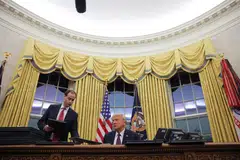
The president signed several executive orders within hours of returning to the White House, with border security, energy production and cutting federal diversity programmes at the forefront.
“I will declare a national emergency at our southern border,” Trump said. “All illegal entry will immediately be halted, and we will begin the process of returning millions and millions of criminal aliens back to the places from which they came.”
President Trump also said that he would declare Mexican drug cartels foreign terrorist organisations and rename the Gulf of Mexico as Gulf of America.
He promised to temper inflation in part by declaring a national energy emergency, promoting drilling for fossil fuels and reversing president Joe Biden-era policies aimed at combatting climate change.
Freezing temperatures forced the inauguration ceremony inside the US Capitol. The last time that happened was during president Ronald Reagan’s second inauguration in 1985.
But the frigid weather didn’t prevent thousands of President Trump’s supporters from descending onto Washington, DC, filling the hotels, restaurants and bars.
And while much of the city was barricaded, there were no signs of widespread protests, reflecting the waning public opposition to President Trump.
If anything, he enters the White House with much more support than when he first took office eight years ago, after succeeding in attracting more working-class voters in the 2024 election, including Black and Hispanic voters.
Indeed, according to a recent New York Times/Ipsos poll, many Americans who may still dislike President Trump personally, now support some of his most contentious proposals.
Hence 55 per cent of Americans either strongly or somewhat support his call for mass deportations, according to the poll.
And 46 per cent of Americans say that trade with foreign nations should be subject to increased tariffs, while a large majority is sympathetic to efforts, backed by President Trump, to strictly limit how doctors can treat children struggling with gender identity.
President Trump enjoys unified support by the Republicans who now narrowly control the House of Representatives and the Senate. At the same time, the US Supreme Court is dominated by conservative Justices, including those nominated by the president during his first term.
This political reality provides President Trump with an opportunity to advance his ambitious agenda, including passing massive tax-cut packages, boosting American energy production, and overhauling the Justice Department and the intelligence agencies.
On foreign policy, President Trump is expected to pursue a nationalist America-First agenda that places emphasis on US security and American geo-strategic and geo-economic interests, playing down such goals as the promotion of human rights and democracy abroad, and embracing scepticism regarding US military interventions overseas. Indeed, during his inauguration address, Trump told his audience he would like to be remembered as a “peacemaker” as president.
President Trump has already asserted his commitment to maintain a US sphere of influence in its hemisphere that includes Canada, the Panama Canal and even the island of Greenland. In his address, he said that the United States is “taking back” the Panama Canal, repeating previous false claims that “China is operating” the waterway.
He has also put pressure on US European allies to protect their security interests, in their sphere of influence, including in Ukraine. He promised to bring an end to that war in a very short time.
Yet US relations with China are expected to dominate the new president’s global strategy. President Trump has already promised to impose a set of punishing tariffs on China, although he refrained from elaborating on how he would respond to a Chinese invasion of Taiwan.
In the Middle East, President Trump has vowed to prevent Iran from acquiring nuclear weapons and to promote peace between Israel and Saudi Arabia.
Trump’s earlier threat that “all hell will break out” if Israel and Hamas did not reach a ceasefire in the war in Gaza before his inauguration helped facilitate an agreement between the two sides that led to the release on Sunday of three Israeli hostages held by Hamas since Oct 7, 2023.
“America will reclaim its rightful place as the greatest, most powerful, most respected nation on Earth, inspiring the awe and admiration of the entire world,” President Trump said in his address.
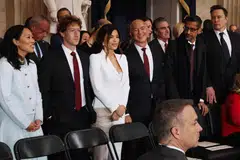
The world may not be bending before the new president – unlike members of the business community, including Silicon Valley’s technology moguls, notably Amazon’s Jeff Bezos, Meta’s Mark Zuckerberg and Google’s Sundar Pichai, who were conspicuously in attendance at the inauguration ceremony at the US Capitol Rotunda on Monday.
Leading the list of billionaires who are bowing down before President Trump is the world’s richest man, Elon Musk, who will oversee a Department of Government Efficiency (Doge) that aims to reduce the size of the federal government. He reacted in glee at Trump’s mention of plans to plant the US flag on Mars – a mission close to the heart of the SpaceX CEO, who has plans to launch spacecraft to the Red Planet.
Decoding Asia newsletter: your guide to navigating Asia in a new global order. Sign up here to get Decoding Asia newsletter. Delivered to your inbox. Free.
Share with us your feedback on BT's products and services