

US central bank’s ‘new phase’ suggests the party is over for Wall Street
Before the December meeting, US financial markets had been drunk on rate-cut euphoria over the last three months
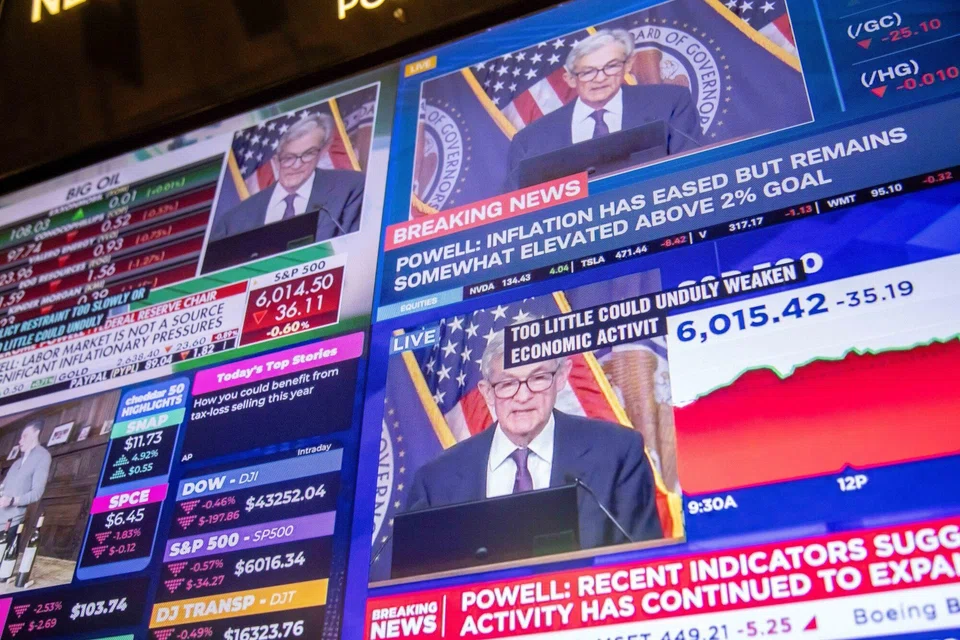
THE Grinch arrived early to steal Wall Street’s Christmas this year.
At its December meeting on Wednesday (Dec 18), the US Federal Reserve cut interest rates by a quarter of a percentage point to a range between 4.25 and 4.5 per cent – a decidedly hawkish cut.
The central bank unexpectedly shifted from a focus on economic support back into inflation-fighting mode.
Fed chairman Jerome Powell made it clear he was cutting the stock bulls off, after they had had months of gorging themselves at the punchbowl. There would be no more freebies, he warned; no more rate cuts unless inflation behaves itself.
Powell lauded the central bank’s success in pulling inflation back into line, but also acknowledged the fact that it was beginning to get a bit out of hand again.
“We’re in a new phase,” he said. “From this point forward it’s appropriate to move cautiously and look for progress on inflation. We’ve done a lot to support economic activity with 100 basis points of cuts. From now, we are in a place where the risks are in balance, and we need to see progress on inflation.”
Fewer cuts
The biggest shock for the stock market came in the Fed’s latest “dot plot”, the first tally of voting central-bank board members’ rate projections since September.
In September, falling inflation and rising unemployment had resulted in an average expectation of four rate cuts in 2025. On Wednesday, that expectation had fallen to two.
In its formal statement, the Fed warned that the “timing and extent” of rate cuts were now less certain – meaning that an indefinite pause was possible if inflation suddenly spiked again, as some economists say is possible.
At the press conference, Powell was asked whether that reflected Fed concerns about the incoming Trump administration’s vow to raise tariffs on imports from its largest trading partners: Canada, Mexico and China.
Powell acknowledged the Fed was monitoring the inflationary risk of this policy, but denied that this was having any significant impact on projections so far.
Rather, he said, the main factor behind the more neutral stance was the recent uptick in inflation.
While inflation still appears to be heading in the right direction, the central bank is obliged to respond to the unexpected increases in consumer inflation in September and October.
The main concern in September – when the Fed made the first of its three rate cuts this year – was the risk of deteriorating labour markets, but risks are now perfectly balanced, he said.
The US economy has surprised the Fed and the world with its remarkable resilience, he added. The labour market is still slowing but in an “orderly” fashion. Job security is as strong as it was pre-pandemic for most US workers, even if most companies are not hiring new workers aggressively.
But the outlook has been dimmed by ambiguity about the Trump administration’s precise economic and trade policies, and the fact that both inflation and employment data are surprising to the upside.
“It’s common sense, when the path is uncertain, to go a little slower,” said Powell. “It’s not unlike driving on a foggy night or going into a dark room full of furniture.”
Keeping an eye on labour
One brokerage said the Fed was premature in shifting its focus away from the labour market.
As one journalist pointed out during the press conference, the unemployment rate is unchanged from September, when the Fed believed the labour market was in so much peril that it took the drastic step of cutting rates by half a percentage point.
Central bankers may regret this vow to wait and see what happens with jobs, said strategists at brokerage Standard Chartered.
“The hawkish lean today was so pronounced we doubt they can get enough ‘bad’ data in January to justify a cut, but we don’t think that the economic picture has changed as dramatically as the Fed projections have,” said the Standard Chartered strategists, in a note to clients.
The US could see a more rapid increase in unemployment than Powell anticipates, and that could lead to yet another pivot – yet another “new phase”.
Sobering up
The US financial markets were undoubtedly drunk on rate-cut euphoria over the last three months. The Russell 2000 index of small caps, the index most tied to the US economy, rose about 20 per cent between September and its peak a few weeks ago.
On Wednesday, the Russell plunged by more than 4 per cent. It is now in correction territory, more than 10 per cent below.
There’s a chance that inflation will pick up. Beef, coffee and cocoa prices are all hovering near all-time highs because of drought, livestock diseases and tariff threats. A range of other commodities and consumer products could see prices rise if the Trump administration carries out its tariff threat.
The yield on the 10-year Treasury, a benchmark for many consumer loans, surged to its highest level since May, testing the 4.5 per cent level following the Fed’s statement.
“We believe investors should anticipate a deceleration in the pace of rate cuts in 2025 and near-term volatility as markets recalibrate the Fed’s standpoint,” said Solita Marcelli, chief investment officer Americas, UBS Global Wealth Management, in a note to clients.
But she stuck to her bullish projection for US stocks’ 2025 performance, noting the resilience of the economy, the artificial intelligence boom and other factors that will offset inflation and rate risks.
TRENDING NOW

Once staunchly pro-China, Malaysian Chinese businesses are now distancing themselves from Beijing

Britain’s mansion tax shows the difficulty of targeting wealth

Three hats, one goal: How Ng Kian Swan runs sustainability at NUHS

COE review: The gap between luxury and mass-market cars isn’t the only one worth bridging

