

US GOP primary: Does Tim Scott have a chance?
THE political news in Washington last week was dominated by the Republican Florida Governor Ron DeSantis’ launch of his presidential campaign on a live Twitter chat on Wednesday evening (May 24) that was plagued by glitches, but which nonetheless enjoyed an audience of hundreds of thousands of listeners.
From that perspective, less attention was focused on Republican politician Tim Scott – South Carolina’s first Black senator and now the Senate’s lone Black Republican, whose personal and political story embodies in many ways the American dream – when he declared his candidacy for president last Monday.
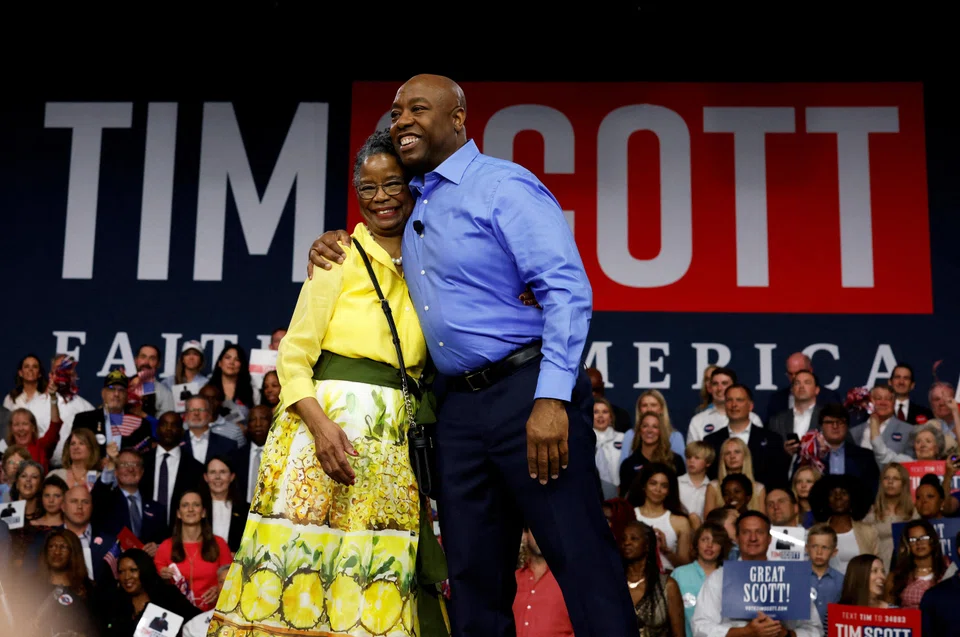
“We live in the land where it is possible for a kid raised in poverty by a single mother in a small apartment to one day serve in the People’s House and maybe even the White House,” said 57-year-old Senator Scott, who held the official announcement event at his alma mater, Charleston Southern University. He was speaking in front of supporters, with his name and campaign slogan, “Faith in America”, on the backdrop.
“America is the city on the hill,” Scott said in his closing remarks. “I’m living proof that God and a good family and the United States of America can do all things if we believe,” he stated, asking his supporters: “Will you believe it with me?”
Scott credits his mother, who worked 16-hour days as a nursing assistant to support her family. This enabled him, growing up in his grandparents’ 700-square-foot rental house, to rise from working-class poverty to the US Senate. “Those 16-hour days put food on our table. And kept our lights on,” he recalled. “They empowered her to move her boys out of a place filled with anger into a home full of love.”
Senator Scott was first appointed to the Senate in 2013, pulled out from the US House of Representatives by then-South Carolina governor Nikki Haley, whom he will now face in the Republican primary race. Scott then retained his seat in a 2014 special election and skated to victory again in 2016 and 2022, with more than 60 per cent of the vote in both cycles.
While his polling for the 2024 Grand Old Party (GOP) nomination remains in the low digits, Senator Scott has been able to create a buzz among party activists and donors, not to mention the media, which are intrigued by the spectacle of a credible African-American Republican politician running for president and jumping into a primary race that is currently dominated by former president Donald Trump, the frontrunner, and his main challenger, Florida Governor DeSantis.
Indeed, it may not be surprising that Republican figures, like Senator John Thune of South Dakota, the Senate’s number-two Republican, have endorsed his candidacy, and that major donors, including tech company Oracle founder Larry Ellison, have contributed to his campaign – which explains why he would be joining the race with US$22 million in his box, more campaign cash than any of the other candidates have.
The conventional wisdom in Washington now is that DeSantis’ momentum has been slowing down while Trump’s support is being solidified as the former president enjoys the backing of leading lawmakers. The Florida governor has failed to win the support of even the major Republican politicians in his state; apparently he seems to have difficulties “connecting” with voters due to his somewhat “introverted” personality.
The expectation is that at some point during the Republican primaries, when the former president’s nomination would seem to be inevitable, members of the Republican Party’s establishment, including major donors who believe that candidate Trump would have no chance to win the 2024 general election, would unite behind a “Stop Trump” campaign.
That would mean pressing all the other Republican candidates – who currently include, in addition to Senator Scott and former governor Haley, other hopefuls such as wealthy Indian-American entrepreneur Vivek Ramaswamy, with ex-vice-president Mike Pence, former secretary of state Mike Pompeo and New Jersey Governor Chris Christie also considering a run – to withdraw from the race and congregate behind the candidate who would have the best shot at beating Trump and winning the general election.
Senator Scott and his allies believe that he could emerge as exactly that kind of compromise candidate who could unite the divided GOP, win the support of both conservatives who are inspired by his embrace of traditional values, and moderates who see him as an antithesis to the polarising Trump and his racialist and xenophobic attitudes.
At the same time, Senator Scott also reminds many Republicans and politically independent voters of former president Ronald Reagan, who, notwithstanding his conservative views, projected a “sunny” personality and a sense of optimism during the 1970s that, very much like today’s America, reflected sentiments of doom and gloom.
Candidate Scott could also draw support from not only African-American voters, but even Democrats who are unhappy about the idea of an elderly Democrat president running for re-election and are keen on having a “fresh face” in the White House. They would never vote for former president Trump or Governor DeSantis. But they might consider Republican candidate Scott.
But Scott has to date refrained from criticising the former president or, for that matter, the Florida governor, and many doubt very much that he would be willing to pick a fight with Trump, and believe that his more realistic plan is to market himself to the winning presidential nominee as a positional vice-presidential candidate.






