NEWS ANALYSIS

The US government shutdown didn’t happen again, but patience wears thin
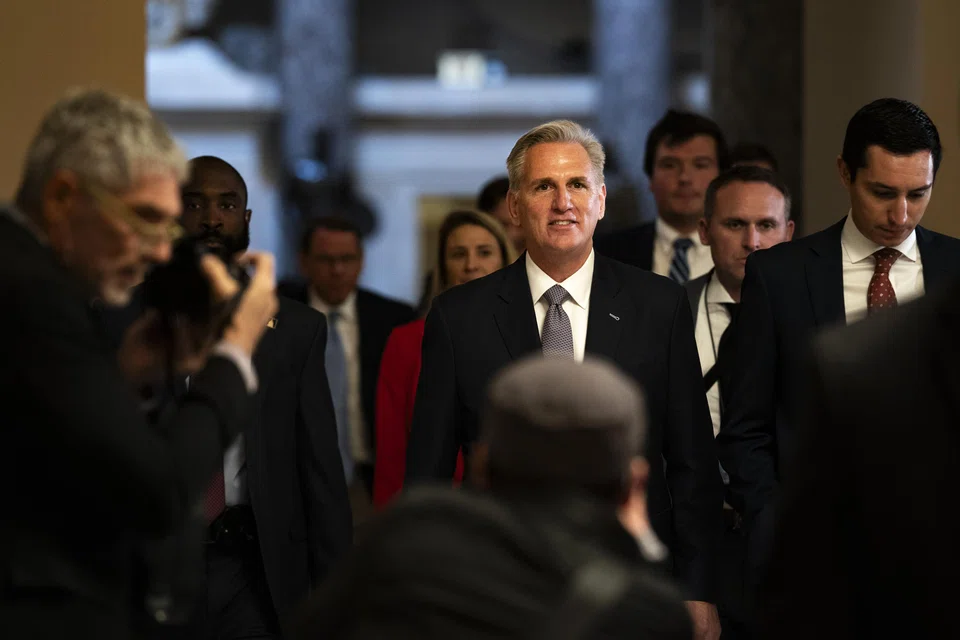
    • US House Speaker Kevin McCarthy at the US Capitol in Washington on Sep 30, 2023. He struck a compromise deal with Democrats over the weekend, averting a government shutdown.
    • US House Speaker Kevin McCarthy at the US Capitol in Washington on Sep 30, 2023. He struck a compromise deal with Democrats over the weekend, averting a government shutdown. PHOTO: NYTIMES
    Published Mon, Oct 2, 2023 · 12:44 PM

    TO THE great surprise and relief of stock traders and politics observers the world over, the US government did not blow itself up in the latest budget debate.

    Stocks are bound to rally in relief as the government averted a shutdown, with US futures already higher in Asian trading hours. But the continuing resolution that was signed late on Saturday (Sep 30) will only keep the US government open for another 45 days, meaning the celebrations may be short lived.

    It may have cost US House Speaker Kevin McCarthy his job, but he struck a compromise deal with Democrats, agreeing to continue all funding at current levels, excluding controversial Ukraine aid.

    Coming just hours before all budgetary authorisation expired, the deal was another instance of the high-stakes brinksmanship that has become the hallmark of Capitol Hill in recent years, exasperating voters, investors and analysts.

    “It shouldn’t have been this complicated,” said Maya MacGuineas, president of the Committee for a Responsible Federal Budget, a non-partisan organisation, in a statement. “We had to endure an absurd amount of wasted hours, palace intrigue, and breathless media countdown clocks, to arrive at this sensible outcome of a short-term continuing resolution.” 

    Already, Florida Republican Matt Gaetz has launched a campaign to oust McCarthy as head of the Republicans in the House of Representatives, taking the position that a shutdown was preferable.

    McCarthy, for his part, has accused Gaetz and the other Republican dissidents of a nihilistic approach to the spending debate, seeking to “burn the whole thing down”. Gaetz was one of a handful of far-right Republicans who repeatedly blocked McCarthy’s nomination, forcing the veteran Californian legislator to sign a pledge to cut spending they now say he has violated.

    Investors had braced for the fourth shutdown in a decade, selling out of stocks and US Treasury bills last week.

    Had the compromise not been reached on Saturday evening, thousands of non-essential federal workers – from mailmen to Securities and Exchange Commission officials – would have faced furloughs and many routine parts of government would have ceased.

    This time around, the warnings from Wall Street firms had been dire. A shutdown would leave “markets and the US Federal Reserve in an extended fog”, warned analysts at BNP Paribas.

    “When you’re looking at a data-dependent Fed, will they be able to access needed data if the federal government is shut down?” said JD Joyce, president of financial advisory Joyce Wealth Management.

    Fitch Ratings cut their view on US debt in August, citing exactly the kind of “dysfunction” and brinksmanship that characterised the September budget fight in the House of Representatives.

    Moody’s Investors Service – the only one of the three major ratings firms that still had the top AAA rating on the US – echoed Fitch’s logic, warning that a shutdown would be the last straw. S&P Global, for its part, had cut its view on US debt during an Obama-era shutdown in 2013.

    Analysts at brokerage Goldman Sachs had estimated a shutdown would lop 0.2 percentage points a week off gross domestic product. With growth already negative if adjusted for inflation, a further slowdown would soon begin to sting.

    Despite the compromise, investors still have plenty to worry about. Long-term Treasury yields have spiked, with many testing multi-decade highs of around 5 per cent, because of fears that the Federal Reserve will have to keep raising rate hikes to quash inflation.

    A downgrade from Moody’s would likely have caused another leg up in yields – and that would have triggered a further leg down in stocks. Other factors, including a move in oil prices above US$100 a barrel, could have the same effect. Stocks are already undergoing something of a correction, with the Nasdaq 100 down more than 10 per cent from its artificial-intelligence inspired summer high.

    Despite the compromise, the dysfunction that credit-ratings agencies fret about in Washington is still very much alive. Shutdowns have been part of House Republicans’ playbook since the “Tea Party” wing of the party orchestrated one 10 years ago, when Joe Biden was then the vice-president. There were two more during the Trump administration, also called by the far-right Republican fringe.

    If Gaetz and his allies, including Marjorie Taylor Greene, purge McCarthy for passing the continuing resolution, it’s unlikely his replacement will be able to forge another compromise to avoid a shutdown in November. These fringe Republicans appear to be on an extended campaign to permanently shut down the US government.

    Meanwhile, the likely 2024 presidential candidates, the incumbent Biden and his Republican challenger Donald Trump, are both under investigation. Trump is bitterly branding all criminal complaints against him as politically motivated, while Biden is facing bitter, politically motivated complaints in a tenuous impeachment probe. The stage is set for more dysfunction and, possibly, more civil unrest.

    For now, investors will celebrate a brief moment of political sanity – the shutdown that wasn’t.