

A US war president: America faces a historic moment
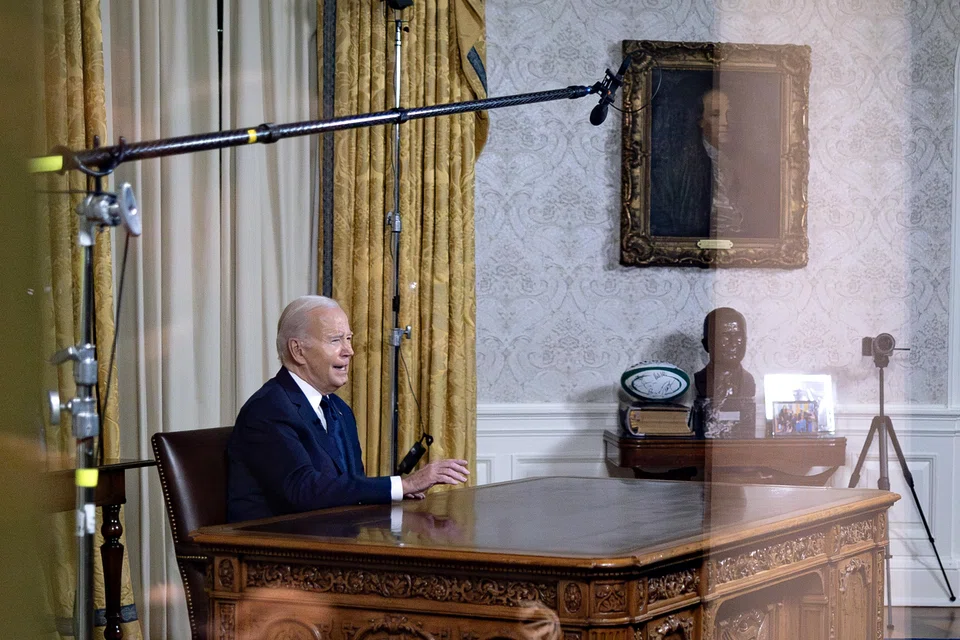
DURING his address to the nation last Thursday (Oct 19), US President Joe Biden told Americans that their country is now facing a new world of threats, an “inflection point”, and that as the commander-in-chief, he is ready to insert them into two wars in which America’s global leadership position would be tested – and in the process, his own role too as a war president.
The current White House occupant will probably be recalled as the last American president whose world-view was shaped by the events of World War II and the Cold War, in which America led the West towards victory over the enemies of freedom.
Now, he is asserting the country’s role in defending Ukraine against a nuclear-armed Russian aggressor and pledging assistance to Israel in its fight against the terrorists of Hamas.
And at the age of 80, he has visited these two countries in the midst of war, demonstrating his commitment to both of them, while at the same time dispensing advice to their leaders.
The US president has challenged growing isolationist sentiments in both major political parties in the nation, with many right-wing Republicans opposing aid to Ukraine and some progressive Democrats questioning the support for Israel, and demanding that the US reassesses its commitment to these two countries.
He is therefore trying to mobilise the support of Congress and the American people for reasserting the US global position in fighting dictators and terrorists after several years during which they were pressing their leaders to start retreating from the world. President Biden made clear on Thursday that America is back, ready to fulfil its mission of maintaining global stability and promoting the nation’s ideals.
The wars in Ukraine and the Middle East “can seem far away”, he said during his Oval Office address last week. “And it’s natural to ask: Why does this matter to America?”
As he then explained, “history has taught us that when terrorists don’t pay a price for their aggression, they cause more chaos and death and more destruction”, resulting in direct threats to American national interests.
Russian President Vladimir Putin and Hamas may “represent different threats”, but they “both want to completely annihilate a neighbouring democracy”, he said.
During his address President Biden stressed that the US will refrain from direct military intervention in the wars in Ukraine and Gaza. In the case of Ukraine, he succeeded in mobilising the Western allies in providing critical military and economic assistance to the Ukrainian people, providing them with the resources to stand up to the Russians.
In the Middle East, President Biden has ordered the deployment of two US aircraft carriers and 2,000 Marines to the region, not to join the Israelis to fight in Gaza but to warn Iran and its regional proxies not to intervene in the war between Israel and Hamas, a move that could ignite a military confrontation between Israel and Iran that could draw the US into the battle.
The president has also made it clear to the Ukrainians and the Israelis that in exchange for the American assistance the US requires that they take certain steps. He demanded that the Ukrainian government get rid of the corruption that is rife in some of its institutions. And he insisted that while fighting Hamas, Israel needs to maintain the rules of war and in particular to avoid innocent civilian casualties among the Palestinians.
The Biden administration is now asking Congress for US$61 billion in new assistance for Ukraine, including replenishing US weapons stocks, and US$14 billion as a part of an aid package to Israel, including help in the country’s air defences.
These steps represent a reversal of a process of an earlier American disengagement from the Middle East after the fiascos of the wars in Iraq and Afghanistan, and the weakening of the ties with America’s European allies under former president Donald Trump.
In fact, when he stressed that “American leadership is what holds the world together”, President Biden seemed to have been appealing directly to the American people, who have been exhausted by the rising human and economic costs of the nation’s military interventions around the world since the end of the Cold War.
Unlike the older folk, those of the generations of World War II and the Cold War, younger Americans are more “inward-looking” and less inclined to support an activist global US role.
Interestingly enough, US interventions in Ukraine and the Middle East are taking place at a time when the talk in Washington has been about bidding farewell to these parts of the world and diverting more resources to deal with the rise of China in the Indo-Pacific region, or the vaunted “pivot” to Asia.
But President Biden insists that the moves to expand US military engagement in Europe and the Middle East would not distract from the US strategy to boost America’s strategic presence in East and South Asia. In his Oval Office address last week, he also asked Congress for US$7 billion to pay for America’s Pacific priorities, in particular to defend Taiwan.
If the Republicans on Capitol Hill would get their act together and finally succeed in electing a new Speaker for the House of Representatives, which could happen this week, it is expected that President Biden’s requests for funding the new US war efforts will enjoy bipartisan support.
After all, the American people and their representatives must recognise, like their president, that their nation is facing now a historic moment, not unlike those it had confronted on the eve of World War II and the Cold War.
TRENDING NOW

Two Singapore-listed palm oil firms named in Greenpeace report on Indonesian plantation fires

Singapore Airlines flight returns to San Francisco after ‘unruly’ passenger incident

Singapore looking into which companies responsible for haze-causing fires: PM Wong

Deluge IPO 3.86 times subscribed ahead of SGX debut

