
What exactly were we cheering for at the Olympics?

It’s great to root for Biles, Marchand and Lyles, but let’s be clear about what we’re celebrating
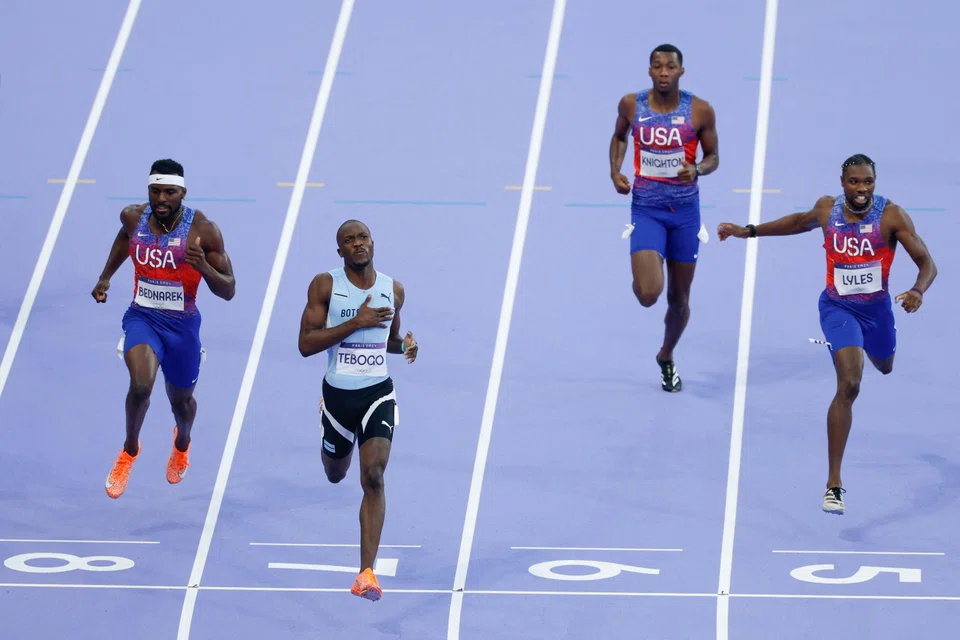
    • Botswana won its first Olympic gold ever when Letsile Tebogo beat out his rivals in the men's 200-metre sprint in Paris on Aug 8, 2024.
    • Botswana won its first Olympic gold ever when Letsile Tebogo beat out his rivals in the men's 200-metre sprint in Paris on Aug 8, 2024. PHOTO: AFP
    Published Mon, Aug 12, 2024 · 06:15 PM

    I WAS a messy Olympics fan. During the Games in Paris, I rooted for several national delegations.

    Because I was born in the Philippines, I cheered for the Filipinos. I am ethnic Chinese, so I was thrilled by the achievements of China, Hong Kong and, uhm, Chinese Taipei. I am an American citizen, so I am happy when Team USA is No 1 (or 2 or 3). I live in London, so whenever the UK medalled, I experienced frissons of delight.

    I also found myself celebrating when these categories blended together, say, the triathlon gold going to the UK’s Alex Yee, the son of an overseas Chinese father and an English mother. Or when I heard that the most decorated member of the US fencing team, Lee Kiefer, has a Filipino immigrant mother.

    Then there was that scene after the men’s gymnastics floor exercise where the Philippines’ Carlos Yulo, who won gold, shared the podium with the UK’s Jake Jarman, who took the bronze and whose mother is from Cebu in the central part of my native archipelago.

    But I also cheered for the nations that medalled for the first time in Olympic history: Cape Verde, Dominica and Saint Lucia. Botswana won its first gold ever when Letsile Tebogo beat out US superstars Kenny Bednarek and Noah Lyles in the men’s 200-metre sprint.

    And for the rising powers that have yet to reflect that status fully at the Olympics: India, Nigeria, Pakistan, Indonesia. Especially moving are tales like the Pakistani village that raised the money for its native son Arshad Nadeem to train for what would be an overwhelming gold medal in javelin.

    There is a kind of satisfaction that comes to everyone when countries unused to athletic achievement notch precedent-setting victories – a joy as heartfelt as national and ethnic pride.

    But while cheers and huzzahs may sound alike, they all come from different parts of the heart. Some websites, for example, re-ranked the top 10 medalling countries by distributing the medals per capita. I suspect an Antipodean hand in that because, heading into the final weekend by that measure, Australia was No 1, followed by the Netherlands, France, the UK and South Korea, relegating the two big Olympic superpowers, the US and China, to seventh and 10th, respectively.

    A more judicious use of the parameter would reorder not just the top 10 medal winners, but all participating nations. The top five spots would then go to Grenada, Dominica, Saint Lucia, New Zealand and Jamaica. It is not as if Australia needs more boosting: it came in at No 4 behind the US, China and Japan in the final medal standings that weights for gold.

    In any case, prizes are won by individual humans (or groups of humans who have trained together as a team), not by anonymous parcels of the population.

    It is one thing to take pride in people from your country or ethnic group. It is another to insinuate that victory is evidence of some kind of broader superiority. Patriotic prejudice is one thing, but I also have to catch myself when I applaud victories of people who are part-Filipino or part-Chinese and hold other citizenship. What exactly am I cheering? An Olympic medal justifying some nebulous race-based advantage?

    The Olympics have been a way for once-downtrodden countries to emerge from histories as 100-pound weaklings: nation-building by way of bodybuilding, so to speak.

    Most recently, China boosted its self-esteem with a sports prowess to match its economic renaissance. But even that did not come overnight. The country has been part of the Olympic movement for decades, but it won its first gold medal only in 1984 in Los Angeles.

    The national medal rankings of each Summer Olympics can be less impressive than they appear. The 1984 Los Angeles Games, for example, were marked by the absence of the Soviet Union (tit for tat because the US boycotted the Moscow Games in 1980). This year’s Paris Games did not see the participation of Russia. Who knows what the standings in track and gymnastics would have been if Moscow had not been banned because of its invasion of Ukraine.

    Nowadays, the Chinese – in the middle of trying economic times – are wondering if their government is spending too much money on athletics. Gold medals, though, are proof that developing countries, too, can have First World problems.

    And it is good to have a sense of humour about physical prowess and victory. The Indian-American standup comic Zarna Garg joked about her homeland’s paucity of gold medals. “So the two big sports for Indians at the Olympics? Shooting and archery,” she says. “What do shooting and archery have in common? You don’t move. I make breakfast for my family and I move more than those guys.”

    That may all change in 2028 when an “Indian” sport becomes part of the next Summer Games in Los Angeles. Cricket, anyone? BLOOMBERG



