

What more can Xi Jinping do for China Inc?
Beijing wants more high-end manufacturing, but it’s on Chinese companies to make the next big leap
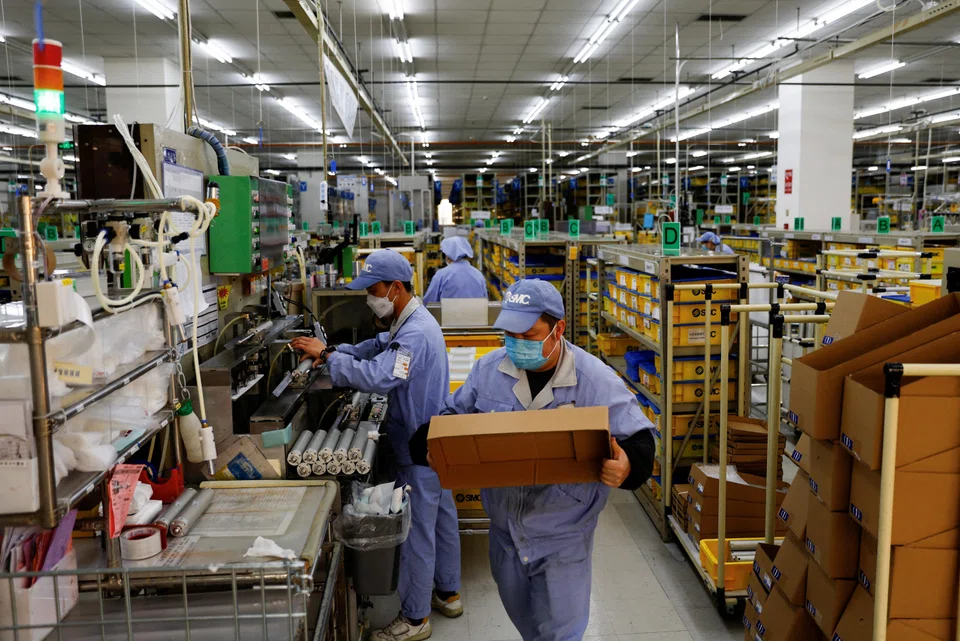
AS BEIJING tries to set growth expectations and bolster its economy, President Xi Jinping has reinforced the manufacturing industry’s pivotal role. It is, he said, “an indispensable sector to China at all times”.
That’s true, but it’s worth wondering how China can maintain the sector’s contribution as it tries to move up the industrial value chain. Rallying delegates at the annual session of the National People’s Congress (NPC) in Beijing on Sunday (Mar 5), Xi said China would take “forceful” measures to support advanced production. He called for better quality growth and accelerating moves “to attain a high level of self-reliance in science and technology”.
The ambitious rhetoric came as Beijing revealed its annual growth target of 5 per cent – the lowest in its history of goal-setting. In the face of China’s economic challenges, partly self-inflicted by lockdowns, value-add from high-tech manufacturing grew 10.6 per cent. Sustaining this momentum, even with the country’s unmatchable production heft, will be an uphill task now.
What has worked for policymakers so far is unlikely to push the needle much further. Since 2008, Beijing has rolled out support for corporate research and development expenditure, including government grants, tax benefits like credits and so-called super deductions at a rate of 100 per cent that allow firms to expense spending or accelerate amortisation. Manufacturing companies can depreciate a larger portion of an asset’s cost in the early years to lower tax bills — a common way to subsidise businesses.
All told, these policies helped infuse and free up capital to boost spending. That, in turn, allowed companies to upgrade factories, making production processes faster and more efficient. It created more room to invest in precision equipment and higher-end fabrication.
The results of these measures, however, show it was harder to translate the upgrades into financial gains. As China’s publicly listed companies ramped up research and development (R&D) spending, this outpaced their revenue growth. Median expenditure grew more than 14 per cent in the first half of 2022, leading sales by 8.5 percentage points, according to Fitch Ratings.
Over the past five years, that gap has widened. Even if these firms continue to pile into R&D, on the back of policy direction and sweeteners, it won’t guarantee returns in the form of industrial progress that leads to actual earnings for reinvestment.
What’s more, the big spenders are large, state-owned entities. The most R&D intensive businesses – those that reinvest significant chunks of their revenues – are in information technology services. The manufacturing sector, which accounts for the greatest number of listed firms, spent 4.4 per cent in 2021. If policies aren’t resulting in profit growth, then it’s hard to see how more of the same will help.
Meanwhile, Xi urged private companies to boost innovation and play a bigger role in China’s goals of technological self-sufficiency. These firms – typically more productive, small and medium enterprises with higher returns on assets – already invest a larger portion of their revenues in R&D than their state-owned peers. However, their ability to grow this spending has been constrained in recent years as government-owned champions take centre stage.
Part of the problem is, China Inc has for too long taken a cue from the state and worked opportunistically to find ways to leverage Beijing’s policy goals. Few big industrial firms have been self-directed when it comes to investing in hard technology for the future.
Even the likes of Contemporary Amperex Technology (CATL), now the world’s largest battery maker that has made itself crucial to global automakers including Tesla, initially followed the path of incentives and subsidies around the electric-vehicle and battery manufacturing industry. CATL was business savvy, boosting investment where there was a growing future opportunity and deepening state interest.
Governments globally play a big role in R&D spending and encouraging high-tech innovation. However, it is often left to companies to decide where and how to put their money to work, as is the case in the United States and Japan.
At this stage, Beijing can’t direct corporates to be more innovative when it comes to the nitty-gritty of industrial hardware – there’s only so much it can do. Nor can the state allocate their capital expenditure at a granular level. The word “innovation” appeared 38 times in the government work report delivered by outgoing premier Li Keqiang. It also noted that “enterprises should be the principal actors” in this arena.
China’s executives recognise these shortcomings, too. Li Dongsheng, founder and chairman of consumer electronics giant TCL Technology Group, who is also a deputy to the 14th NPC, noted that Chinese manufacturing firms still face many challenges.
He suggested that policymakers back companies that have expanded their presence overseas in other ways, including legal aid, policy advisory, patent litigation services and cross-border investments. Li also said companies needed to transition from exporting products to building their industrial capacities abroad.
That’s a clever strategy. With new markets to expand into, this could potentially help lift profits. Ultimately, though, companies will have to figure out where to invest and how to put their capital to work effectively – without Beijing’s breadcrumbs – to make the next big technological leap. BLOOMBERG






