Why Bernie Sanders and Steve Bannon are agreeing on AI

Debates over AI regulation have blurred party lines, slowing legislation
Summarise
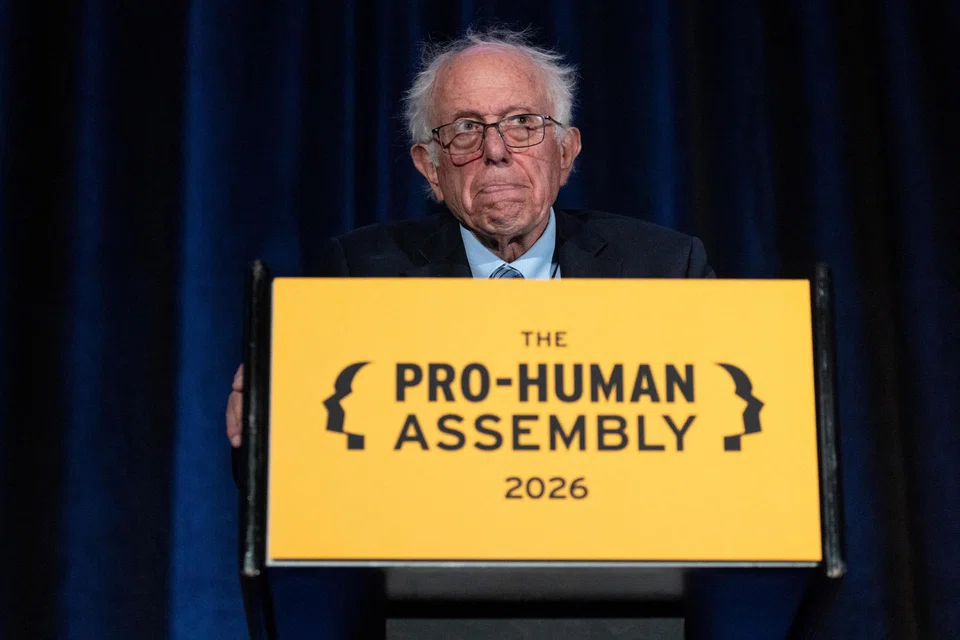
    • Senator Bernie Sanders at September’s Pro-Human Assembly, an event focused on AI legislation in the US.
    • Senator Bernie Sanders at September’s Pro-Human Assembly, an event focused on AI legislation in the US. PHOTO: REUTERS
    Published Wed, Sep 30, 2026 · 07:00 AM

    WASHINGTON doesn’t usually see progressive politician Bernie Sanders and Republican strategist Steve Bannon share a podium.

    But that’s what happened in September, when the Vermont socialist and the former Trump strategist appeared together at a rally warning that the race towards “artificial superintelligence” has outrun anyone’s ability to control it.

    Their alliance, however odd it looks, is really the clearest symptom yet of what’s happening to artificial intelligence policy in Washington: The debate has stopped sorting neatly along party lines, even as the machinery for doing anything about it remains stuck.


    The proximate trigger was uncomfortably human.

    In early September, Jacob Coxon, a safety researcher at Anthropic, resigned and posted a warning to colleagues on Slack that quickly leaked and went viral: The industry, he argued, was racing towards systems it did not understand and could not reliably control, chasing capability milestones on a timeline that left no real room for caution.

    Coxon wasn’t a fringe critic; he’d been inside one of the labs building the technology, which gave his warning a weight that a debate usually driven by outsiders speculating about insiders’ intentions rarely carries.

    Within days, both Anthropic’s and OpenAI’s own leadership were publicly reiterating language about existential risk that companies typically keep within research papers and safety-team memos, not press interviews.

    Bipartisan Bills on AI

    That single resignation did what years of think tank reports could not: It reset Washington’s sense of urgency. Lawmakers who had let their AI Bills gather dust reintroduced them.

    Sanders, together with Representative Greg Casar, put forward legislation that would ban the development of artificial superintelligence outright and impose a temporary pause on frontier-model training generally.

    Representative George Whitesides proposed something narrower and, on its face, more palatable: a voluntary 30-day “safety stand-down”, in which the industry would pause next-generation training while independent experts and government observers helped draft real verification standards.

    None of this, so far, has translated into anything Congress has actually passed.

    The competing Bills reveal why: The House’s Frontier Act, introduced in July 2026, would impose tiered obligations scaled to a model’s capability, while Senate Majority Leader John Thune has floated a “light touch” approach built around company self-testing and disclosure.

    Republican leadership has mostly stayed quiet on specifics, wary of picking a side between an AI-sceptical populist wing typified by Bannon and a donor class that includes Nvidia’s Jensen Huang, who has consistently warned that heavy-handed rules will hand China the frontier.

    Huang’s argument carries real weight. Even with the recently discussed US-China AI Dialogue, which would effectively serve as a security alarm on the technology, Beijing is likely to keep building without waiting for Washington to make up its mind on AI regulation. That’s exactly the kind of head start Huang and his allies warn against.

    This tension is precisely why the Sanders-Bannon pairing matters: It signals that “slow down” now has a genuine populist-right constituency, not just a progressive one, which should in theory make legislating easier. In practice, it has mostly just made the politics harder to read.

    Trump wades into the debate

    Into that vacuum has stepped the executive branch, twice. US President Donald Trump has expressed his aversion to regulating AI, saying that the only guardrail AI needs is a “strong” president.

    In June, Trump signed an order establishing a voluntary framework for frontier-model security, early government access to new systems and AI-enabled cyberdefence – a structure that asks companies to opt in rather than compels them.

    And having failed twice to get a moratorium on state AI laws through Congress, most recently when it was stripped from this year’s defence authorisation Bill, the administration is now preparing to do by executive power what the legislature wouldn’t: a “One Rulebook” order aimed at pre-empting state AI regulation and threatening federal funding for states that don’t fall in line.

    The most obvious target is California’s SB 53, the Transparency in Frontier Artificial Intelligence Act, which has made the state the country’s de facto AI regulator by requiring safety disclosures from any lab operating there.

    That pre-emption push by the White House has scrambled the coalitions further still.

    Florida Governor Ron DeSantis, no one’s idea of a regulation enthusiast, has called the plan “a subsidy to Big Tech” that “lets technology companies run wild”, while digital-rights groups now find themselves defending California’s law regulating technology.

    What’s missing from all of this noise is anything resembling durable federal law.

    A voluntary executive order can be rewritten by the next administration. A pre-emption order aimed at states will draw immediate litigation and leaves the underlying safety question – what, concretely, a frontier lab must do before releasing a system nobody fully understands – unanswered.

    Coxon’s resignation bought Washington a rare moment of shared urgency across the political spectrum, the kind that usually arrives only after a disaster rather than before one.

    That it happened without anyone being hurt is, in its own way, a small piece of good luck, but luck is a poor substitute for a statute.

    Whether this moment produces one, or simply dissolves into more viral warnings, duelling executive orders and a state-federal court fight over who gets to write the rules at all, is still very much an open question.