

Why the West is on fire
Protests are erupting across Europe over cost of living and reduced opportunities
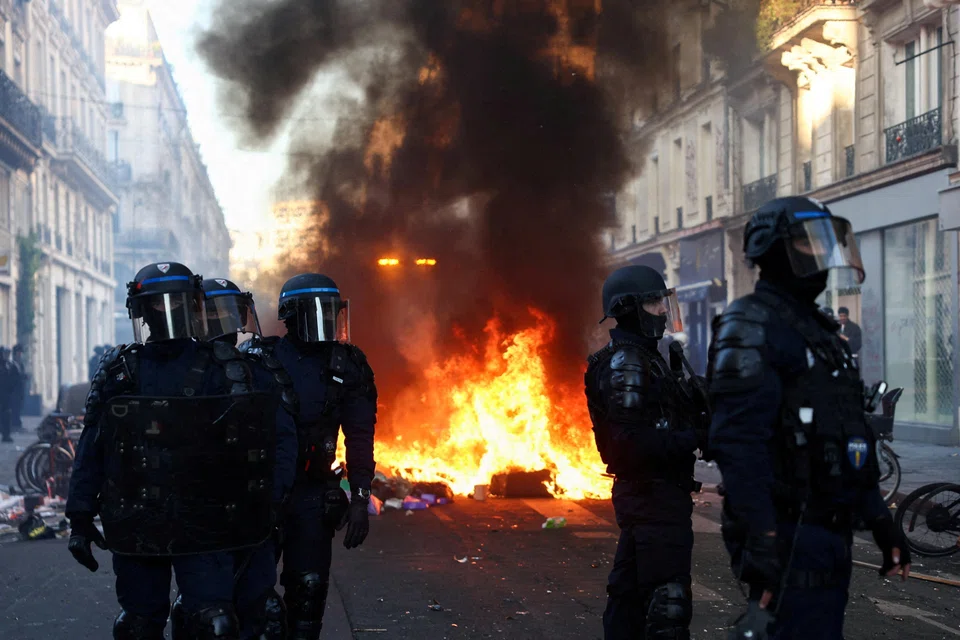
ON OCT 17, the roof of the 19th-century town hall in Limoges collapsed after it was set alight during a coordinated nationwide protest in France against the cost of living.
That same weekend, smoke drifted past Milan Cathedral, Brussels police turned water cannons on teenagers, and tent cities rose in the central squares of Lisbon and Madrid. Across the Atlantic, Americans rallied in all 50 states under the banner “No Kings”.
It is tempting to file each of these as a local story – a French schools dispute, a Belgian budget row, an Iberian housing shortage. That would be a mistake. Taken together, they describe a West where political and economic settlement is coming apart at the seams.
The West is on fire – in more senses than one.
Start with the numbers, because they explain the anger better than any slogan. Food prices in the EU have risen by about a third in five years, reported Eurostat, and wages in most places have not kept up.
Portuguese housing prices have more than doubled since 2017. Spain is roughly 750,000 homes short, going by the Bank of Spain’s estimate, and social housing makes up under 2 per cent of its stock.
And a fresh energy shock, set off by escalation in the Middle East, has pushed up fuel bills just as governments have run out of room to soften the blow.
That last point matters most. In 2022, Europe met an energy crisis with an open cheque book. In 2026, that cheque book is overdrawn.
France is borrowing heavily and edging towards a fiscal reckoning that could unsettle the whole euro zone. Belgium is cutting 500 million euros (US$558 million) from French-language education and proposing to raise value-added tax.
Governments are asking citizens to accept less – fewer teachers, later pensions, higher taxes – at precisely the moment those citizens feel they already get less for more.
A broken promise
The result is a broken generational bargain. The post-war West promised that work and education would buy security: a home, a pension, a future better than that of one’s parents.
For millions of people under 30, that promise now reads like fiction. It is no accident that this autumn’s protests were led by students and school pupils, nor that most of those detained in Milan were minors.
A generation that cannot afford to rent, let alone buy a home, has little stake in the existing order, and it is saying so in the streets.
Those affected, however, span generations. Nothing captured the mood more starkly than the fate of Maricarmen Abascal. The 87-year-old had lived in the same Madrid flat since 1956. After an investment company bought the building and tried to raise her rent from 500 to 2,650 euros a month, she was forcibly evicted in September.
She died in hospital two weeks later. Her story turned a statistic into an outrage and sent protesters into more than 50 Spanish cities. When parliament rejected two emergency housing decrees, Prime Minister Pedro Sanchez called snap elections for Nov 29. That is the political dimension of the fire. Economic grievance no longer stays in its realm; it corrodes the institutions meant to manage the economy.
France shows the chain most fully. A long-running deficit problem has repeatedly toppled governments: In 2025, Prime Minister Francois Bayrou lost a confidence vote and had to resign after his proposed 44 billion euros in savings for the 2026 budget failed to win consensus.
His successor survived only by concession: Sebastien Lecornu’s minority government got a key health budget through parliament by suspending Macron’s flagship pension reform, which raised the retirement age from 62 to 64.
This month, France’s economic squeeze moved into the streets. The protestors’ grievances include 54 billion euros in public spending cuts, overcrowded classrooms and rising fuel and food prices.
The fire is not confined to the Western core. In Albania, a candidate for EU membership, students have fought police for more than a week, demanding the prime minister’s resignation over corruption, jobs and university fees. Even countries queuing to join the Western club are discovering that the club’s promises no longer sell themselves.
A warning not to be ignored
Fragmentation feeds on itself. When centrist governments cannot deliver affordable homes or decent public services, voters drift to the edges, left and right.
Parliaments become harder to govern, which makes delivery harder still. The street fills the vacuum in parliament.
None of this excuses the looting of shops in Paris and Marseille, the attacks on police, or the torching of a historic town hall. Violence discredits legitimate demands and hands governments an excuse to treat a social crisis as a public-order problem.
Arrests – more than 2,400 in France after a single day of unrest – may clear the streets, but they will not close the gap between incomes and rents.
What would? There is no single answer, but there is a direction.
Western governments must treat housing as infrastructure rather than as an asset class: Build at a scale unseen in decades, and curb the bulk-buying that turns homes into yield.
They must be honest about trade-offs; if budgets have to tighten, the burden cannot fall first on schools and the young. And they must rebuild the belief that politics can still change things, that a ballot is worth more than a cobblestone.
The fires of October will burn out, as protest waves do. The conditions that lit them will not, unless leaders find the nerve to confront them.
History is unkind to elites who mistake a warning for a riot. The West has been warned.
TRENDING NOW

If Europe goes to war, the fallout will be felt in East Asia
Stocks to watch: Seatrium, MIT, Keppel Reit, Clint, UI Boustead Reit, Digital Core Reit, ST Engineering
Chairman’s role in spotlight with raft of proposed new rules for Singapore boards

Mapletree Industrial Trust posts 6.6% drop in Q2 DPU to S$0.0297

