Will UltraGreen.ai be able to shine in a market dominated by big, dividend-paying companies?
As the newly listed stock slides below its IPO price, DFI Retail Group is soaring on plans to boost its profitability and lift its dividend payout ratio

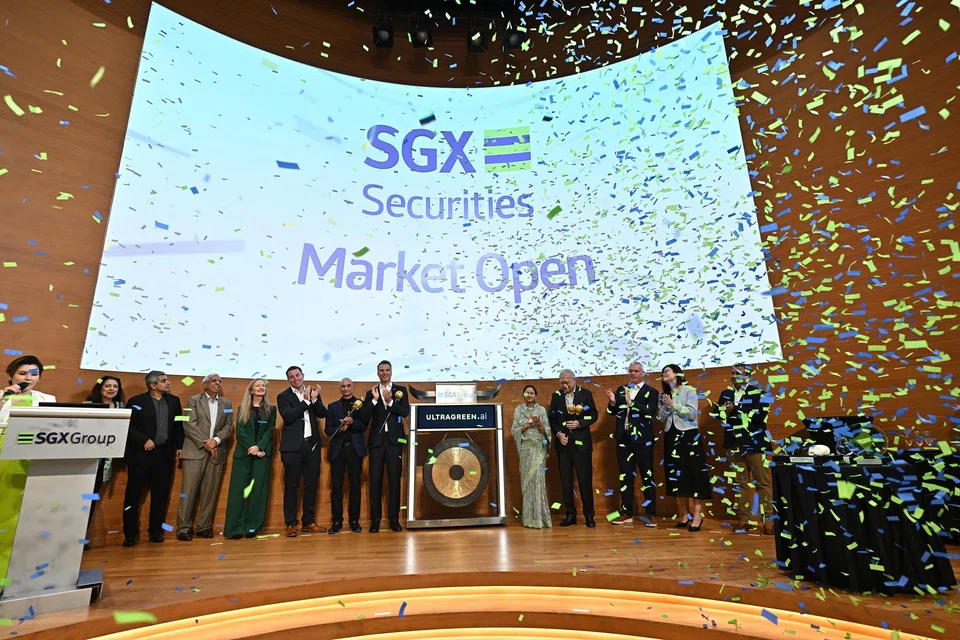
[SINGAPORE] In the end, the much anticipated listing of UltraGreen.ai on Dec 3 was something of an anticlimax.
While its shares popped nicely when trading kicked off, they were struggling to stay above water by the end of the week. They closed on Friday (Dec 5) at US$1.44 – just below their initial public offering (IPO) price of US$1.45.
On the face of it, this lacklustre start is disappointing. UltraGreen.ai is exactly the kind of technology-driven, growth-oriented listing aspirant that Singapore’s public market ecosystem has been trying to draw in order to revive its fortunes.
The company has a dominant position in the emerging field of fluorescence-guided surgery. Its revenue has been rising fast, and it commands large operating profit margins. On top of that, it has already attracted some research coverage.
In a report dated Dec 2, UOB Kay Hian said it sees the company achieving earnings of US$85 million in 2026, and US$100.9 million in 2027. Valuing the company at 24 times forecast earnings for 2026, the research house came up with a price target of US$2 for its shares.
The weak post-listing performance of UltraGreen.ai is all the more perplexing, considering the bullish sentiment in the local market. Since the beginning of the year, the Straits Times Index (STI) has climbed 19.6 per cent, on the back of the value-unlocking moves and strong financial performance of its various constituents.
Last week, it was DFI Retail Group’s (DFIRG) turn to shine, as it announced a number of “strategic initiatives” to drive shareholder returns. The group – which operates retail brands such as Guardian, 7-11, Wellcome and Ikea – said it is now targeting to achieve underlying earnings of between US$310 million and US$350 million by 2028.
DFIRG also said it will adopt a new dividend policy based on a 70 per cent payout ratio, effective from the final dividend of 2025, up from the previous 60 per cent payout guidance. The group said the move reflects its confidence in its ability to generate cash, and its commitment to shareholder value.
As recently as Oct 30, DFIRG had been guiding for underlying earnings for 2025 to come in at between US$250 million and US$270 million. On Oct 15, it paid an ordinary interim dividend of US$0.035 per share, and a special dividend of US$0.443 per share.
DFIRG closed on Friday at US$4.10, up 19.2 per cent for the week. This put its year-to-date gain at 77.5 per cent, making it the best performing component of the STI, just ahead of ST Engineering’s advance of 75.3 per cent.
With the dividends reinvested, DFIRG has achieved a total return of 110.8 per cent since the beginning of the year, versus ST Engineering’s total return of 79.2 per cent.
Allure of dividend payers
This column highlighted last month that dividends have become a much smaller proportion of the STI’s total return in the wake of the benchmark index’s strong rise over the last few years. Yet, a company’s capacity to continually raise its dividend payouts can be a potent driver of its share price.
When JPMorgan set a lofty price target of S$70 on DBS shares last month, the research house said the bank’s commitment to steadily lift its dividend was absolutely crucial to its bullish call. JPMorgan noted in its Nov 28 report that DBS had said it would hike its regular quarterly dividend to S$0.66 per share by Q4 2025, and to S$0.72 per share by Q4 2026, on top of its non-regular payouts.
“This amounts to 82 per cent of (forecast earnings per share for 2027), a significant commitment that only best-in-class banks can make and deliver,” JPMorgan said.
DBS declared dividends of S$0.75 per share for each of the first three quarters of 2025, comprising an ordinary dividend of S$0.60 per share, and a “capital return” dividend of S$0.15 per share. DBS had previously said it would pay a capital return dividend of S$0.15 per share each quarter in 2025, and a “similar amount” in the following two years.
DBS has delivered a total return of 31.6 per cent this year, which makes it the 10th best performing component of the STI.
Another heavyweight STI constituent that is returning significant amounts of cash to investors is Singtel. Under its Singtel28 programme, the group is seeking to deliver shareholder value through enhanced operational performance as well as active capital management.
Reflecting this strategy, the group now pays a core dividend that tracks improvements in its underlying performance, and a “value realisation” dividend funded by excess capital from its asset recycling activities. For the six months to Sep 30, Singtel will pay an interim dividend of S$0.082 per share, comprising a core dividend of S$0.064 per share and a value realisation dividend of S$0.018 per share.
For the same period last year, Singtel paid an interim dividend of S$0.07 per share, comprising a core dividend of S$0.056 per share and a value realisation dividend of S$0.014 per share. Singtel’s core dividend for both periods amounted to 78 per cent of its underlying net profit.
Singtel has achieved a total return of 55.1 per cent this year, which makes it the seventh best performing constituent of the STI.
Will UltraGreen.ai dip further?
Are hefty dividends the only way to attract Singapore investors? Where does that leave less established companies such as UltraGreen.ai, which is still developing its suite of products and building its supply chain?
The way I see it, Singapore investors are not as timid and conservative as they are often made out to be. Many of them are active global investors, and are more than eager to express their views on the latest trends in the technology sector. When China’s DeepSeek rocked the artificial intelligence world and sparked a big sell-off in Nvidia early this year, Singapore investors were reportedly big traders of the chipmaker’s shares.
The weak investor interest in UltraGreen.ai at the moment may just be due to a lack of familiarity with the company. Indeed, UltraGreen.ai is currently faring no worse than other recent technology-oriented mainboard listings – such as Info-Tech Systems and NTT DC Reit. If the company delivers solid growth and strong financial results, it should eventually garner a decent following among local and international investors, in my view.
In the meantime, some investors may find information in UltraGreen.ai’s listing prospectus about its pre-IPO share sale useful. According to the document, a significant portion of the shares currently held by the company’s chairman Kwa Chong Seng and Anchor VI, which is linked to Temasek’s 65 Equity Partners, were acquired during the pre-IPO round at an effective cash cost of US$1.30 per share.
There is no reason that UltraGreen.ai shares would dip that far, of course; or that they might not fall a lot further. Yet, some investors might feel that the pre-IPO price represents a threshold that would put them in the same boat as some of the company’s more influential shareholders.
TRENDING NOW
He built the Vingroup empire. Now South-east Asia’s richest man is handing some key roles to his sons
Grab CEO’s wife Chloe Tong on life with Anthony Tan and finding her purpose
What role can Japan play in Asean’s future?
From folding clothes to factory work: Why China is sending humanoid robots to school