World’s food security is facing a triple threat
Humanity’s risk of starvation is going up with falling crop yields, strained water supplies and restrictive food trade
THERE are five times as many people alive today as there were in 1900. Yet, humanity is better fed than at almost any point in its history.
This comes from three major developments that have made our planet far more resilient to the risk of starvation: yield improvements, water usage and trade.
But worryingly, all are under threat right now.
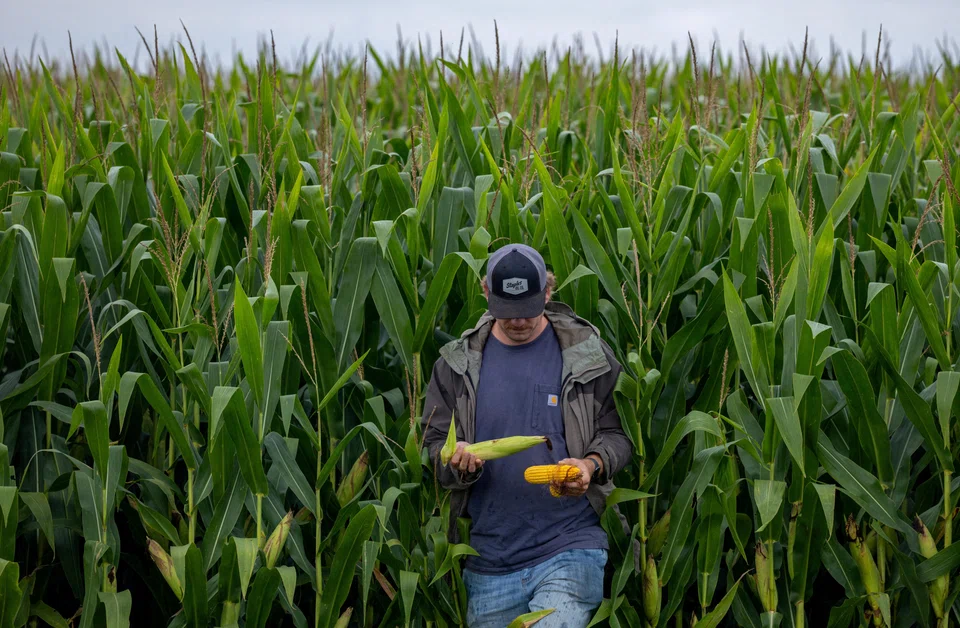
The most important of these has been quietly rescuing humanity from hunger since the industrial revolution: agricultural productivity. For centuries, farmers were able to coax ever larger harvests from each hectare. The steady climb in yields has sometimes felt less like an achievement than a law of nature.
This iron law may be breaking under the stress of a warming climate. Farm output has consistently grown by more than 2 per cent a year for six decades, Since 2020, it has slowed to 1.6 per cent.
Total factor productivity – a measure of the food system’s efficiency, rather than the increases in harvests driven by adding more land, water, fertiliser, labour and machinery – has stood at 0.8 per cent over the past decade, barely more than a third of what we will need to feed 10 billion people in 2050.
The picture is even worse if you look at some individual plants. Yield growth for the three main cereals – corn, rice and wheat – has nearly flatlined over the past five years; the same goes for the major vegetable oils.
A similar pattern has emerged in many tropical staples that sustain hundreds of millions of lives in sub-Saharan Africa, the tropical Americas and the Pacific. Cassava, yam and plantain have been suffering prolonged stalls in productivity improvements.
As recently as 2000, about 95 per cent of farm output came from crops whose yields were increasing rapidly, one study found last year. But those with stagnant or falling yields now make up almost a quarter (23 per cent) of the total, suggesting that many plants are approaching the limits of what they can produce.
One possible factor behind this stagnation is the depletion of a resource that has taken millennia to accumulate: groundwater.
A United Nations study in January 2025 concluded that we have moved past the era of “water crisis” into one of “water bankruptcy” – the situation in which withdrawals from rainfall, rivers and wells exceed the capacity of those systems to recharge themselves, pushing humanity inexorably towards catastrophe.
Some 70 per cent of the world’s aquifers are now in long-term decline, threatening the viability of systems that provide about half of our household water and 40 per cent of irrigation.
Saudi Arabia is a cautionary tale. In the early 1990s, it was briefly the world’s sixth-largest wheat exporter, thanks to a government programme that encouraged the extraction of groundwater under the desert to improve food security.
Wheat production has since fallen by close to 90 per cent, as aquifers that took thousands of years to fill up ran dry.
Similar stresses are spreading to poorer, more populous regions. In parts of India’s Punjab, the water table is sinking by nearly half a metre every year. The number of wells in the country sunk more than 70 m to reach deep aquifers has grown rapidly, from about 100,000 in the late 1980s to 3.8 million today. Some are now almost as deep as the Empire State Building is tall.
Desiccation of the water table that Iran depends on to feed its 93 million people has led to proposals to relocate the capital Teheran. Rolling water shortages have contributed to the economic insecurity that fuelled recent protests.
A third pillar has long helped bail out hungry countries: trade. Since the 1960s, much of the world’s surplus has come from the extraordinary fecundity of the Western Hemisphere. The pampas of Argentina, cerrado of Brazil and prairies of Canada have all played their part, but no country has played a larger role than the US.
Net exports of corn, rice, wheat, vegetable oil and sugar from the US in 2024 contained about 2.7 trillion calories of nutritional energy – sufficient to feed America’s own population for a year.
Barren Kuwait can import “virtual water” embodied in crops grown half a world away. Land-constrained Japan can use trade to take advantage of another country’s farmland.
But that is the theory. The danger is that this optimistic picture reflects a fading era, when international commerce was seen as a positive-sum game, rather than one with clear winners and losers.
US President Donald Trump’s hunger for export dollars kept America’s farm exports mostly immune from the tariff chaos of the past year. There is no guarantee that restraint lasts.
Russia already tried to turn attacks on Ukraine’s grain and cooking oil exports into a point of leverage after its 2022 invasion. In Gaza and Darfur, Ethiopia, Yemen and Nagorno-Karabakh, restrictions on food trade have been used for political ends.
If the nativist strain in US politics outlives Trump, do not be surprised to see future governments follow the same logic with their own harvests. Starvation is among the oldest tools of political coercion. In a more chaotic, climate-ravaged world, it would be naive to assume it has been retired. BLOOMBERG