Foreign workers: Boon or bane to Singapore?
The issue on migrant workers requires a rational weighing of benefits and costs, and trade-offs.
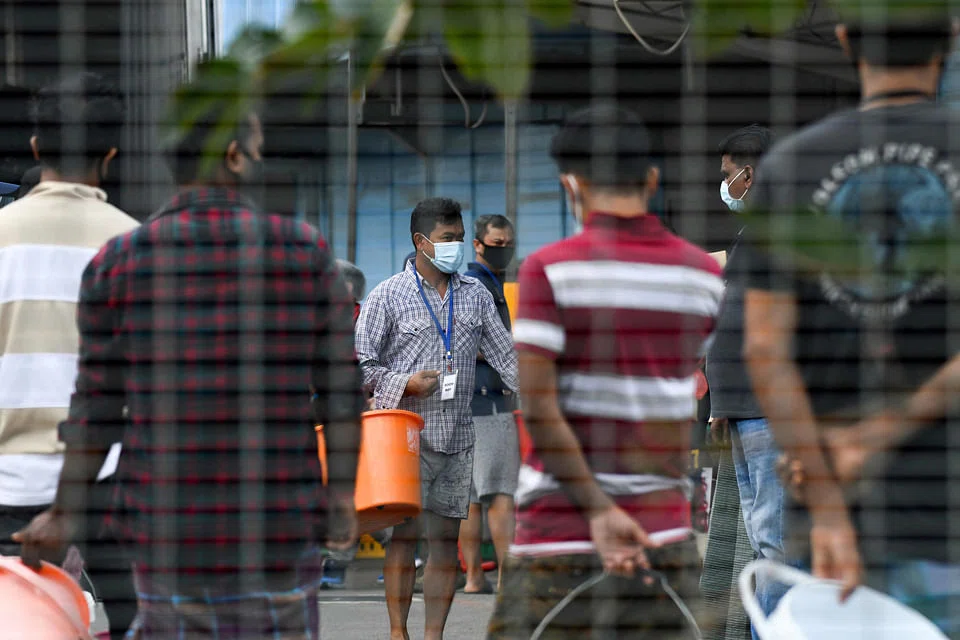
FOREIGN labour issues experience a certain periodicity in the local news cycle, typically peaking nearing general elections before fading (albeit incompletely) into the background after. The script seems to have remained largely unchanged in 2020 with one exception - the rapid spread of Covid-19 among the foreign worker population added the dimension of lives to the conversation that had until then, mainly revolved around livelihoods.
The perennial questions of whether foreign labour yields net benefits for Singapore and related to that - what the optimal size and growth rate of the foreign labour force should be - divide opinions, while new questions about our responsibility towards migrant workers' lives have emerged amid the pandemic.
Benefits and costs
Proponents for a growing foreign worker population point to the benefits that foreign labour brings such as lowering the costs of doing business, maintaining international competitiveness and by extension, the cost of living; augmenting the local labour force through providing a supply of labour for jobs that locals do not wish to take up, or that locals lack the skills for; attracting foreign investments that also provide jobs for Singaporeans; and freeing up locals to participate in the labour force by harnessing foreign domestic workers for household work.
In contrast, opponents point to the costs of worsening income inequality from a larger supply of low-skilled labour depressing wages at the bottom end; disincentivising productivity gains due to the availability of plentiful and cheap labour; social friction; and strains on public infrastructure.
Both the benefits and costs are valid. And, a rational approach would require a weighing of benefits and costs to determine what the optimal size of the foreign labour force should be. Additionally, because the relative extent of the benefits and costs will differ according to the industry, the optimal size of the foreign labour force would be sector dependent with the optimal size of the total foreign labour force being a simple aggregation across all sectors.
What markets can and cannot do
One way to determine the optimal size of the foreign labour force in each sector is to simply leave it to the free market. Individual economic agents such as firms and households would not employ foreign labour unless it brings them net benefits. For instance, businesses in Singapore only employ foreign labour if they are cheaper and/or more efficient and hence add to the firms' bottom line - the benefits to the firm of hiring an additional unit of foreign labour exceeds the costs incurred. Similarly, households only hire foreign domestic workers when the costs of doing so are less than the opportunity costs of not doing so - when what we pay the foreign domestic worker is less than what we would forgo in income or comfort if we were to do the work ourselves.
It would seem that the market argument would be against arbitrary limits on foreign labour. Where there is demand for foreign labour, it signals that the benefits of foreign labour must outweigh the costs and as such, allowing the entry of foreign labour would yield net benefits. Conversely, when the foreign labour no longer generates net benefits, there would be no demand for them. Operationally, what happens is that employment passes or work permits do not get renewed and the foreign labourer goes home.
However, any good economist must recognise what markets can and cannot do. The market mechanism achieves what is termed allocative efficiency. This means that it is a very good tool for directing resources (including labour) to their best use to maximise social welfare. However, allocative efficiency is a static efficiency. It is concerned with whether resources are best allocated at a point in time, given the state of technology and constraints. It is not dynamic in that it does not consider whether there is an incentive to create technological improvements over time. In the context of foreign labour, the two may even be in conflict. Using more labour-intensive means of production may be allocatively efficient given the availability of cheap labour but this also disincentivises firms from investing in productivity-enhancing measures like automation, hence trading off dynamic efficiency.
The need to exploit dynamic efficiency forms a basis for intervening in the free market and tightening foreign labour entry requirements. The other is that allocative efficiency, which is what the market provides, is about maximising net welfare regardless of who benefits and who loses. In concrete terms, a business enjoying cost savings of $100 by paying a local worker $100 less is welfare-neutral. Concerns about equity between labour and firms may be another factor in favour of tightening foreign labour flows.
Nonetheless, this again must also be viewed in Singapore's context of being a very open economy. While domestic concerns are valid and important, we must also be cautious to avoid the situation where Singapore firms become uncompetitive on the global stage or where Singapore is no longer an attractive place for investments.
What all of these boil down to is an unsexy conclusion - that a sector-based (or even finer) calibration is key. For each sector, we will need to consider whether foreign labour (high-skilled, semi-skilled, or low-skilled) play a complementary or substitutive role to local labour, whether the sector is outward or inward facing, and the scope for incentivising automation to determine whether more or fewer foreign labour is needed. We must also recognise that every choice involves a trade-off. It is just a matter of what is being traded off. We must also be informed of society's preferences in for example, the service industry where pure efficiency gains may not replace the feel-good and qualitatively efficient services.
Finally, as with any policy, however well-designed, there will still be people who are disadvantaged and fall through the cracks. Finely calibrated policies can reduce the number but not eliminate it. For such people, tailored help in terms of reskilling and job placement will need to be provided. The more well-calibrated the policy, the smaller this group will be and the easier it will be to provide help.
On lives and welfare
The pandemic shone a spotlight on the living conditions of migrant workers, spurring calls to protect their welfare. A hard-nosed market approach is to point out that they came of their own volition and their willingness to stay and work here means that the option to stay, despite the assertions of poor living conditions, must still be better than other options they have at home. Some have also pointed out that there are migrant workers who prefer to stay in cramped conditions in order to save more money to send home. In essence, this is again the free market argument - that a trade (of labour in this case) would not happen unless both parties mutually benefit.
Apart from humanitarian concerns, there are two arguments against this. The first is that free exchange only assures mutual benefits when there is perfect information and when property rights are respected. Such assumptions may not always hold true. For instance, a foreign worker may have agreed to pay a large agent fee to come to Singapore because he/she was under the impression that he/she would receive a certain wage rate and enjoy certain working or living conditions. If actual wage rates or conditions are poorer than what was advertised, then the foreign worker was making a decision under imperfect information and the trade may not actually be mutually beneficial. The problem may be compounded by the fact that the foreign labourer may have limited recourse due to the debt incurred and fear of retaliation from his/her employer.
While laws to establish and protect the property rights of foreign labour already exist in Singapore in the form of the Employment Act and the Employment of Foreign Manpower Act (EFMA), compliance is uneven. For example, according to a survey by Transient Workers Count Too (TWC2), as at August 2018, 22.5 per cent of foreign workers surveyed were not issued itemised payslips, which is required by law to ensure transparency of wages.
The other argument made for better living conditions for migrant workers is that even if the workers themselves would rather squeeze into cramped rooms to save on rental fees, such conditions present a public health hazard. Individual freedoms are often curbed in the interest of public health (eg, smoking, driving models of cars that emit too much pollutants). This is no different. Furthermore, it should be the case like any other businesses, it is the responsibility of the employers to provide not only just renumeration but associated costs such as accommodation, health insurance and medical coverage. These costs must be borne by the employers, and the role of the authorities is to ensure compliance through strict enforcement. The trade-off is that we will have to accept a higher cost of doing business and a higher cost of living.
Other considerations
We teach in economics that we should look at our strengths and comparative advantage. And though we could also have an army of blue-collar Singaporean workers, why do we not encourage this policy? Because it is cheaper to outsource a ready supply of them to meet our needs for construction, repair works, cleaning services and the like. In many First World countries, costs are very high and supply of such skilled trained workers are often low. Many households just their own repairs. That raises opportunity costs.
Moreover , Singapore has a small population with a very low fertility rate. This means we do not have enough people to supply these jobs, and this also means that our growth in infrastructure will slow down - and those in sales will also be affected, which in turn affects business opportunities. Singapore should not just follow these other countries without examining closely its own circumstances and constraints.
While technology with artificial intelligence and robotics can go some way to replace labour, not all can be done with ease, without incurring high costs in some industries and in cases where human dexterity and human interactions are required.
In sum, the issue on migrant workers requires a rational weighing of benefits and costs, and trade-offs are important. The free market is a powerful tool in organising an economy and is efficient in resource allocation (in terms of how many foreign workers an economy should have and also what compensation remuneration they should receive). However, we must recognise that the market is not necessarily a perfect tool and where it fails to achieve what we desire (eg, dynamic efficiency or equity, and other market failures), intervention is needed.
READ MORE: Layoffs double in Q2; total employment dives by quarterly record of 122,000