

G-20 summit: China to focus on positives
G-20 agenda likely to flesh out China's vision for global order, with focus on long-term rather than immediate concerns. It's a key step in its growth as a global leader.
Paris
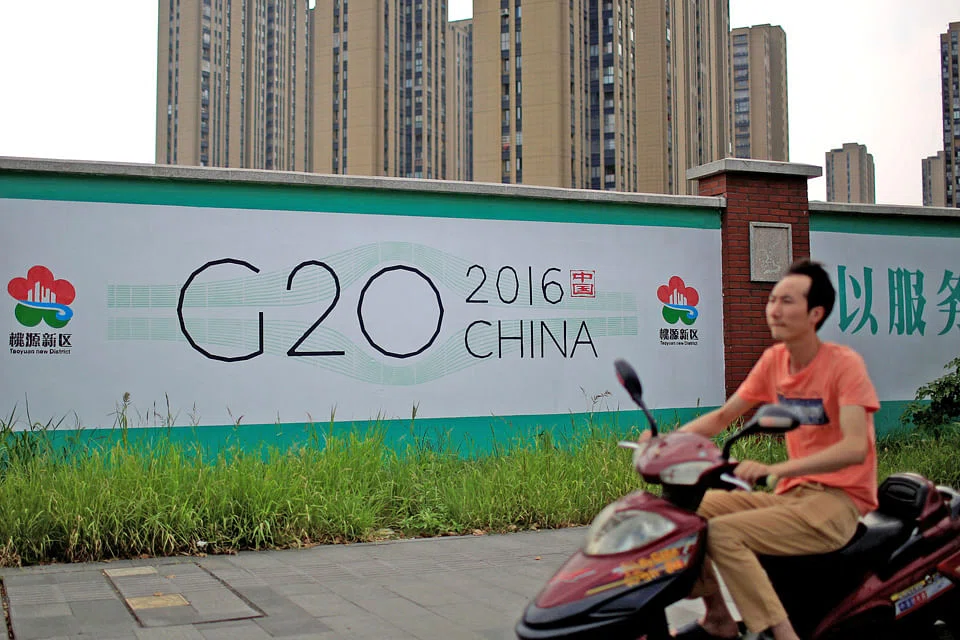
WITH the approach of the Group of 20 summit in Hangzhou, there is expectation that China might clarify its position on the contested South China Sea. Contrary to expectations, those Asian neighbours and Western leaders who want to seize the occasion to press China on immediate issues will be disappointed. There will be little space to question publicly China's drive into the South China and East China Seas, to seek confirmed implementation by China of UN sanctions targeting North Korea, to ask for more direct involvement by China in resolving the most urgent issue of our time - the Middle East in tatters and resulting refugee flows - or even to challenge China's record-breaking attack on human rights and legal activists at home.
Instead, the summit offers China's leader Xi Jinping a unique occasion to shine and for China to extoll its complementary - or alternative - vision of the global order.
As host country, China has engineered impeccable rhetoric and goals that are hard to disagree with, if somewhat distant and abstract, for the G-20 leaders to focus on. US President Barack Obama is now a lame-duck president with much uncertainty over what follows him. European leaders are weakened by the continent's inward turn, so powerfully shown by the Brexit. Western leaders are on the defensive much more than their Chinese counterparts. There may be isolated supporters in favour of focusing on issues of the day - Australia, Japan and even Korea spring to mind. Others like Brazil or Indonesia may not fully support China's professed goals for the G-20, but few will take the risk of disowning them. Too much of their economy is now tied to China's fortune.
For China, its G-20 goals are based on a sound political analysis. Chinese leaders see the G-20 as an event borne out of the 2007 financial crisis and the G-7's inability to deal with it. For them, the G-20 is pivotal. China has more influence than any G-7 member present in Hangzhou, save possibly the United States. Yet China espouses some goals of the larger emerging economies, with rhetoric to spare for the little guys - those developing countries in need that do not have a seat at the table.
In fact, China wants the G-20 to move away from crisis-solving - and one imagines that if this applies to financial and monetary issues, it also applies to geopolitical ones. It wants the G-20 to focus on long-term development issues and sustainable growth. These, along with innovation and the ubiquitous connectivity motto, constitute China's keywords for the G-20. Who could disagree with that, or with a completion of the International Monetary Fund (IMF) reform, an international anti-corruption drive - a matter with deep domestic implications for China - and the industrialisation of Africa?
There is a parallel with China's recent positions on climate and environmental issues: the convergence with the US which allowed for the Paris climate summit, COP21, to achieve a common position, to which China and the US have just announced they would indeed adhere, centres on a very long-term objective with little intermediate goals and literally no verification mechanism.
Even that, by the way, proved too much for America's energy and industry lobbies, and as Mr Obama's capacity to obtain ratification in the next four months is not self-evident, China can now appear as a better contributor than the United States to climate mitigation.
In other words, the message is to move away from immediate issues and crises, set long-term and somewhat indeterminate goals, separate economics from politics, and achieve convergence at the G-20.
Second-track comments from China hint at another goal, partly reflected in official speeches. Chinese analysts want the G-20 to become an international institution, with a secretariat and links to other international organisations, starting with the United Nations. In May, China's Foreign Minister Wang Yi singled out 10 objectives; the one about reinforcing "the G-20 Trade Ministers Meeting, Trade and Investment Working Group and other institutionalised platforms" stands out. Here, the operative word is the proposed institutional nature for G-20 meetings and groups. This time, this is not a swipe at the G-7 group that excluded China, but at the World Trade Organisation (WTO).
This year, China has had issues with both Europe and the United States regarding previous commitments at the time of its accession to WTO. One understands that China is looking at alternatives and alliances to avoid the risk of isolation on trade issues. If both Europe and the United States were to deny China effective market economy status and therefore continue significant anti-dumping measures, China will start a long legal challenge at WTO. But it will also build on its commercial strength with other partners and downplay the importance of WTO trade rules.
IS IT JUST TALK?
Chinese analysts sometimes acknowledge that all of the above might remain rhetoric. They realise that the G-20 is an amalgamation of three different groups - the G-7, the BRICS (Brazil, Russia, India, China, South Africa) and even MITKA (Mexico, Indonesia, Turkey, Korea, Australia), an interesting grouping of major but second-tier economies. They know that many G-20 statements are empty talk or rubber-stamping of documents.
It's a long road for China's goals to succeed, but some stones have been laid for that path. The Asian Infrastructure Investment Bank (AIIB) launched by China and the BRICS Development Bank in Shanghai are part of the same strategy, officially described as a complement to existing international institutions which on their part need adaptation. Having become the world's largest capital exporter, unavoidable as such as investor or lender, China is in an ideal phase to speed up this strategy. And even if third countries - and particularly competing emerging economies - worry about China's pull, they simply do not have a real alternative strategy. Europe has goodwill but simply no institutional strength beyond its immediate neighbourhood. The United States is strained by a deep skepticism towards international organisations, trade agreements or undertakings. Yet, the United States still ranks first in terms of Overseas Development Assistance, defined broadly with some goals such as counter-proliferation included.
China, increasing its own efforts, now ranks sixth, excluding overseas commercial lending, which is often confused with assistance. In fact, China prefers to lend rather than give, but the country's second White Paper on the topic shows it is also sprinkling humanitarian assistance and some development money to the neediest countries. In sum, China is moving slowly, behind its surface rhetoric, in the right direction.
The Hangzhou summit will take some of the heat off China's most questionable policies. It is doubtful that the summit will matter on significant issues of the day - the Middle East tragedy, North Korea's defiance of a non-proliferation regime, risks in the East and South China Seas, and the whole issue of growth in industrialised countries now souring their domestic political climate. But in the words of a Chinese expert, China "picks and chooses" among international organisations and issues. It has mostly left the major crises to the West and claims for itself paths to the future. The Hangzhou summit will mark a small but important step in the journey for leadership China began after the Great Recession hit the West.
READ MORE: China readies for G-20 meeting in Hangzhou
TRENDING NOW

He built the Vingroup empire. Now South-east Asia’s richest man is handing some key roles to his sons
Despite the de-dollarisation debate, demand for dollar liquidity in Asia is growing
Can a first-time homebuyer couple earning S$18,000 a month afford a new EC unit?
Asia needs new energy security architecture

