Aw & Sons’ Josh Hu takes co-living into the heartlands with Mber
This is the third-generation scion’s attempt to modernise his family’s property business, one curated project at a time

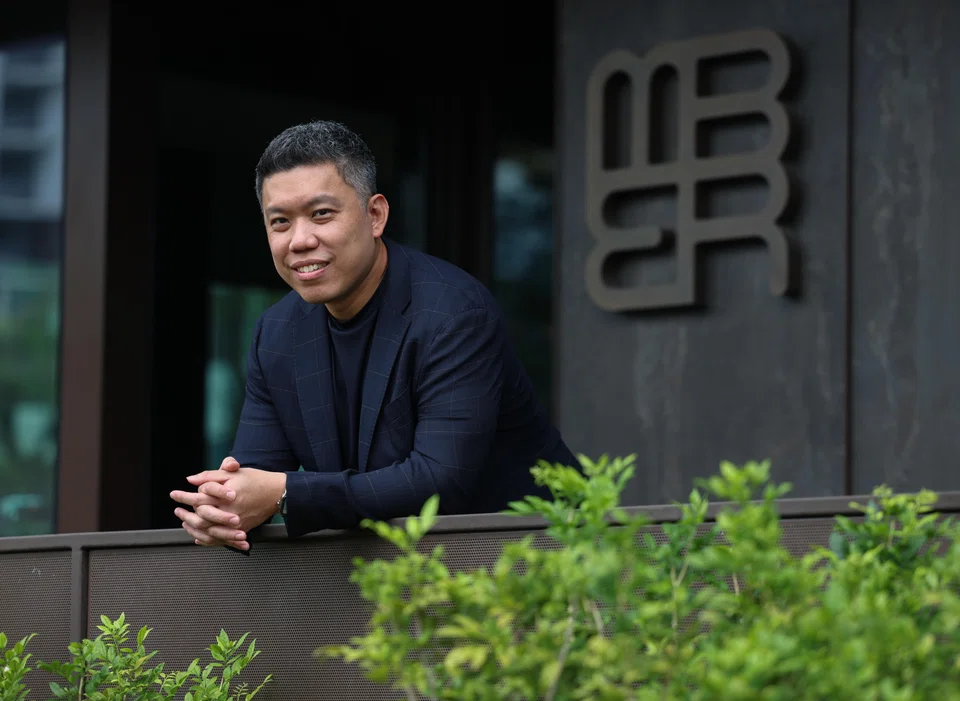
[SINGAPORE] Co-living spaces and serviced apartments tend to follow the bright lights of the city centre. Josh Hu, Aw & Sons Capital’s managing director, has taken them into Singapore’s heartlands instead.
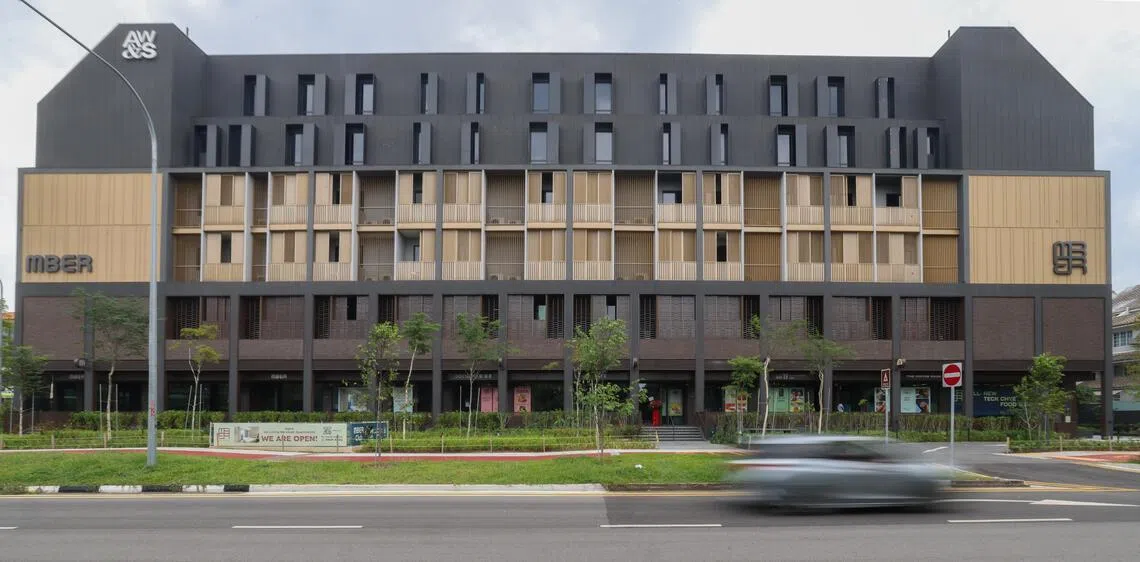
His latest project, Mber Co-Living & Serviced Apartments, sits along Upper Serangoon Road, in a neighbourhood better known for its mature housing estates and old-school shophouses.
The site was once home to Lim Tua Tow Market. Today, it is a 125-unit purpose-built hybrid of co-living spaces and serviced apartments, complete with communal work and social spaces, wellness facilities and F&B offerings.
The location may seem unconventional, but Hu argues that that is precisely where the opportunity lies. He sees a potential catchment stretching from Paya Lebar and Tai Seng to Seletar, Changi and Punggol, which he believes lack “compelling” hospitality options. Singapore’s push to decentralise jobs and business hubs also work in Mber’s favour, Hu added.
Mber also brings together co-living and serviced apartments under one roof. The two have become increasingly blurred, with some operators simply refurbishing smaller or older properties and marketing them as co-living spaces, he said.
“They scale for the sake of scaling, and are willing to take (either) one shophouse or one landed (property), and split it into four bedrooms with 10 beds. But that, to me, is not co-living.”
Meanwhile, Mber is touted as Singapore’s first “built-to-suit” co-living space.
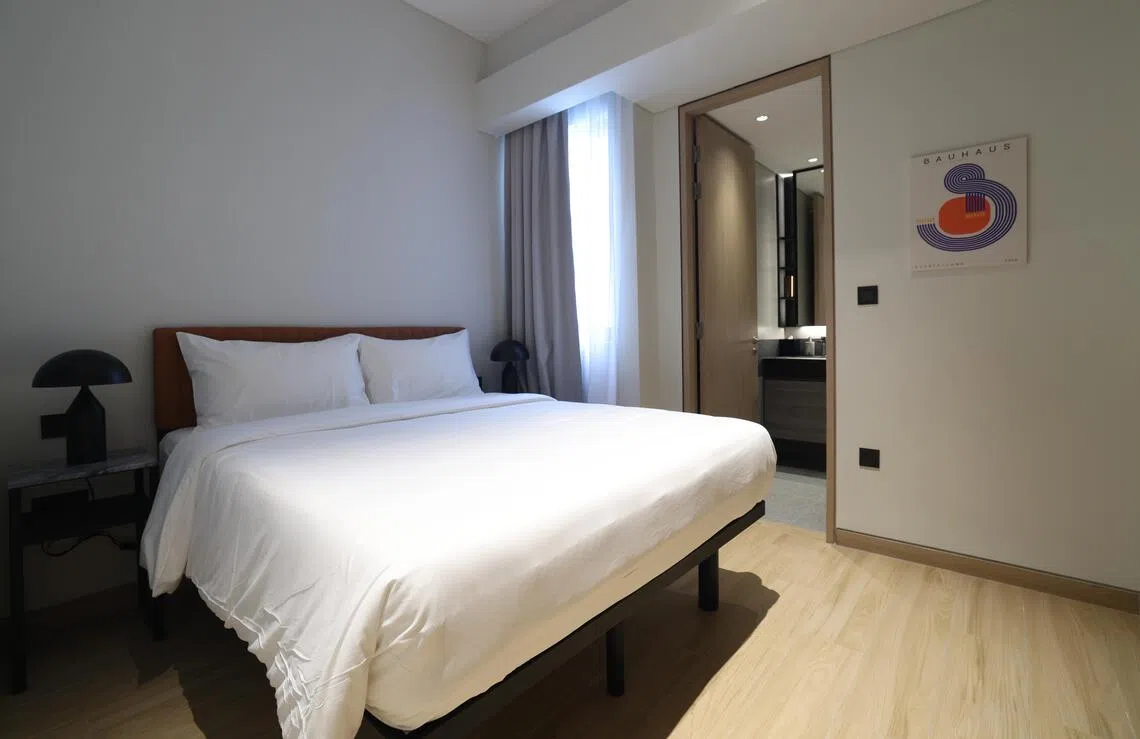
Its 78 co-living units, sized around 160 to 300 square feet (sq ft), occupy the top two floors, with en suite bathrooms and shared kitchens and lounges. Another 47 three and four-bedroom serviced apartments, spanning 920 to 1,340 sq ft each, occupy the second to fourth floors.
This is meant to cater to different groups, Hu said. For example, a family could take a serviced apartment, while visiting friends or relatives could stay in the co-living rooms.
So far, Mber’s co-living residents are typically singles, couples or shorter-term travellers. The serviced apartments see more families from around the region, including those looking at schools in Singapore, corporate clients and students.
Hu’s bet appears to be gaining some early traction. Since becoming operational in May, Mber has seen an average occupancy rate of 80 per cent.
Hu, however, cautioned against reading too much into the early numbers, noting that July is typically a strong month for inbound travel. Still, he believes Mber is on track to hit its target of 100 per cent occupancy before the year ends.
Playing the long game
Mber is the sort of patient bet Hu’s family has traditionally made.
The 44-year-old is the third-generation scion of Aw & Sons Group, a boutique developer and family office.
His grandfather, Aw Kim Chen, founded the group in 1971 as a rubber trading business before diversifying into real estate.
Hu heads Aw & Sons Capital with his father, Aw Chye Wee. Its sister company Kimen Group is led by Hu’s uncles, Aw Chye Huat and Arthur Aw. Past projects include prime-district residential developments such as Jervois Mansion and Nassimville.
Hu shared that his father tasked him with using Aw & Sons Capital to “experiment with new concepts that can bring value and modernise the group”.
Its earlier projects include The Offshore, a shophouse development on North Canal Road, and Hotel Soloha, a 45-room boutique hotel in the Keong Saik area, which was jointly developed with Kimen Group.
The latest Mber Co-Living & Serviced Apartments has been years in the making.
In 2015, Aw & Sons Capital bought five adjoining shophouses at Teck Chye Terrace for S$14.6 million.
Rather than push ahead with a small “shoebox” residential development, the family waited to acquire the other 10 shophouses before deciding on a concept. “We wanted to be patient to... curate the right product,” said Hu.
In 2020, the company acquired the remaining shophouses for S$39 million.
Besides its co-living spaces and serviced apartments, the development – zoned residential with commercial on the first floor – includes five F&B units, a public plaza and a heritage corner.
All F&B units are leased, with four already open. The remaining unit is expected to begin operations by September.
The first floor also houses GYMber, a gym and recovery facility that is open to non-residents through a separate membership.
Hu traces his approach back to his grandfather and father, who impressed upon him the importance of “giving back to society”.
He noted: “The way I see it now, we’re giving back to Singapore with a well-designed building, beyond the economics or commercial aspect, whereby people can come and look back at Singapore’s heritage and identity.”
This long-term perspective also shapes how the family thinks about return.
The Serangoon site’s long gestation period means Mber may not look especially attractive when measured by its internal rate of return (IRR).
He noted with a laugh that the first five shophouses were bought more than a decade ago, “so the IRR becomes horrendous”. But the returns were “comfortable” for the family as long-term shareholders.
“It’s a family legacy,” he said. “It’s something that we want to be proud of, that we can pass down (through) generations... so the specifics of IRR are not really that pertinent to us in that sense.”
In good time
In July, Aw & Sons Capital acquired two shophouses in Neil Road for S$40.9 million – well below the S$65 million guide price a year prior.
Hu called it an “opportunistic buy” and long-term strategic holding, since shophouse values have returned to “reasonable levels” since 2023.
He aims to redevelop the shophouses and eventually bring them into the broader Mber stable, potentially with wellness or co-working facilities.
For Mber, Hu intends to scale the brand in Singapore. “But the land and product must be right,” he said. “We’re not really in what I would call the ‘quick fix and flip’ game.”
The group is similarly keeping the door open for Hotel Soloha. The Teck Lim Road boutique hotel was sold to seasoned property investor Lim Chin Huat for S$53.4 million in 2022 – significantly higher than its S$31 million price tag in 2017.
“Personally, I like to build brands,” Hu noted. “We are not relinquishing the brand... Soloha is still going to remain within the stable, but the right acquisition has not surfaced at this point in time.”
Commercial and residential properties also remain on the group’s radar, he pointed out. “But given that I’ve been entrusted with this family legacy, and to think of where the group can grow, it has to be complementary to the whole concept that we’re trying to build.”
The managing director is wary of letting the group be pulled towards whatever happens to be fashionable – a restraint he credits to his grandfather.
“He always told me that we should try to do one project at a time instead of getting distracted by everything,” said Hu.
“There’s always the next hot or sexy trend to chase... That is not in our DNA. Rather, we want to think about how the product should be, and we’re willing to take the time to conceptualise and curate it.”